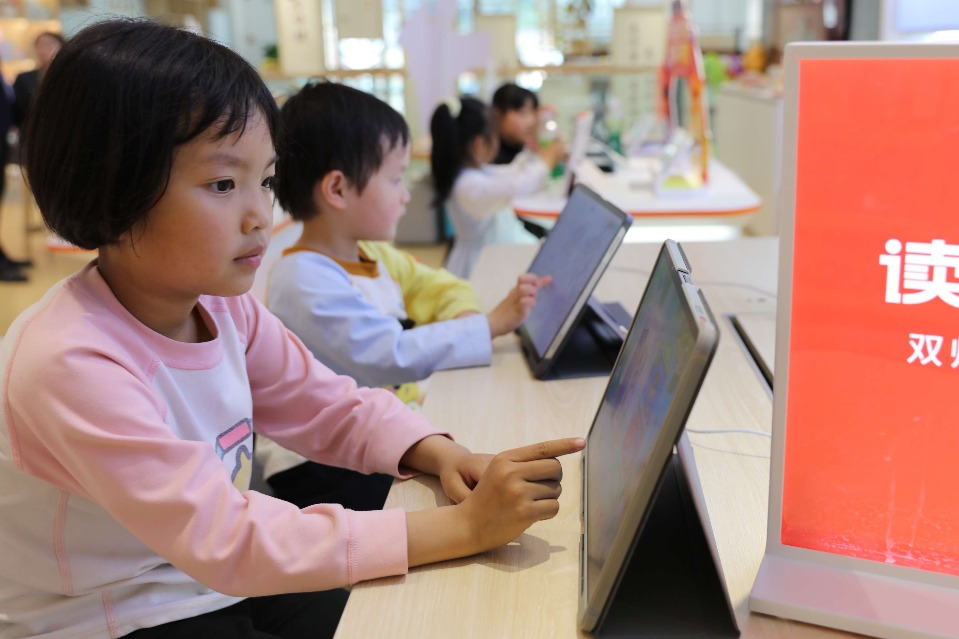
NANCHANG — A sweeping surge in digital reading has unlocked new access to literary content across China, pushing more citizens to build consistent reading habits as national efforts to cultivate a book-loving society drive steady growth in overall reading engagement.
New data released Monday during the fifth National Conference on Reading reveals that China’s overall adult reading rate climbed to 82.3 percent in 2025, with the average number of books consumed per capita across both print and digital formats rising to 8.39. The findings, pulled from a national reading survey and the 2025 China Digital Reading Report, confirm that digital formats have become a core driver expanding the country’s total reading population.
The annual conference, hosted this year in Nanchang, the capital of East China’s Jiangxi province, opened alongside the inaugural launch of China’s first official National Reading Week, which will run through this coming Sunday. The week-long celebration is a key part of broader national initiatives designed to embed a strong reading culture in communities across the country.
According to the national survey, 80.8 percent of Chinese adults now regularly interact with digital reading content, spanning e-books, serialized online literature, audiobooks, and short-form video book summaries. Researchers behind the data note that the flexibility of digital formats has been instrumental in growing participation: commuters can listen to audiobooks during daily travel, and mobile readers can access serialized fiction at any time, removing long-standing barriers to consistent reading.
By the end of 2025, China’s total digital reading user base hit 689 million, marking a 2.95 percent year-over-year increase, while the total number of available digital reading works surpassed 70 million. Over the past five years alone, the overall market size of China’s digital reading industry has nearly doubled, expanding from 30.25 billion yuan (approximately 4.4 billion U.S. dollars) to 59.48 billion yuan, a clear indicator of robust growth on both the supply and demand sides of the market.
Industry leaders attribute much of this market expansion to the evolution of online literature from a niche digital product into a pillar of the broader cultural economy. “The essence of reading is to allow stories to break through boundaries and enter everyday life,” explained Xie Lanfang, vice-president of Yuewen Group, China’s leading digital publishing platform. She added that digital reading content is increasingly expanding beyond online platforms to integrate with offline cultural consumption and interactive consumer experiences, creating new touchpoints for reader engagement.
Chinese authorities have long prioritized reading as a core driver of national intellectual and ethical development, as well as a catalyst for broader innovation and creativity, spurring ongoing, coordinated efforts to build a nationwide book-loving society. To strengthen institutional support for these goals, a formal regulation on promoting nationwide reading entered into force this past February. The new policy outlines concrete measures to expand public reading facilities, improve public reading services, and strengthen long-term supporting mechanisms for reading promotion.
Under the new regulation, the fourth week of April is officially designated as National Reading Week, marking 2026 as the first year the initiative has been observed nationwide. Over the course of the week, thousands of reading-focused events will be held across every region of China, including author lectures, book fairs, reading salons, and public book donation drives, all targeted at encouraging greater public participation in reading.
“Reading service facilities have improved, and public awareness and satisfaction are relatively high,” noted Feng Shixin, president of the Chinese Academy of Press and Publication. He added that continued work is still needed to further improve accessibility for marginalized groups and upgrade the quality of public reading services nationwide.
Even as digital formats continue their rapid growth, traditional print reading has remained resilient, with new data showing enduring public demand for immersive, long-form reading experiences. The national survey found that 45.9 percent of Chinese adults still prefer reading printed books, particularly full-length literary works, highlighting that digital growth has not displaced demand for traditional reading formats.
Wu Shulin, chairman of the Publishers Association of China, emphasized that deep, focused reading remains the foundation for personal growth, professional advancement, and moral cultivation even in an increasingly digital age. He called for stronger public guidance to help readers navigate digital content and deepen a national culture of deep reading, encouraging audiences to move beyond superficial fragmented browsing to engage in more intentional, in-depth reading practices.