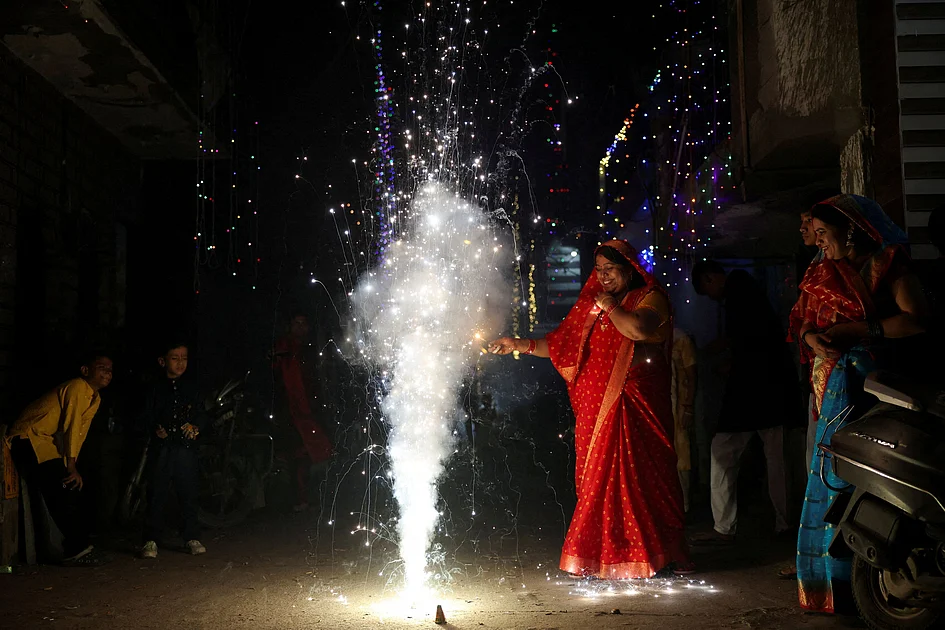
New Delhi’s air quality has reached alarming levels, registering as the most polluted major city globally following the Diwali festival. According to Swiss air quality monitoring group IQAir, the city’s PM 2.5 concentration soared to 442, exceeding the World Health Organisation’s annual guideline by more than 59 times. This hazardous spike is attributed to the widespread use of firecrackers during the Hindu festival of lights, despite the Supreme Court of India’s partial relaxation of a ban on their use. The court had allowed ‘green crackers’ for a limited three-hour window on Sunday and Monday, but reports indicate violations of these restrictions.
PM 2.5, particulate matter measuring 2.5 microns or less in diameter, poses severe health risks, including respiratory and cardiac diseases. India’s Central Pollution Control Board (CPCB) classified Delhi’s air quality as ‘very poor,’ with an Air Quality Index (AQI) of 350. The Ministry of Earth Sciences predicts no immediate relief, forecasting AQI levels to remain between 201 and 400 in the coming days.
Delhi’s winter smog, exacerbated by construction dust, vehicle emissions, and agricultural fires, has long been a public health crisis. Past measures to combat pollution include school closures, construction halts, and vehicle restrictions. The issue extends beyond India, with neighboring Pakistan’s Punjab province also grappling with toxic air. Lahore, Punjab’s capital, recorded an AQI of 234, the second-highest globally. Pakistani authorities have implemented an emergency plan targeting farm fires, smoke-emitting vehicles, and deploying anti-smog guns.
Experts warn that cross-border air pollution is exacerbating the crisis. Sajid Bashir, spokesperson for Punjab’s Environment Protection Agency, highlighted the impact of air currents from Indian Punjab on Pakistani air quality. As both nations face this environmental challenge, coordinated efforts are essential to mitigate the health and environmental impacts of hazardous air pollution.