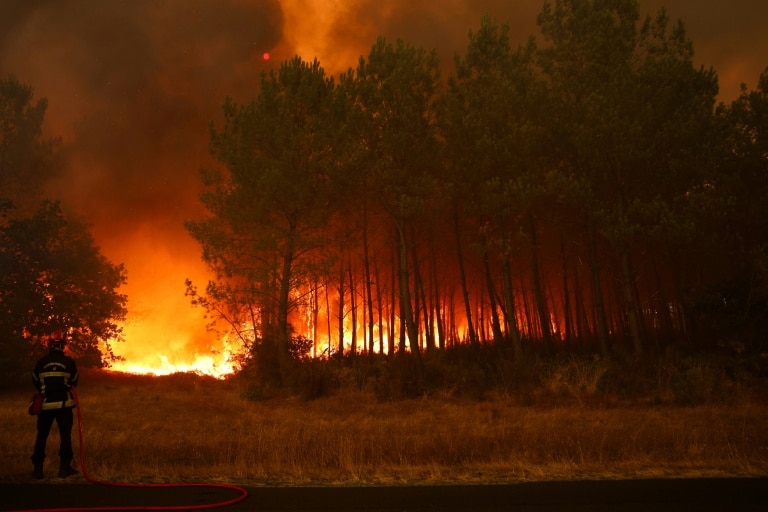
As a brutal heatwave pushes temperatures past 40 degrees Celsius across the Mediterranean, fast-moving wildfires have ripped through populated and forested areas of Italy, France and Spain this week, leaving three firefighters dead and forcing tens of thousands of residents and tourists to flee their homes and accommodations. The ongoing disaster comes as climate scientists have long warned that human-caused fossil fuel emissions are intensifying extreme weather events, making heatwaves and wildfires more frequent, longer-running, and far more destructive than historical averages. In Italy, the island of Sicily has become one of the hardest-hit regions, where roughly 6,000 first responders including firefighters, forest rangers and civil protection personnel have battled dozens of blazes that have burned uncontrolled for days. Even with the support of water-bombing aircraft, crews have struggled to contain the flames, fueled by extremely high temperatures and parched, drought-stricken soil that acts as kindling for wildfires. Italian Interior Minister Matteo Piantedosi confirmed one firefighter died after suffering a medical emergency while on the fire lines, with the nation’s Civil Protection Agency describing the overall situation on the island as “serious.” To the northeast of Sicily, the adjacent Calabria region has recorded more than 160 separate blazes, with local civil protection chief blaming most of the fires on intentional arson perpetrated by “malicious individuals.” In one shocking allegation, he claimed arsonists tied flammable liquid-soaked rags to the tails of stray cats to ignite new fires across the region. Across the border in southwestern France, more than 10,000 tourists were forced to evacuate campgrounds and holiday rentals near Bordeaux on Thursday after a wildfire tore through a coastal pine forest. The Le Porge blaze has consumed more than 2,000 hectares of land – an area roughly three times the size of Gibraltar – since it ignited on Wednesday. Two firefighters were killed on Tuesday while battling a separate blaze near Bordeaux Airport, a loss that came as fire department unions warned crews were already stretched to breaking point, facing widespread exhaustion and critical shortages of resources. Wilfried Schneider, a fire captain on the ground in Le Porge, described the blaze as having an intensity rarely seen in the region, fueled by densely packed pine stands that burn hot and spread quickly. “We saw a big cloud of black smoke spread across the sky in the middle of the afternoon,” said Julie Leonard, a 30-something Bordeaux resident who traveled with her family to a safe observation point outside the evacuation zone. Bernard Roche, a 75-year-old long-term resident of the area who evacuated his cabin, noted that conditions had been exceptionally dry for weeks. “If I’d been brave, I would have stayed in my cabin, but it was too hot. I got in my car and left,” Roche said. While Le Porge mayor Martial Zaninetti suggested the fire may have started from a machine used to clear forest tracks, no official cause has been confirmed. Local authorities confirmed that 700 residents evacuated their homes as a precaution, with an additional 3,000 campers relocated to safer areas further from the fire. Further north in Spain, emergency officials reported Thursday that progress on containing a large wildfire south of Madrid has allowed most displaced residents to return to their homes. That blaze ignited Wednesday near Toledo, roughly 75 kilometers from the Spanish capital, prompting immediate evacuation orders for multiple communities as flames advanced toward residential areas. Only residents of El Encinar del Alberche in Villa del Prado municipality remain under evacuation orders as of Thursday. Fire crews called overnight containment progress “very positive,” though the blaze has not been fully stabilized and multiple regional roads remain closed. Hundreds of firefighters continue to battle a much larger, older blaze in Guadalajara province, roughly 100 kilometers north of Madrid, which has burned nearly 32,000 hectares since it started one week ago. According to data from the European Forest Fire Information System, Spain has already lost more than 393,000 hectares of land to wildfires in 2025 – the worst annual wildfire toll in the country’s modern recorded history.