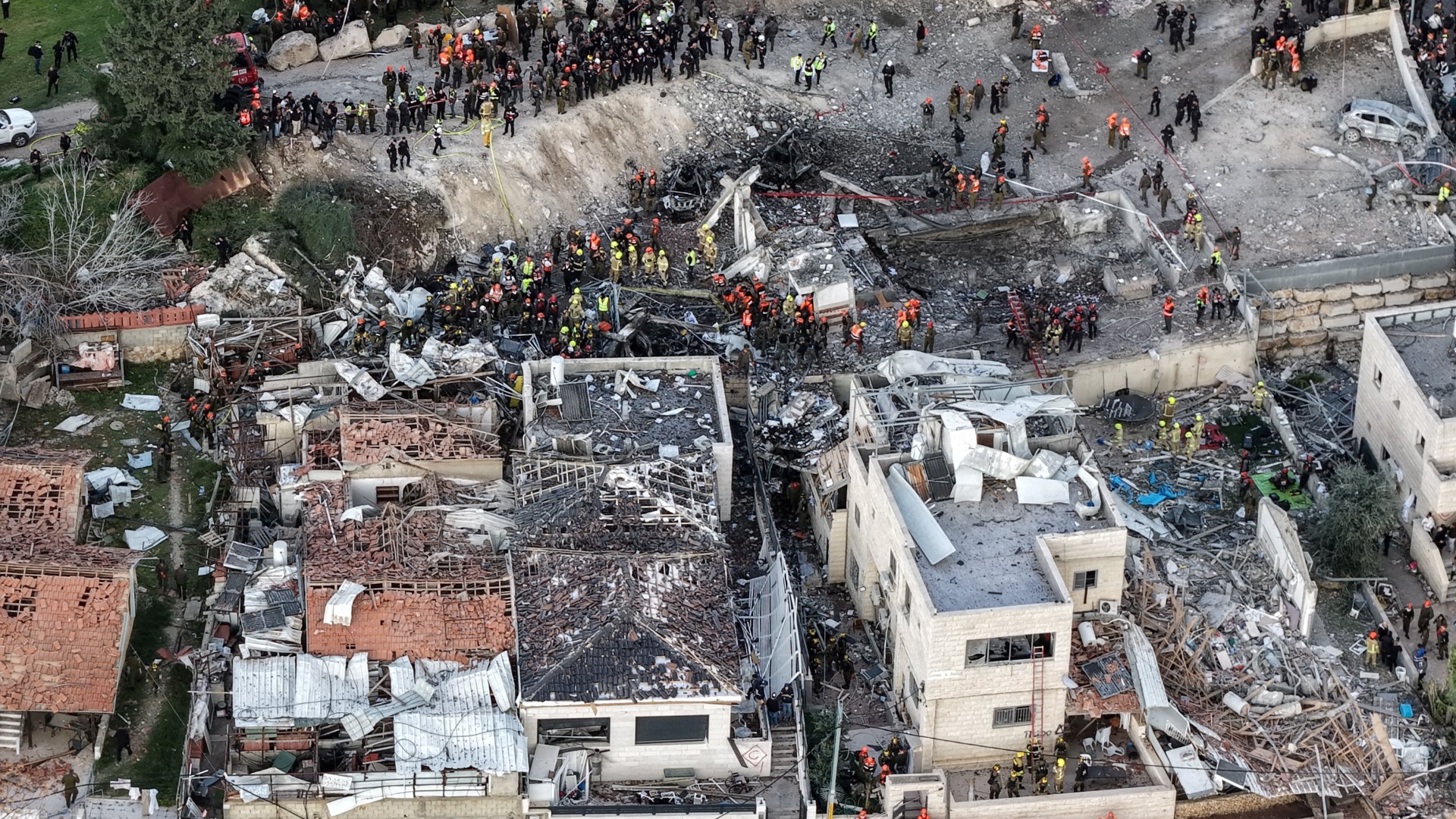
The Middle East plunged deeper into a widespread military confrontation as Iran, reeling from the assassination of its Supreme Leader Ali Khamenei, announced an interim governing council and vowed severe retaliation against the United States and Israel. For a second consecutive day, the region endured a relentless exchange of missile and drone attacks, marking a significant escalation in hostilities.
Iranian authorities confirmed the deaths of several high-ranking officials, including Islamic Revolutionary Guard Corps (IRGC) Commander Mohammad Pakpour, Defence Council Secretary Ali Shamkhani, and Defence Minister Aziz Nasirzadeh, attributing their killings to coordinated strikes by Israel and the U.S. Former U.S. President Donald Trump claimed that 48 Iranian leaders had been eliminated since operations commenced on Saturday.
Despite these significant losses, Tehran continued its offensive operations. An Iranian missile struck a bomb shelter in the densely populated ultra-Orthodox town of Beit Shemesh, Israel, resulting in at least nine fatalities and raising the Israeli death toll to twelve since the conflict began. Simultaneously, Iranian forces launched attacks across the Gulf, targeting capitals including Riyadh, Abu Dhabi, Dubai, Manama, Doha, and Kuwait City, as well as Oman—a nation previously engaged in mediation efforts. Civilian casualties were reported, with three killed in the UAE and one in Kuwait.
The U.S. military reported three personnel killed and five seriously wounded during ‘Operation Epic Fury.’ In a strategic move with global economic implications, Iran closed the Strait of Hormuz, a critical chokepoint for 20% of the world’s oil supply. Attacks on two vessels in the strait, including an oil tanker reported to be sinking, threatened to trigger a surge in crude prices. The U.S. claimed to have sunk an Iranian warship in the Gulf of Oman, while the IRGC asserted an attack on the USS Abraham Lincoln, a claim promptly denied by the Pentagon.
In response to the leadership vacuum, Iranian President Masoud Pezeshkian appeared on state television alongside Judiciary Chief Gholam-Hossein Mohseni-Ejei and senior religious scholar Ayatollah Alireza Arafi, forming a three-man interim council. President Pezeshkian declared a ‘legitimate duty and right to avenge’ Khamenei’s killing, which he labeled a ‘historic crime.’
The political atmosphere within Iran was deeply fractured. Organized pro-government rallies demanding ‘severe revenge’ dominated the streets of Tehran, Isfahan, and Qom. Conversely, celebrations erupted in some areas, such as the conservative holy city of Mashhad, where residents distributed sweets and openly flouted hijab laws, highlighting the nation’s internal divisions. The Iranian Red Crescent reported a preliminary toll of at least 201 killed and 747 wounded in airstrikes, with a devastating strike on a girls’ primary school in Minab claiming 153 lives, most of them children aged seven to twelve.
Israeli Prime Minister Benjamin Netanyahu declared that the campaign would intensify, with 100,000 reservists called up and strikes continuing ‘at the heart of Tehran.’ He warned the situation would ‘only escalate in the days ahead,’ signaling no near-term de-escalation despite unverified claims from Trump about potential negotiations and a reported refusal from Tehran for a ceasefire.