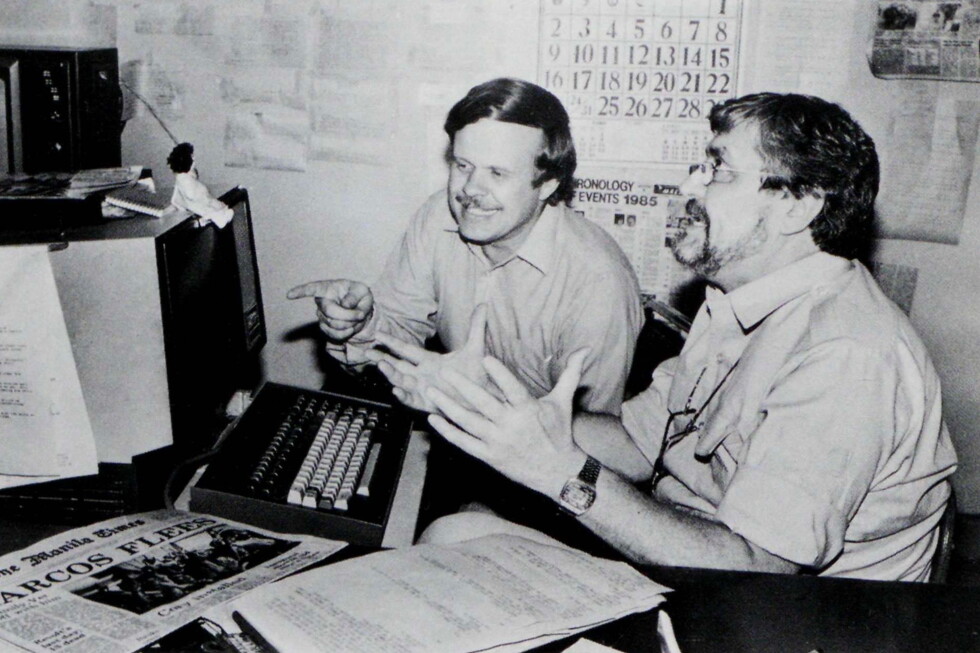
Veteran Associated Press journalist David Briscoe, whose decades-long career was defined by his vivid on-the-ground coverage of the collapse of authoritarian rule and the birth of democracy in the Philippines during one of the nation’s most turbulent modern eras, has died at the age of 82. His wife, Leonor Briscoe, confirmed he passed away Sunday at an assisted living community in Kapolei, Hawaii, following an April diagnosis of amyloidosis, a progressive condition marked by dangerous protein buildup that damages vital organs.
Over a career that stretched across five decades and multiple continents, Briscoe brought his signature relentless curiosity to assignments across his home state of Utah, the nation’s capital in Washington D.C., and Hawaii. But it was his posting as Manila bureau chief that placed him at the center of the most consequential story of his professional life.
When Briscoe took the reins of the AP’s Manila bureau in 1980, he spent the next six years documenting the final declining years of Ferdinand Marcos’ brutal authoritarian regime, and the national chaos that erupted following the assassination of opposition leader Benigno Aquino Jr. Briscoe and his reporting team crisscrossed the archipelago, traveling via chartered aircraft, rented jeeps, and on one notable occasion, a horse-drawn cart, to keep up with the fast-moving story. They covered a relentless string of corruption investigations, legislative hearings, and the unlikely 1986 presidential campaign that saw Aquino’s grieving widow, Corazon Aquino, pushed into the national spotlight to lead a grassroots democratic movement.
The iconic finale of that movement, which saw Corazon Aquino sworn in as president and Marcos forced into sudden exile, remained etched in Briscoe’s memory for the rest of his life. He often recalled searing, unforgettable images from that period: “of nuns kneeling in front of military tanks” and “soldiers and civilians crying in each other’s arms.” Writing for AP World, the outlet’s in-house publication shortly after the revolution in 1986, Briscoe noted, “I expect to witness or cover no greater event in my life.”
Born David Chesley Briscoe on July 30, 1943, in Salt Lake City, Utah, Briscoe grew up in a working-class household, where his father worked as a union steward and his mother as a homemaker, raising Briscoe and his brother in the Church of Jesus Christ of Latter-day Saints. He first discovered his passion for journalism while studying at the University of Utah, writing for the campus student newspaper before landing his first professional role at the Deseret News, where he cut his teeth writing obituaries and profiles of high-achieving local students.
After two years at the Utah paper, Briscoe joined the Peace Corps and was assigned first to Paracale, then to Naga City in the Philippines, where he taught English. For a young man who had barely left his home state of Utah in his early life, every corner of the Philippines was a revelation: from water buffalo cooling off in muddy waterholes to children running along sunbaked dirt roads.
Briscoe quickly fell in love with his adopted country, and bristled at the thought of leaving when his Peace Corps service came to an end. He took a job at a local Philippine newspaper, and while covering an event featuring a speech by Ferdinand Marcos, he met Leonor Aureus, an editor at a competing local outlet. The pair bonded over their shared love of journalism, and soon married, decorating their wedding aisle with copies of their respective papers, The Naga Times and the Bicol Mail.
In 1970, Briscoe was hired by the AP’s Manila bureau, where he covered major breaking stories including a deadly earthquake that shook the capital, an assassination attempt on Pope Paul VI during a pastoral visit, and a commercial plane hijacking. By 1971, however, AP leadership ordered Briscoe to return to the United States to take up a domestic posting. He moved back to Salt Lake City, holding out hope that fate would one day bring him back to the Philippines he had come to love.
During his time back in Utah, Briscoe found himself increasingly at odds with the Latter-day Saint Church that had shaped his upbringing. His wife recalled he faced church discipline after speaking out against the Church’s longstanding ban barring Black men from the priesthood during a discussion class he taught; Briscoe openly opposed the exclusion, which the Church eventually lifted years later. He also ran afoul of Church leadership after co-writing a three-part investigative series with colleague Bill Beecham that examined the Church’s extensive network of business holdings, estimating that annual revenue from member tithing alone exceeded $1 billion. No major Utah newspaper dared to publish the reporting, the pair later said.
After nine years back in Salt Lake City, AP leadership offered Briscoe the chance to return to Manila as bureau chief. He immediately called his wife with the news, asking her, “Noree, are you sitting down?”
After completing his six-year term leading the AP Manila bureau, Briscoe relocated to Washington D.C. in 1986, where he covered international affairs. He went on to serve as AP’s Honolulu bureau chief from 2001 until his retirement in 2009. In Hawaii, dressed in casual aloha shirts and soaking up the tropical sunshine, Briscoe often said he felt “halfway back” to the Philippines he cherished.
Until his final days, Briscoe held his time covering the Philippines close to his heart. As his health declined in his final weeks, his family gathered at his side to pray. He squeezed his wife’s hand, told her he loved her, and asked her to let him pass peacefully.
Per his family’s plans, a boat will carry Briscoe’s ashes out into the Pacific Ocean, where they will be scattered, with the hope that ocean currents will carry his remains back to the Philippines that became his adopted home. “The land that David learned to love,” his wife said, “and where he met the love of his life.”