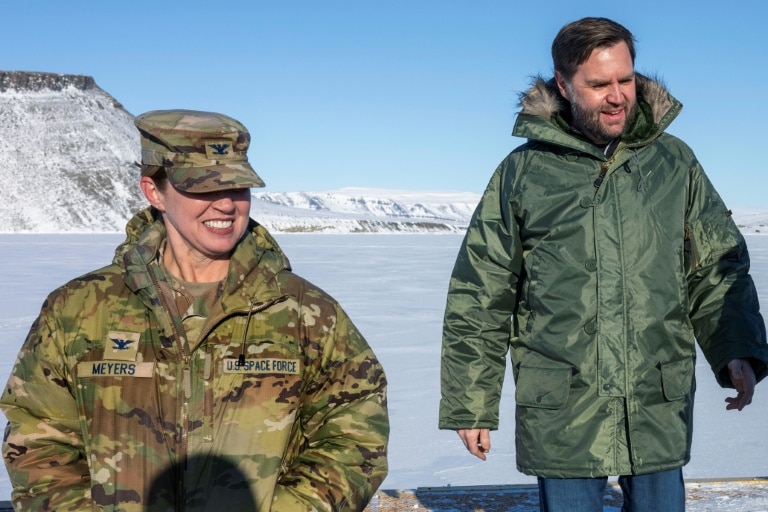
In a high-stakes diplomatic confrontation, Danish Foreign Minister Lars Lokke Rasmussen is scheduled for critical talks at the White House regarding escalating tensions over Greenland’s sovereignty. The meeting comes amid increasingly assertive statements from former President Donald Trump about acquiring the strategically vital Arctic territory, regardless of local preferences.
The diplomatic engagement, requested by Rasmussen with US Secretary of State Marco Rubio, will include Vice President JD Vance following his unexpected participation. This development occurs against the backdrop of Trump’s recent declarations that the United States requires Greenland to counter potential Russian or Chinese expansion in the Arctic, despite neither nation having territorial claims on the Danish autonomous territory.
Greenland’s leadership has maintained an unequivocal position against any transfer of sovereignty. Prime Minister Jens-Frederik Nielsen explicitly stated: “Greenland does not want to be owned by the United States. Greenland does not want to be governed by the United States. Greenland does not want to be part of the United States.” This position has received full backing from the Danish government, with Prime Minister Mette Frederiksen characterizing Trump’s pressure as “completely unacceptable” from a NATO ally.
The geopolitical significance of Greenland has intensified due to climate change transforming Arctic accessibility, prompting increased great power competition. Denmark has emphasized its substantial military investments in the region, totaling approximately $14 billion, to reinforce Arctic security within the NATO framework.
Analysts suggest the meeting’s outcome hinges on whether the Trump administration maintains its uncompromising stance or demonstrates diplomatic flexibility. Penny Naas of the German Marshall Fund noted that insistence on acquisition “at all cost” could prematurely terminate discussions, while a nuanced approach might foster productive dialogue.
Concurrently, a bipartisan congressional delegation predominantly comprising Democrats plans to visit Copenhagen in a show of solidarity, with Senate Democratic Whip Dick Durbin criticizing Trump’s threats as detrimental to NATO cohesion. The diplomatic standoff represents one of the most significant challenges to US-Denmark relations in recent history, with implications for Arctic governance and transatlantic alliance stability.