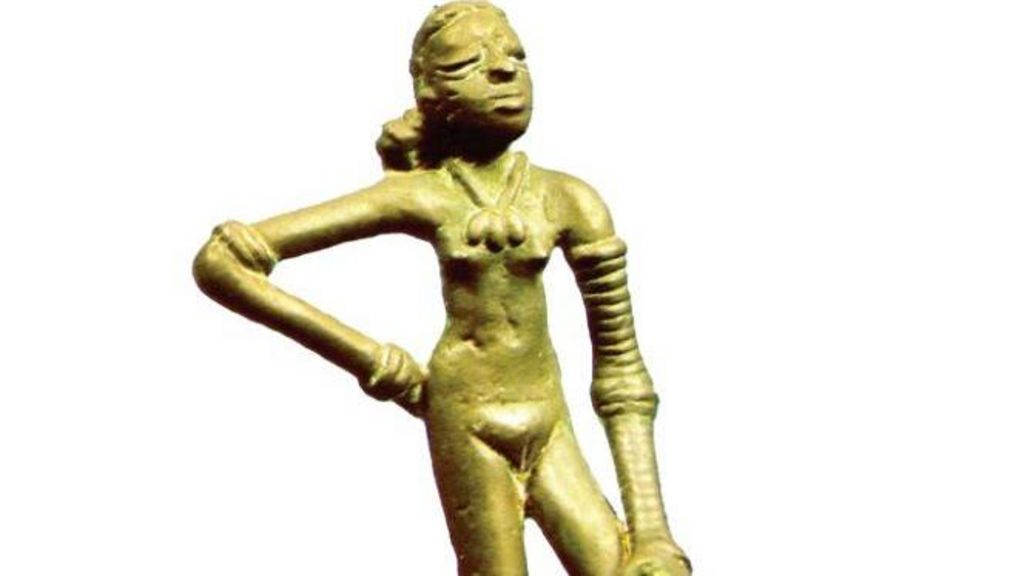
One of South Asia’s most celebrated archaeological artifacts, the 4,600-year-old Dancing Girl bronze figurine from the Indus Valley Civilization, is back to its original form in Indian school textbooks after a controversial censorship attempt sparked widespread outrage among historians, educators, and cultural commentators.
Discovered at the Mohenjo-daro archaeological site in what is modern-day Pakistan, the small bronze sculpture is widely regarded as a masterpiece of ancient art. Depicting a young figure standing confidently with one hand on her hip, adorned with bracelets and her hair styled in a neat bun, the artifact has long been celebrated for its artistic nuance and evidence of the Indus Valley Civilization’s advanced mastery of bronze metallurgy. For decades, the unedited image of the Dancing Girl has been a staple of Indian secondary school history curricula, including in previous iterations of textbooks published by the National Council of Educational Research and Training (NCERT), India’s autonomous government-backed textbook and curriculum development body under the federal Ministry of Education.
The controversy emerged earlier this month when the newly released 9th-grade textbook, part of NCERT’s new Arts Education Series rolled out under India’s 2020 National Education Policy, featured a modified version of the artifact’s image. The sculpted torso of the Dancing Girl was covered with opaque dark shading, erasing the figurine’s natural anatomical features. The modification was first reported by the *Indian Express*, which quickly drew sharp condemnation from academic circles.
Historians and educationists accused NCERT of intentionally disfiguring one of India’s most iconic cultural artifacts for unnecessary censorship. Media speculation widely linked the change to unstated concerns over the sculpture’s nudity, though NCERT had not publicly offered an official explanation for the modification prior to the backlash. In a scathing editorial, the *Indian Express* criticized the censorship, arguing that the Dancing Girl’s cultural significance lies not in its adherence to arbitrary modern standards of modesty, but in its embodiment of poise, confidence, and ancient artistic excellence. The editorial noted that meaningful education requires trusting students to engage with history and art as it exists, rather than sanitizing the past to fit narrow contemporary norms.
Facing mounting public and academic pressure, NCERT officials announced a reversal of the change. NCERT Director Dinesh Saklani confirmed to India’s ANI news agency that the modified image would be fully withdrawn, and the original unedited photograph would replace it. “Following consultations with experts, the department is replacing the image of the Dancing Girl with its original version,” Saklani stated. The correction has already been implemented in the digital version of the textbook, and all future print editions will carry the unaltered image of the sculpture, which is currently housed in New Delhi’s National Museum.
The controversy is not the first recent dispute over NCERT curriculum changes. In recent years, multiple scholars have publicly disavowed their contributions to NCERT textbooks over what they describe as biased edits that distort Indian history to align with specific ideological agendas. The Dancing Girl censorship attempt has reignited broader debates about academic freedom, the portrayal of ancient culture in public education, and the role of unnecessary censorship in shaping young people’s understanding of history.