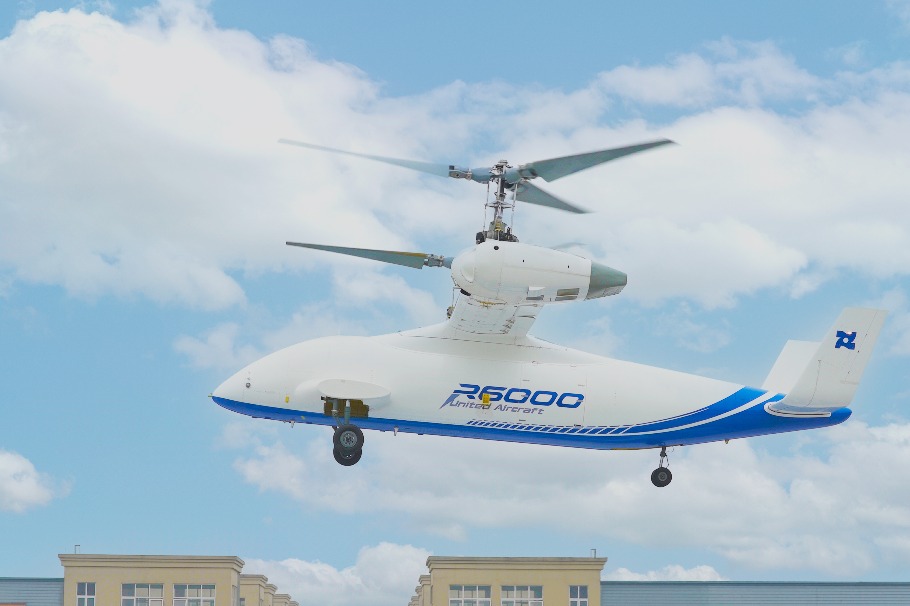
In a landmark achievement for advanced aviation technology, China’s United Aircraft Corporation has successfully conducted the inaugural flight of its Lanying R6000 tiltrotor unmanned aerial vehicle in Shifang, Sichuan province. The December 30th, 2025 milestone represents a significant advancement in hybrid aircraft capabilities, merging vertical takeoff functionality with fixed-wing performance characteristics.
The Lanying R6000, boasting a substantial six-ton maximum takeoff weight, represents the cutting edge of UAV design with its unique tiltrotor configuration. This engineering marvel combines the vertical ascent and precise hovering capabilities traditionally associated with helicopters with the extended range, substantial payload capacity, and superior cruising speeds of conventional fixed-wing aircraft.
With dimensional specifications of 11.8 meters in length, 5.3 meters in height, and 17.5 meters in width during helicopter configuration, the aircraft features an impressive 7.5-meter rotor diameter. The UAV’s technical capabilities include a remarkable 2,000-kilogram payload capacity, an operational range extending to 4,000 kilometers, a maximum cruising velocity of 550 kilometers per hour, and a service ceiling reaching 7,620 meters.
Performance comparisons reveal substantial advantages over traditional helicopter designs, with the Lanying R6000 demonstrating twice the cruising speed and service ceiling altitude, alongside quadruple the maximum operational range. The aircraft’s design accommodates up to twelve passengers for regional transit operations, while its vertical launch and recovery capabilities eliminate dependence on conventional runway infrastructure, enabling operations in topographically challenging environments including mountainous regions and island territories.
United Aircraft Corporation has announced subsequent testing phases commencing January 2026, focusing on tilt-mode transition examinations and comprehensive flight process evaluations to accelerate airworthiness certification. Future development roadmaps prioritize practical implementation across multiple sectors including executive air travel, logistical transportation networks, and emergency response operations.