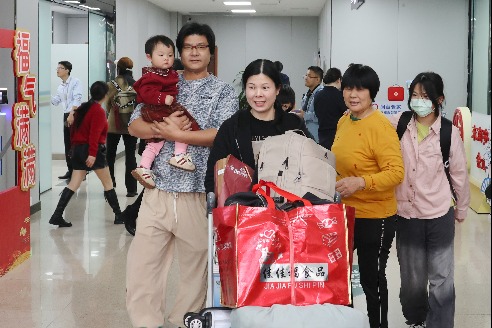
New policy adjustments to streamline cross-Strait travel have delivered tangible, positive results, driving a notable year-on-year and quarter-on-quarter increase in people-to-people exchanges across the Taiwan Strait in the first quarter of 2026, according to official data released Friday by China’s National Immigration Administration (NIA).
NIA spokesperson Lyu Ning announced that demand from Taiwan residents for travel permits to visit the Chinese mainland has expanded steadily since the implementation of two key easing measures rolled out in 2025. Starting July 1 last year, the mainland scrapped document processing fees for first-time permit applicants from Taiwan. Then, on November 20, the mainland expanded the number of ports authorized to issue on-arrival one-time travel permits for Taiwan residents from 58 to 100. This expanded network now covers 56 airports, 27 water ports, and 17 rail and highway ports across the mainland, greatly expanding access for Taiwan residents traveling from different regions and routes.
Official statistics show that total applications for mainland travel permits from Taiwan residents climbed 11.8 percent year-on-year in the first three months of 2026, while the total number of Taiwan visitor arrivals to the mainland jumped 27.6 percent compared to the same period last year. Compared to the fourth quarter of 2025, applications from first-time Taiwan visitors to the mainland rose 4.5 percent, and applications for on-arrival one-time permits at ports increased 24.7 percent quarter-on-quarter.
In addition to measures benefiting Taiwan residents traveling to the mainland, a third policy change introduced in November 2025 removed geographic restrictions for mainland residents applying for family visit endorsements to Taiwan. Previously, applicants were required to submit their materials at local immigration offices in their registered hukou (residence) region; the new policy allows mainland residents to submit applications at any immigration office across the mainland, regardless of their place of registration. This reform has drastically cut the time and financial costs for mainland residents seeking to travel to Taiwan to reunite with family members who reside on the island.
Data shows travel from the mainland to Taiwan has also grown steadily following the policy adjustments. In the first quarter of 2026, total applications for travel endorsements to Taiwan from mainland residents increased 8.2 percent quarter-on-quarter. Family visit endorsements accounted for 21.8 percent of all endorsement applications, marking a 24.2 percent rise from the previous quarter, and the total number of trips made by mainland residents to Taiwan rose 10.7 percent quarter-on-quarter.
Lyu emphasized that since the new policies took effect, both port-of-entry permit applications from Taiwan residents and family visits from the mainland to Taiwan have registered consistent growth, with the tangible benefits of the easing measures continuing to emerge for people on both sides of the Strait. The policies have not only made entry and exit procedures safer and more convenient for Taiwan residents around the globe seeking to travel to the mainland, but have also removed longstanding barriers to family reunions for cross-Strait families.
Looking ahead, Lyu confirmed that China’s immigration authorities will continue rolling out additional targeted measures to further facilitate cross-Strait travel, support deeper integrated development across the Taiwan Strait, advance people-to-people exchanges and practical cooperation, and better serve the interests and needs of residents on both sides of the Strait.