Against a backdrop of rising living standards and shifting consumer priorities, the concept of “emotional value consumption” has evolved from a cultural buzzword to a core policy focus and fast-growing economic driver across multiple Chinese provinces. The movement first gained formal recognition this year when it was officially written into Hubei province’s 2026 government work report, paving the way for a surge in consumer spending centered on personal well-being, stress relief, and experiential joy.
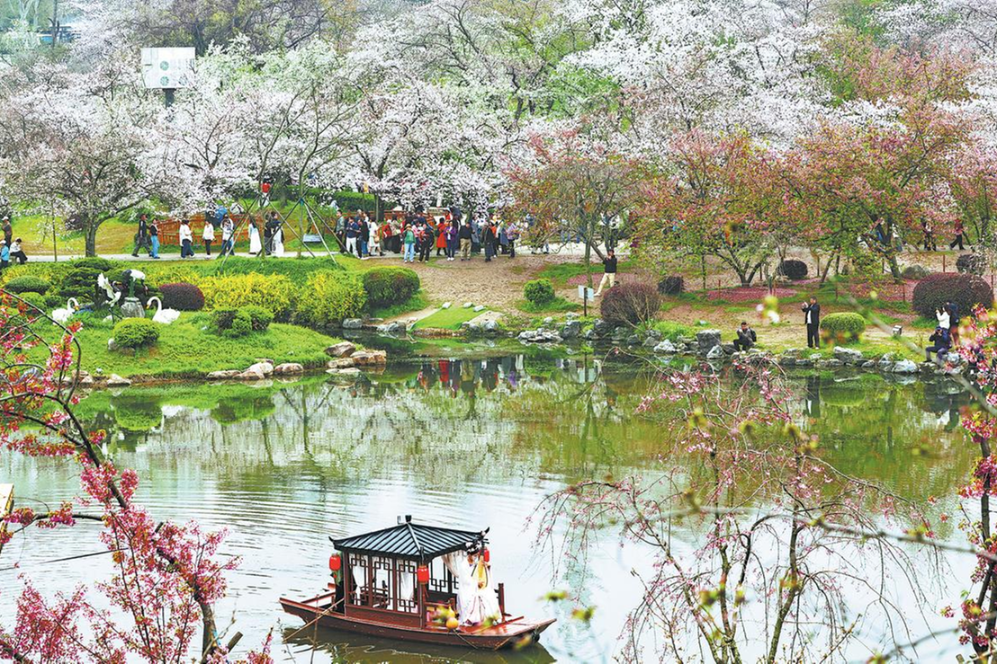
Wuhan, Hubei’s capital, has emerged as a leading example of how this trend translates into tangible economic gains, with its world-famous “cherry blossom economy” driving record tourism and business activity. In late March, the city played host to the annual Wuhan Marathon, drawing more than 30,000 runners from 69 countries around the globe. Race organizers designed the course to highlight the city’s most iconic landmarks—from the ancient Yellow Crane Tower to the historic Yangtze River Bridge—and wove the region’s famous spring cherry blossoms into the route, with competitors passing more than 3,500 blooming trees and finishing on a 760-meter stretch lined with falling pink petals. “The scenery kept me energized mile after mile,” shared Fang Bo, a Beijing-based runner who took first place in the men’s half-marathon.
That widespread enthusiasm for the seasonal floral spectacle has translated into a massive financial windfall for local businesses. Roughly 55 percent of Wuhan’s leading catering companies rolled out cherry blossom-themed menus, featuring creative offerings ranging from cherry blossom-infused noodles to limited-edition floral rice wine. Data from Wuhan Customs shows the spring blossom season triggered a 110.99 percent year-on-year jump in inbound international visitors from major source markets including South Korea, Malaysia, Singapore, and the United States. During the April 4–6 Qingming Festival holiday, searches for “Wuhan cherry blossoms” on Chinese travel platform Tongcheng Travel nearly quadrupled compared to the previous month, reflecting sustained, growing demand for the seasonal experience.
Beyond large-scale tourism events, the emotional economy also thrives in small, relatable everyday comforts that resonate with modern consumers. One viral local success story is the “Suan Niao” (literally “forget it”) plush toy, a creation of designer Li Mangguo who drew inspiration from a sprouted garlic bulb. The soft toy is paired with a slogan in local Wuhan dialect: “Forget it, life isn’t easy for any of us.” The down-to-earth, relatable message struck a chord with online audiences, and the toy has already sold more than 200,000 units to date.
This shift toward “self-pleasing consumption”—purchases prioritizing personal emotional satisfaction over practical utility—is particularly pronounced among Generation Z consumers. At a popular recreational sports center on bustling Jianghan Road in Wuhan, young people fill the facility every day, participating in activities from bowling to indoor horse riding. “These activities meet a specific need for self-indulgence and social connection,” explained Gu Wei, the center’s manager, in an interview with Xinhua News Agency.
Industry experts note that this consumer shift marks a clear break from traditional spending patterns. “Consumers are moving past the ‘practical utility’ of goods,” explained Hu Fen, a professor in the School of Tourism Management at Hubei University. “The core drivers are a rigid demand for stress relief and the desire for ‘social currency.’ The younger generation prioritizes how a purchase makes them feel.”
What makes this trend particularly notable is its formal integration into regional government policy. When the fourth session of the 14th Hubei Provincial People’s Congress opened in Wuhan, Governor Li Dianxun announced that the province would prioritize responding to new consumer demand for practical, emotional, and knowledge-based value in 2026. Wang Shenghui, a deputy to the Hubei Provincial People’s Congress and deputy director of Suizhou Museum, noted that including “emotional value” in the government work report underscores the province’s growing focus on public spiritual needs and represents an innovative breakthrough in governance. Wang added that sectors across Hubei have already begun exploring emotional value-driven offerings: “Suizhou Museum’s immersive chime bells and dance show offers visitors a journey through ancient times, while the Yellow Crane Tower’s night tour uses lighting and poetry to inspire visitors’ cultural empathy.”
Ge Tiancai, a provincial congress deputy and chairman of Wuhan Mulan Flower Township Tourism Development, framed the trend as a natural outcome of broader economic progress. “People’s living standards have improved and the problem of food and clothing has been solved,” he said, explaining why consumers are now prioritizing emotional fulfillment over basic needs. During this year’s regional “two sessions” (annual legislative and political consultative conferences), emotional value, the emotional economy, and the self-pleasing economy became top buzzwords, and the concept has since been included in government work reports for multiple other provinces, including Jiangxi and Guizhou.
Industry projections underscore the massive scale and future growth of this market. According to an insight report on China’s emotional economy spending trends covering 2025 to 2029, the national market for emotional value consumption reached 2.31 trillion yuan (approximately $330 billion) in 2024, and is on track to surpass 4.5 trillion yuan by 2029. Jia Xiaoling, account director of consumer insights firm Worldpanel China, offered a strategic recommendation for local policymakers and businesses: by integrating local natural resources and unique cultural features to build distinctive consumption experiences, stakeholders can form genuine emotional bonds with consumers and unlock long-term growth in this fast-expanding sector.