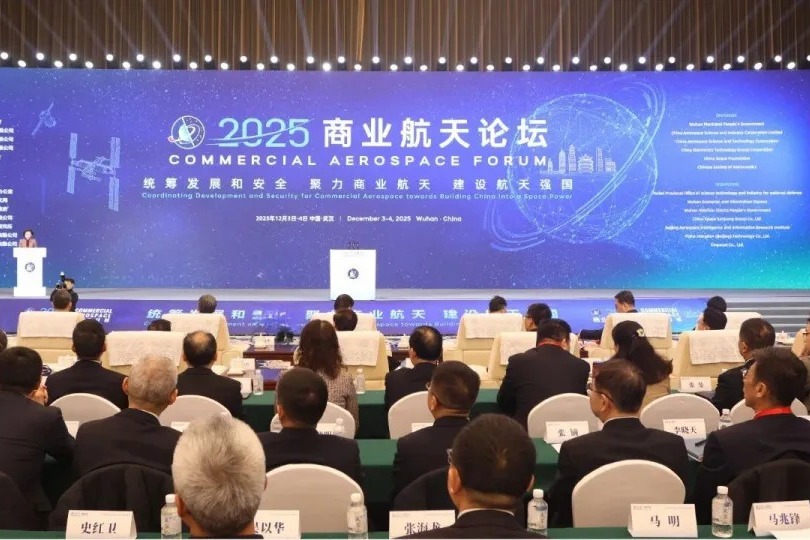
Wuhan, the capital of China’s Hubei province, became the epicenter of commercial space innovation as it launched the 2025 Commercial Aerospace Forum on Wednesday. The two-day gathering brings together government authorities, aerospace corporations, scientific experts, and commercial enterprise representatives to shape the future of space exploration and technology.
The forum represents a collaborative effort between the Wuhan municipal government and China’s leading aerospace entities: China Aerospace Science and Technology Corp, China Aerospace Science and Industry Corp, China Electronics Technology Group Corp, alongside the China Space Foundation and Chinese Society of Astronautics. This convergence of public and private sector leadership highlights the growing significance of commercial space initiatives within China’s broader aerospace strategy.
Chen Ximing, Chairman of China Aerospace Science and Industry Corp (CASIC), emphasized his organization’s deepening commitment to Hubei province through multiple commercial space programs. These initiatives include the development and management of a national commercial space industry base, alongside ongoing research and manufacturing of carrier rockets and satellites. ‘CASIC is determined to strengthen scientific and technological innovation in the commercial space sector,’ Chen stated, noting plans to increase investment in Hubei and expand cooperation with local authorities and enterprises.
As one of China’s pioneering commercial space enterprises, CASIC has established a substantial footprint in the industry. The forum features numerous technical workshops addressing critical topics from advanced rocket propulsion systems to satellite data applications and emerging business opportunities in the space sector.
The event’s first day culminated with the signing of a strategic cooperation memorandum between CASIC and the Hubei provincial government. Several subsidiaries of the state-owned conglomerate further solidified partnerships through additional agreements with local universities and commercial space companies, signaling strengthened integration between academic research, commercial innovation, and aerospace development in the region.