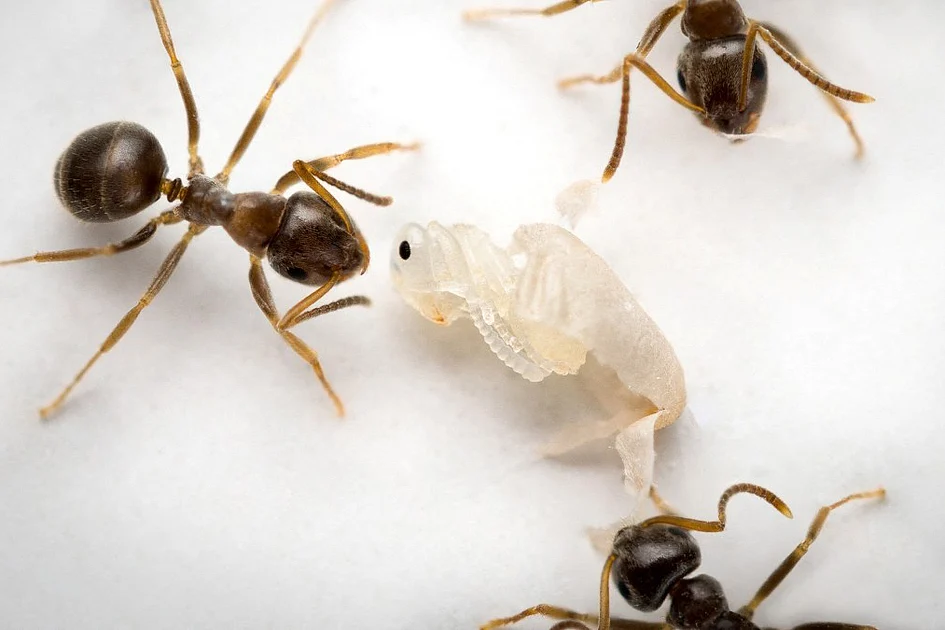
In a remarkable display of social immunity, scientific research reveals that terminally ill ant pupae actively signal worker ants to destroy them to prevent colony-wide infection outbreaks. The study, led by behavioral ecologist Erika Dawson at Austria’s Institute of Science and Technology, demonstrates how ant colonies function as cohesive super-organisms with sophisticated disease containment strategies.
Unlike many species that conceal illness for social reasons, ant colonies have evolved mechanisms reminiscent of cellular responses in complex organisms. When infected cells in human bodies emit ‘find-me and eat-me’ signals, similarly, young ants trapped in their cocoons—unable to practice social distancing—release specific chemical cues when fatally diseased.
The research team working with Lasius neglectus, a common black garden ant species, discovered that worker ants respond to these olfactory signals by tearing open the cocoons and administering poison that simultaneously eliminates both the pathogen and the developing pupae. This disinfectant process protects the broader colony from potential epidemics in the densely populated nest environment.
Crucially, the study established that pupae only produce these chemical signals when workers are present, confirming intentional communication rather than passive chemical leakage. This represents an evolutionary adaptation where individual sacrifice benefits genetic survival through colony preservation.
Notably, queen pupae exhibit different behavior—they neither send destruction signals nor fall victim to this altruistic protocol. Researchers attribute this exception to queens’ superior immune systems, which typically enable them to overcome infections without requiring intervention. The differential treatment underscores the colony’s prioritization of reproductive success over individual worker lineages.
The findings, published in Nature Communications, provide new insights into social insect evolution and disease management strategies in highly organized animal societies.