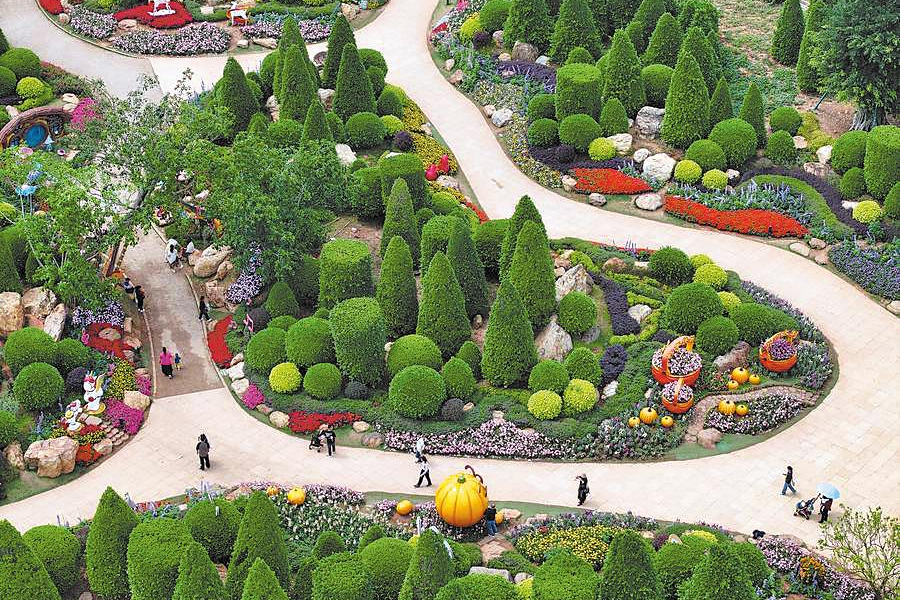
For years, Zhong Zimeng traversed the same daily commute through Nanning, the humid, busy capital of South China’s Guangxi Zhuang autonomous region. Like millions of urban residents around the world, the city existed only as a blurred backdrop to her rushed schedule — that is, until she set out on a simple mission: hunt for every instance of the color pink around her.
Armed with nothing more than her smartphone, Zhong spent an hour wandering a riverside park, scanning her surroundings for her chosen hue. What began as a casual activity unlocked a new perspective: the vivid neon-pink of blooming flowers against gray concrete pathways, a soft pink park bench tucked between trees, even the bright fuchsia deck of a visitor’s skateboard. Details she had walked past dozens of times suddenly jumped into sharp focus.
“I pass this spot all the time,” Zhong explained. “Searching for specific colors made me notice so many scenes I would have otherwise missed completely.”
Zhong is one of millions of Chinese people embracing ColorWalk, a low-stakes, accessible outdoor scavenger hunt that has exploded into the most popular seasonal recreational trend of 2026. On Xiaohongshu, China’s leading lifestyle and social sharing platform, topics related to ColorWalk have accumulated more than 310 million views and 1.88 million public discussions, a testament to the activity’s rapid mainstream adoption.
The rules of ColorWalk are intentionally simple: participants pick one color to look for, set aside rigid travel plans, and simply let their vision guide their walk. Industry observers describe it as a unique hybrid of street photography and mindfulness meditation, designed as an antidote to the digital burnout that plagues many young people constantly glued to their screens.
Clinical psychologist Dai Jian, who works at Jiangbin Hospital, explains that the activity directly addresses the modern harms of fragmented attention and constant digital stimulation. “The entire process relieves fatigue caused by split attention and eases strained, anxious emotions,” Dai said. He also broke down the psychological benefits of different colors based on color psychology research: green, a commonly chosen hue, symbolizes vitality and calm, helping to lower heart rate, relax tense muscles and nerves, and quickly reduce feelings of anxiety, irritability and tiredness. Blue evokes coolness and serenity, while yellow brings a sense of warmth and energy, and pink conveys softness and sweetness.
Dai added that the common practice of sharing ColorWalk finds on social media also adds to the stress-relieving benefits: the process of taking, selecting and editing photos, then writing captions to share, helps people process their experience, release pressure, and reinforce the sense of calm they gained during their walk.
Beyond mental health benefits, ColorWalk encourages urban residents to explore their own cities on foot, paying attention to small, easily overlooked details. What was once a familiar, monotonous hometown transforms into an entirely new destination full of hidden discoveries waiting to be found.
The trend’s surging popularity has already prompted tourism regulators and local businesses across China to develop and promote official ColorWalk routes, many of which weave together scenic green spaces, local shops, and cultural landmarks to create richer, more immersive experiences.
Lin Shanshan, an associate professor at Zhejiang University, notes that ColorWalk fits into a broader shift in China’s spring tourism economy, moving beyond traditional pure sightseeing to integrated, experience-focused activities. These new consumer trends align with national policy goals to upgrade domestic service sectors and cultivate new areas of consumption growth. By reframing urban spaces as sites of discovery, the ColorWalk movement also makes cities more walkable and more endearing to the people who live in them.
Huang Huazhao, vice-chairman of the Guangxi Artists Association, points out that the spontaneous observation and documentation of color that defines ColorWalk also subtly sharpens participants’ sensitivity to color and cultivates a greater awareness of the small beautiful details that exist in everyday life. “Everyone can capture color with their eyes and freeze beautiful moments with their cameras,” Huang said. “Everyone is an artist in their own life.”