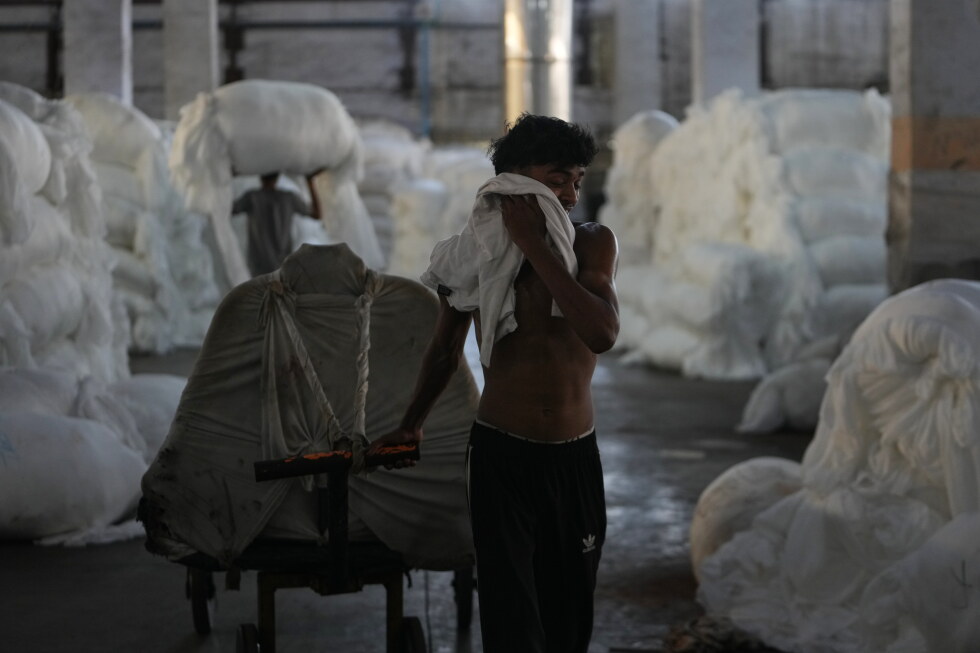
SURAT, India — Tucked in the industrial outskirts of the western Indian city of Surat, dozens of textile workers navigate low-ceilinged factory floors crammed full of heat-generating industrial machinery, where the already record-breaking regional heat is amplified by steam, radiating metal, and acrid chemical fumes. On a recent sweltering spring afternoon, the air hung thick with humidity, the constant roar of stenters (large textile processing machines) filled every corner, boilers hissed continuously, and rolling plumes of steam billowed from drum washers, creating an oppressive work environment that tests even the most resilient laborers.
Soni Pande, a 27-year-old migrant single mother who relocated from eastern India’s Bihar state to work in the factory, explained that existing cooling tools including mist-spraying coolers and standing fans are barely enough to take the edge off the worst heat. “The heat leaves us completely drained. We sweat through our shifts constantly, and many coworkers suffer dizziness and illness,” she said. “Even with the fans and coolers, it remains unbearably hot inside.” Pande’s experience is shared by more than 1.4 million workers across Surat, a global hub for synthetic polyester fabric production that supplies affordable textiles for garments sold worldwide.
Like most regions across India, Surat has seen steadily rising average daily and overnight temperatures, paired with extended summer heat seasons, a shift driven largely by human-caused climate change. For textile factories that rely on high-temperature processes to dry, dye, print and finish fabric, this warming trend has turned routine work into a potentially dangerous health hazard. While many facilities have installed basic cooling equipment, these systems are rarely powerful enough to counteract the constant heat output of processing machinery, and most factory owners have little ability or incentive to invest in more robust infrastructure.
The industry is already grappling with significant economic pressure: supply chain disruptions and energy price volatility stemming from the Iran war, paired with steep punitive tariffs imposed by the United States on Indian goods, have squeezed profit margins across the sector. Most factories have opted for low-cost cooling solutions that avoid the need for sealed production spaces, such as evaporation-based air coolers and exhaust fans, but these measures only deliver marginal temperature relief. During an on-site visit to two Surat-area factories, The Associated Press found that even facilities with cooling systems only deliver temporary relief during 10 to 15 minute rest breaks, with the majority of the production floor still dominated by the heat of running machinery.
Kundan Kumar, another Bihari migrant who operates a dyeing machine at Palsana industrial area’s Vinit Fabrics, echoed Pande’s account of daily hardship. “Even with the coolers, working conditions remain extremely tough,” he said. “Dyeing is physically demanding work, but we have no other option. We need income to support our families back home, so we have to keep going regardless of the heat.”
India, the world’s most populous nation, is ranked among the countries most vulnerable to the impacts of climate change. Every year, extreme weather events including catastrophic storms, widespread flooding, and prolonged heat waves kill thousands of people and cause billions of dollars in economic damage. A 2022 World Bank analysis estimates that 75% of India’s workforce — roughly 380 million people ranging from construction laborers to factory employees — are exposed to unsafe levels of occupational heat that can trigger life-threatening heat-related illness.
While India has existing labor regulations and guidelines designed to protect workers from extreme heat, labor unions submitted a formal letter to the national government earlier this year calling for stricter legislation and stronger on-the-ground enforcement. A core gap in current protections is that over 550 million Indian workers — nearly 90% of the total national workforce — are classified as informal labor, a group that includes most Surat textile workers, and are not covered by existing labor safety laws.
Pooja Yadav, a climate and labor researcher at the New Delhi-based think tank WRI India, who conducted on-site temperature testing at Surat factories, explains that the combination of high outdoor humidity and internal factory heat creates uniquely dangerous working conditions. “In textile processing units that use steam and hot water for production, indoor temperatures and humidity are often far more dangerous than outdoor conditions during a heat wave,” Yadav said. She added that during 12-hour shifts, workers are exposed to a toxic mix of hot air and chemical fumes that causes immediate health effects including dehydration, headaches, and fainting, as well as long-term chronic damage to lung and kidney function. Extreme heat also cuts worker productivity, creating a secondary economic hit for factory owners.
Yadav notes that simple, low-cost interventions — including targeted insulation for heat-emitting machinery, expanded ventilation systems, and structured cooling distribution — can meaningfully improve working conditions. Vinit Fabrics, for example, invested roughly $5,300 in upgrading its cooling systems, added jute insulation to hot machinery, and sealed floor gutters that carry heated wastewater, steps that have delivered modest improvements. But Yadav stressed that the vast majority of Surat’s textile factories still rely solely on basic fans, and widespread adoption of effective cooling infrastructure remains rare. She added that national and state heat action plans rarely account for the unique risks faced by industrial workers, a gap that urgently needs to be addressed by policymakers.
For the workers themselves, there is no alternative to showing up for shifts that pay roughly $7 for 10 to 12 hours of work. “We don’t have a choice,” Pande said. “I have three children to support. Whether it’s dangerously hot or not, we have to keep working.” Factory managers confirm that the extreme heat is worsening existing labor shortages: after production cuts in recent years, many workers returned to their home states and have refused to come back to Surat’s factories due to unsafe heat conditions. Subhash Sharma, production manager at Vinit Fabrics, said the facility normally employs 700 workers but is currently operating at just 60% capacity, due to a combination of economic pressure and labor shortages driven in part by rising heat. “Over the past few years, we have seen the number of available workers decline because of the increasing extreme heat,” Sharma said.