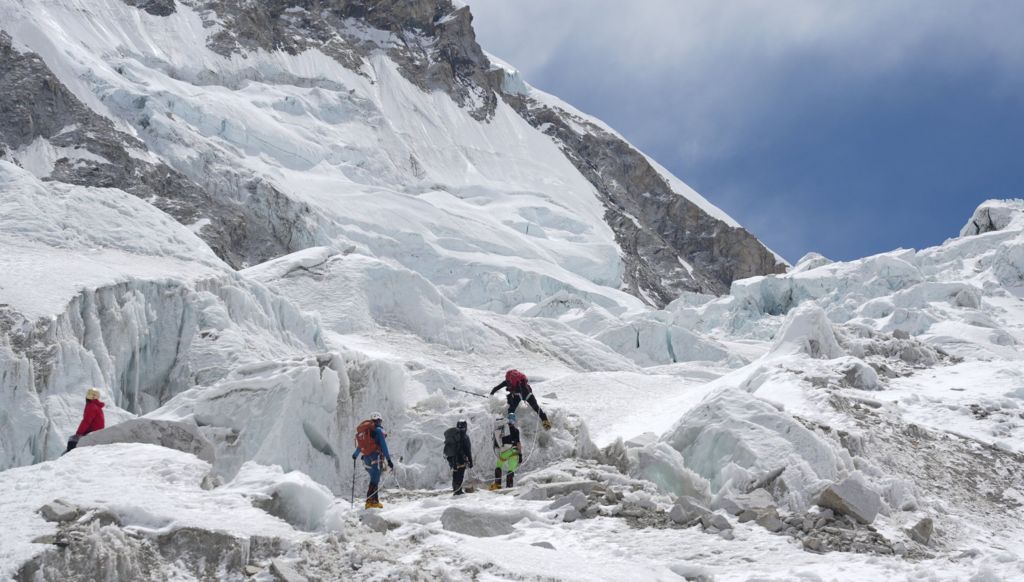
As the annual spring climbing season on Mount Everest gets underway, a massive, unstable block of glacial ice has brought preparations to a standstill, threatening to spark repeated overcrowding issues that have plagued the world’s highest peak in recent years. The 100-foot (30-meter) serac sits just below Camp 1 on Nepal’s southern route, and the specialized team tasked with securing climbing paths, known as icefall doctors, has been unable to identify a safe detour around the obstruction.
The icefall doctors, employed by the Sagarmatha Pollution Control Committee (SPCC) which manages route maintenance up to Camp 2 at 8,848.86 meters above sea level, arrived at Base Camp three weeks ago. In a typical April, the team would have already fixed ropes and ladders all the way to Camp 3, but the massive glacial chunk, located roughly 600 meters below Camp 1, has blocked all progress. Team representatives say there is no feasible artificial method to remove the block, leaving only one course of action: waiting for natural melting and collapse to clear the path.
“We haven’t found artificial ways to melt it so far, so we don’t have any options other than waiting for it melting and crumbling itself,” SPCC Base Camp coordinator Tshering Tenzing Sherpa confirmed in an interview with the BBC.
Veteran icefall doctor Ang Sarki Sherpa, who has worked on Everest routes for years, noted that the lower section of the serac is already weakening. The team first reached the obstruction on April 10, and subsequent observations show the crevasse beneath the block has continued melting, bringing the serac closer to collapse. After four days of scouting the surrounding terrain on both sides of the mountain, the team confirmed there is no safe alternate route to Camp 1 this season, and climbing directly over the unstable serac has been ruled out as too high-risk.
Nepal’s Department of Tourism is now evaluating contingency plans, including the possibility of helicopter airlifts for the rope-fixing team and their equipment directly to Camp 2, allowing work to proceed on higher sections of the route while the team waits for the obstruction to clear.
“We are thinking about airlifting the rope-fixing team and their logistics to Camp 2 by helicopter, so they can open the route above that altitude for now,” said Ram Krishna Lamichhane, the department’s director general. “We will wait for the ice to melt at the place where there is an obstruction and work there when everything is safe.”
The narrow window of favorable climbing conditions on Everest only lasts through the end of May. SPCC teams hold cautious optimism that the serac will collapse within days, allowing route fixing to Camp 2 to finish quickly and the first summit attempts to proceed within a week. Still, the weeks-long delay has stoked widespread concern among climbers about a repeat of the dangerous summit “traffic jams” that have led to deaths and injuries in past seasons.
Purnima Shrestha, a prominent Nepali climber and photographer who is currently acclimatizing at Base Camp ahead of her sixth Everest summit attempt, shared her perspective from the mountain. Normally during acclimatization, climbers rotate repeatedly between Base Camp, Camp 1, Camp 2, and Camp 3 to build tolerance to high altitude, but the route delay has already disrupted this process.
“I am not worried that the route won’t open because we still have time for that. But the window could be narrow – with lots of climbers having to make their attempts in a short period of time,” Shrestha explained. Even if the serac clears in the coming days, the reduced climbing window will force hundreds of permitted climbers to compress their summit attempts into a much shorter timeframe, increasing the risk of deadly overcrowding.
Despite ongoing geopolitical instability from the Iran war, which has driven up fuel costs and disrupted international travel, demand for Everest summits remains strong this year. Dambar Parajuli, president of the Expedition Operators’ Association, noted that there has been only a small drop in numbers linked to flight disruptions, with mountaineering far less affected than lower-altitude trekking.
To date, Nepal’s Department of Tourism has issued 367 climbing permits, with the majority going to Chinese climbers. This year, China has not issued permits for foreign climbers accessing Everest from the Tibetan side of the mountain, meaning nearly all summit attempts will follow the Nepali route. In 2025, more than 700 climbers and guides summited from Nepal, compared to just 100 from the Tibetan side.
After viral images of massive summit queues in 2019 sparked global criticism of overcrowding and lax regulation, Nepal implemented strict reforms to its permit system, including sharp increases in climbing fees. This spring, permit costs for foreign climbers have risen to $15,000, up from $11,000, while fees for Nepali climbers have doubled to $1,000, in a bid to reduce overcrowding and fund better route management. Even with the price hikes, however, the unexpected glacial obstruction has put the 2026 season at risk of the same overcrowding issues regulators sought to prevent.