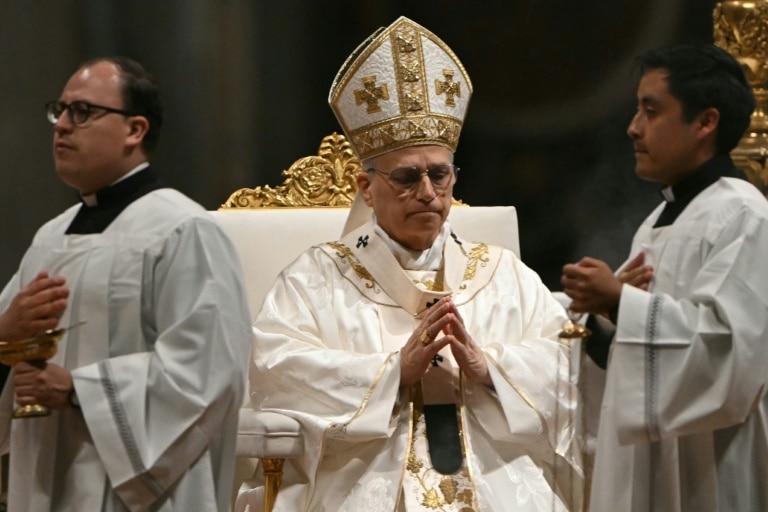
In his inaugural Easter Sunday address as the supreme leader of the global Catholic Church, Pope Leo XIV delivered a urgent, impassioned call for global actors to prioritize peace amid the raging, region-spanning war that has reshaped life across the Middle East just months after his election to the papacy. Speaking to thousands of worshippers and pilgrims gathered in Vatican City’s St. Peter’s Square, the pontiff, who was chosen to succeed the late Pope Francis in May 2025, called out the growing global complacency toward violence that has settled over communities worldwide.
“We are growing accustomed to violence, resigning ourselves to it, and becoming indifferent. Indifferent to the deaths of thousands of people,” Pope Leo told the assembled crowd. The conflict, which erupted on February 28 following joint U.S.-Israeli military strikes against Iran, has since escalated to draw in actors across the entire Middle East, sending shockwaves through global energy and commodity markets and severely disrupting economic activity worldwide. This year’s Easter celebrations, one of the holiest observances on the Christian calendar for the world’s 1.4 billion Catholics, have been overshadowed by the conflict from the Vatican to the Holy Land.
Pope Leo, who has already established himself as one of the most prominent global voices calling for an immediate de-escalation of the conflict, revealed plans Sunday for a special prayer vigil to be held at the Vatican on April 11 focused on peace in the region. He also used the holiday address to pay tribute to his predecessor, Pope Francis, who made his final public appearance exactly one year prior on Easter Sunday, passing away just hours later. In a move that amplified his diplomatic pressure, the pontiff confirmed this week he had personally reached out to U.S. President Donald Trump to urge the administration to seek a diplomatic off-ramp to end the hostilities. Reflecting on the moral weight of the ongoing conflict, he added, “We live in a world ravaged by wars and marked by a hatred and indifference that make us feel powerless in the face of evil.”
Thousands of kilometers away in Jerusalem, the heart of Christian worship, the holiday unfolded against a backdrop of eerie emptiness. The narrow, usually bustling alleyways of Jerusalem’s Old City stood silent, the area all but abandoned amid the expanding regional conflict that follows months of fighting in Gaza. Israeli security authorities have implemented harsh new restrictions on access to the Church of the Holy Sepulchre, the site where Christian tradition holds Jesus Christ was crucified and resurrected, citing ongoing security concerns. Only a small fraction of the usual number of worshippers were permitted to approach the sacred site, with police checkpoints deployed along all access routes to screen visitors. Every shop and business in the surrounding area shuttered for the holiday, deepening the pervasive sense of loss and disruption.
For pilgrims who traveled thousands of miles to mark the holiday at the holy site, the restrictions have been devastating. “It’s very hard for all of us because it’s our holiday… It’s really hard to want to pray but to come here and find nothing. Everything is closed,” 44-year-old Romanian pilgrim Christina Toderas told reporters. Otmar Wassermann, a 65-year-old visitor who was turned away from the church, shared that he left the site feeling deeply frustrated by the disruption to the centuries-old tradition of open Easter worship.
Cardinal Pierbattista Pizzaballa, the Latin Patriarch of Jerusalem, addressed the grim reality in his Easter Vigil homily delivered at the restricted site. “The doors are still closed,” he stated, referencing an incident just one week prior when Israeli police blocked him from holding a scheduled mass at the church, a move that sparked widespread international condemnation. In published excerpts of his sermon released by his office, he added, “The silence is almost absolute, broken perhaps by the distant sound of what war continues to sow in this holy and torn land.”
The conflict has upended Easter celebrations across every corner of the Middle East, home to some of the world’s oldest and most vulnerable Christian communities. In southern Lebanon, majority-Christian towns along the border with Israel are trapped between ongoing crossfire between Israeli forces and the Iran-backed Hezbollah movement. In the small border village of Debel, residents marked the holiday to the constant roar of artillery bombardment surrounding their community. The village is now almost completely cut off from basic services, with residents relying entirely on humanitarian aid deliveries to survive. “The situation is tragic,” local community leader Joseph Attieh told AFP via phone. “People are terrified, and the sound of shelling and gunfire has not stopped for a moment since last night. We haven’t been able to sleep. We are putting our trust in God, because this is the only glimmer of hope we will not give up on.”
Further afield, the security risks of the conflict have forced Christian leaders to cancel or scale back traditional Easter observances. In Dubai, all public Easter masses have been suspended indefinitely as a security precaution. In Damascus, the capital of Syria, Catholic officials confirmed Easter celebrations would be limited to small, private masses following a recent deadly attack on a majority-Christian town in central Syria, leaving communities reeling.