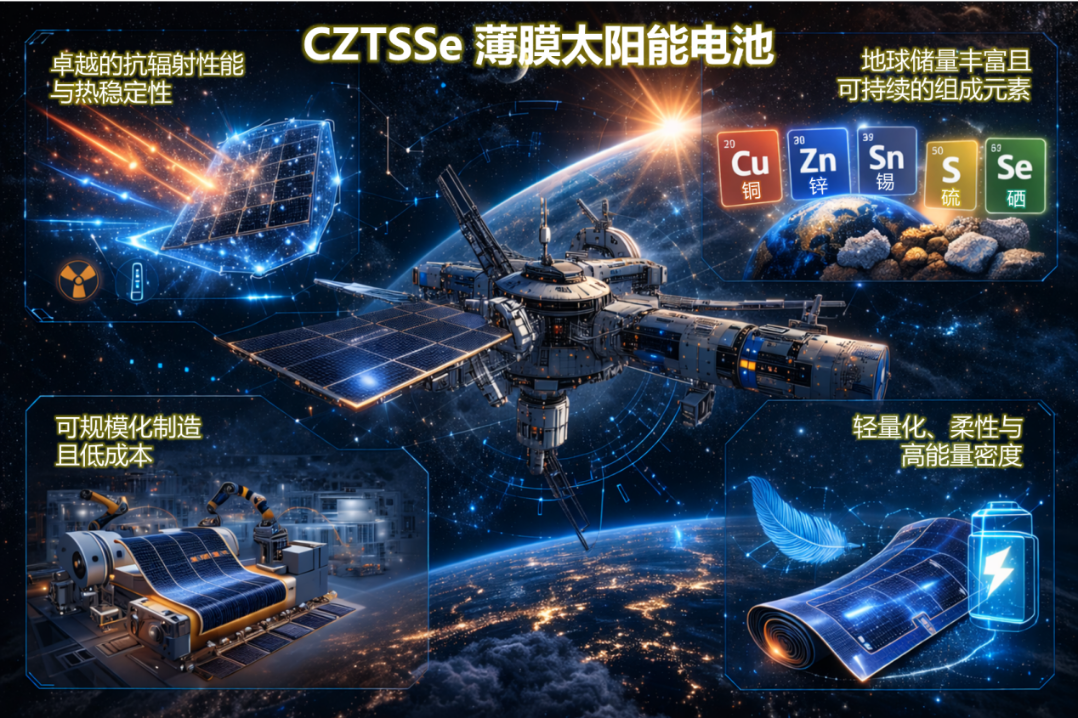
Chinese researchers have made a significant advancement in photovoltaic technology with the development of a high-efficiency thin-film solar cell specifically designed for space applications. The breakthrough comes from the Institute of Physics at the Chinese Academy of Sciences, where scientists have achieved a certified efficiency rating of 16.6% for their CZTSSe photovoltaic technology.
This innovation addresses critical needs in space infrastructure development and deep-space exploration, where solar technology must meet stringent requirements including lightweight design, radiation resistance, long operational lifespan, and sustainable resource utilization. The CZTSSe technology, composed of abundant elements including copper, zinc, and tin, offers distinct advantages over conventional solar solutions through its environmental friendliness, cost-effectiveness, and natural resistance to space radiation.
Led by researcher Meng Qingbo, the team overcame fundamental challenges in material crystallization, atomic structure, and defect control. Their novel approach involved developing an atomic vacancy strategy that guides the precise positioning of copper and zinc atoms within the material matrix. This breakthrough fundamentally reduces defect activity and minimizes internal energy losses, resulting in significantly improved performance.
The research team has already developed flexible cells and modules based on this technology, with the current efficiency level providing a solid foundation for industrial applications. Scientists project that once cell efficiency approaches 20% and module efficiency reaches 18%, enabling mass production, the technology will become commercially competitive and widely applicable in aerospace equipment and other advanced scenarios.