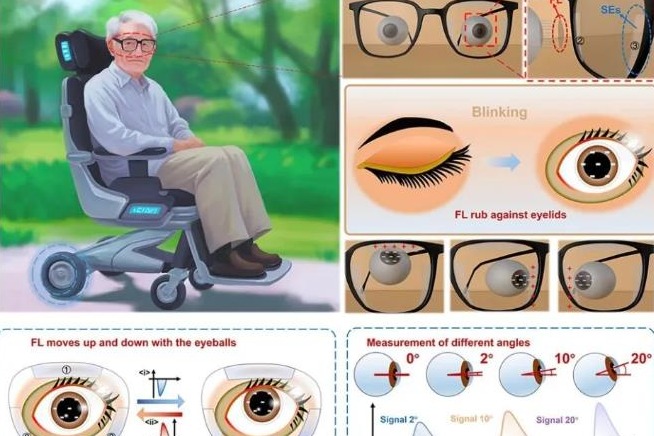
In a groundbreaking advancement for assistive technology, Chinese research teams have pioneered a self-sustaining eye-tracking system that converts blink energy into operational power for controlling external devices. This innovation emerges from collaborative efforts between Qingdao University and the Hong Kong University of Science and Technology, representing a significant leap in human-computer interaction systems.
The technology centers on a triboelectric nanogenerator (TENG) device, designated ET-TENG, which captures microscopic friction generated between eyelids and eyeballs during natural blinking. This mechanical energy is transformed into electrical power sufficient to operate the entire tracking system without external batteries. The device demonstrates remarkable precision with 99% accuracy in detecting eyeball deflection angles as minimal as 2 degrees.
Unlike conventional camera-based eye trackers, the ET-TENG system maintains full functionality in complete darkness, overcoming a critical limitation of light-dependent technologies. This capability ensures reliable operation in various environmental conditions, enhancing its practical application potential.
The primary application targets individuals with severe mobility impairments, particularly those with amyotrophic lateral sclerosis (ALS) and other conditions that preserve eye movement while limiting other motor functions. These patients could potentially operate wheelchairs, computers, and communication devices through intentional eye movements, restoring significant autonomy.
Beyond medical applications, researchers envision implementations in space exploration for hands-free control panels, automotive safety systems for driver fatigue monitoring, and virtual reality hardware for creating more lightweight, energy-efficient headsets. The technology’s simple structure, high sensitivity, and anti-interference capabilities position it as a versatile platform for numerous human-computer interaction scenarios.
The research, documented in the January 2026 edition of Cell Reports Physical Science, reflects the accelerating integration of artificial intelligence with sustainable energy solutions in technological development. This innovation represents not merely an incremental improvement but a fundamental reimagining of how biological energy can be harnessed for technological empowerment.