A groundbreaking advancement in semiconductor technology has emerged from China, where researchers have successfully developed the world’s smallest ferroelectric transistor operating at ultralow power consumption levels. This innovation, detailed in a recent publication in Science Advances, addresses one of the most persistent challenges in modern computing architecture.
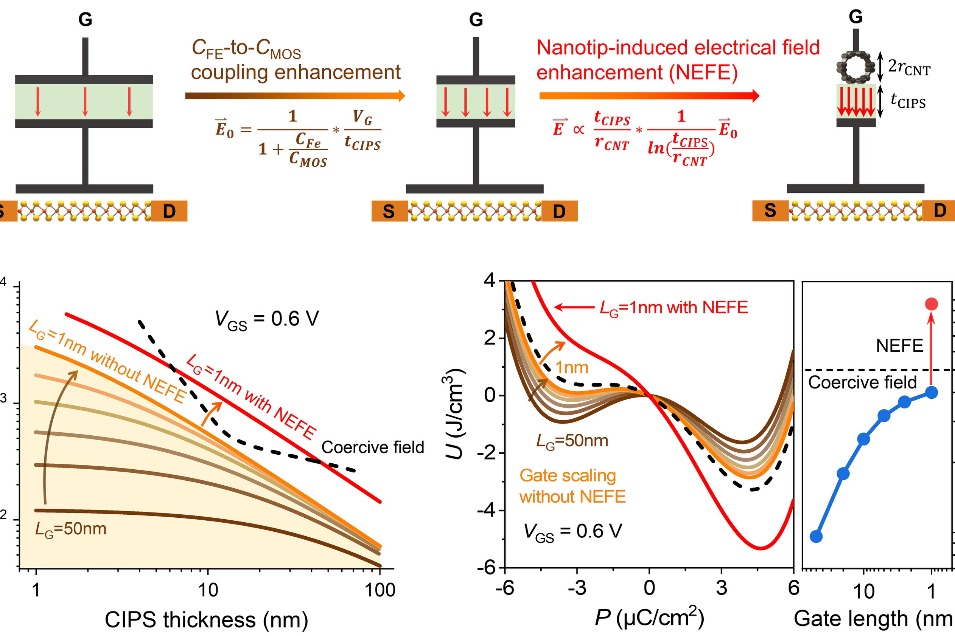
The research team from Peking University, under the leadership of Senior Researcher Qiu Chenguang and Academician Peng Lianmao of the Chinese Academy of Sciences, has engineered nano-gate ferroelectric transistors that operate at a remarkably low voltage of just 0.6 volts. This achievement is particularly significant as it bridges the critical voltage compatibility gap between logic chips, which typically operate at 0.7 volts, and mainstream non-volatile memory components like NAND flash that previously required 5 volts or higher for write operations.
This voltage disparity has long forced chip designers to incorporate complex voltage conversion circuits, resulting in substantial power wastage, increased space requirements, and significant data transfer bottlenecks. In contemporary AI chips, this incompatibility consumes 60-90% of total power allocation solely for data transfer rather than computational processes.
The newly developed technology shrinks the physical gate size to an unprecedented 1 nanometer while demonstrating exceptional memory performance. Science Advances reviewers have recognized that this breakthrough represents the first successful harmonization of voltage requirements between ferroelectric memory devices and logic transistors.
According to Qiu Chenguang, this innovation enables seamless data transfer between memory and computing units at identical low voltages, eliminating previous barriers while maintaining ultra-low power consumption during high-speed interactions. The underlying technological principle demonstrates universal applicability across mainstream ferroelectric materials and compatibility with standard industrial manufacturing processes.
The technology holds particular promise for applications in large model inference, edge intelligence systems, wearable devices, and Internet of Things terminals, potentially revolutionizing energy efficiency across multiple technology sectors.