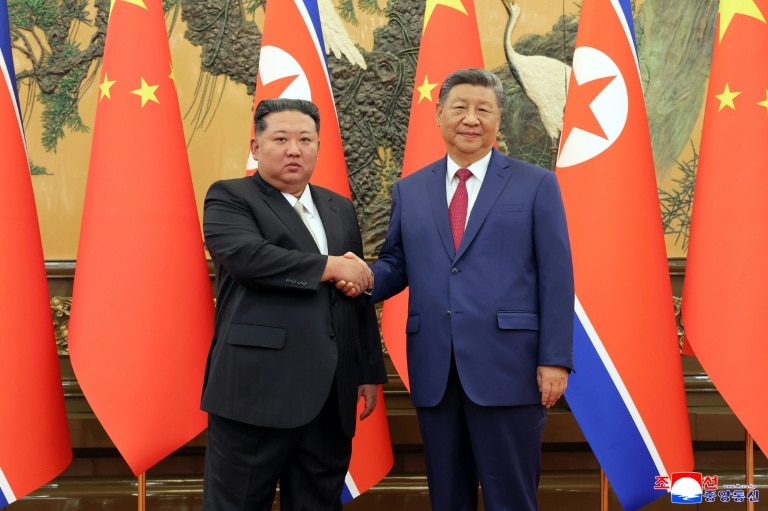
Just weeks after hosting back-to-back summits with U.S. President Donald Trump and Russian President Vladimir Putin, Chinese President Xi Jinping is scheduled to arrive in Pyongyang on Monday for a high-profile meeting with North Korean leader Kim Jong Un. This visit comes at a pivotal moment for regional and global geopolitics, as Washington’s diplomatic efforts to denuclearize North Korea remain firmly deadlocked.
For decades, China has stood as North Korea’s largest trading partner by a significant margin, and has long served as Pyongyang’s primary provider of both diplomatic backing and economic assistance to the country of 26 million people. During last month’s Beijing summit between Xi and Trump, the White House confirmed that the two leaders reaffirmed their shared commitment to the goal of complete denuclearization on the Korean Peninsula. Chinese Foreign Ministry spokesperson Mao Ning outlined the agenda for Xi’s meeting with Kim on Friday, stating the pair will exchange in-depth views on the future of bilateral relations and pressing regional issues of shared concern, with the aim of advancing greater stability for the Korean Peninsula and global peace at large.
However, just 24 hours ahead of Xi’s arrival, Kim Jong Un’s influential sister issued a stark reminder of Pyongyang’s non-negotiable stance: North Korea’s nuclear weapons program remains a “line of no retreat” that the country will not abandon under any circumstances.
Regional diplomacy experts note that Beijing’s core priority in the region has shifted in recent years, amid growing tensions between China and the United States. “China has always prioritized stability on the Korean Peninsula, and right now it has to carefully manage its broader relations and long-running differences with the U.S.,” explained Minseon Ku, a professor of diplomacy at DePaul University, in an interview with Agence France-Presse. “It is likely Beijing has already come to accept North Korea as a de facto nuclear state, but Xi will almost certainly convey to Kim that China values regional stability above all other outcomes.”
Seong-Hyon Lee, a visiting scholar at the Harvard University Asia Center, echoed this analysis, pointing out that Beijing is moving away from attempting to force Pyongyang to abandon its nuclear program and toward a strategy of guaranteeing the durability of the North Korean regime. “China’s broader regional strategy benefits from a stable, heavily armed, aligned buffer state that occupies the military attention and resources of the U.S. and its regional allies,” Lee noted.
Since the collapse of the 2019 summit between Kim and Trump, which fell apart over disagreements on the scope of denuclearization and the scale of sanctions relief, Pyongyang has repeatedly and publicly declared its status as an irreversible nuclear weapons state. During his first term in office, Trump met with Kim three times, but his October 2024 comment that he was “100 percent” open to another meeting with the North Korean leader has gone unanswered by Pyongyang.
In recent months, Kim has gained greater diplomatic and material leverage from the ongoing war in Ukraine. After committing thousands of North Korean troops to fight alongside Russian forces in Ukraine, Pyongyang has secured critical military technology, food, and economic support from Moscow. This growing Russia-North Korea alignment has led some analysts to speculate that Xi’s visit is, in part, an effort to push back against Moscow’s expanding influence in Pyongyang. But DePaul University’s Ku pushed back on that framing, arguing that “overall, Moscow cannot match China’s historic role and influence in North Korea.” She added, “Russia and North Korea have a far more equal dynamic than China and North Korea: Moscow needs Kim’s support for its war in Ukraine just as much as Pyongyang needs Russian technology and food aid.”
The last meeting between Xi and Kim took place in September 2025, when Kim joined Putin as a guest of honor at a Beijing military parade marking the 80th anniversary of the end of World War II and the defeat of imperial Japan. Analysts say that high-profile appearance highlighted Kim’s rising global standing, placing him alongside the leaders of the two largest Eurasian powers in a moment of international attention.
Against a backdrop of growing U.S. geopolitical competition and an increasingly unpredictable Washington under the second Trump administration, Xi has hosted a steady stream of global leaders in recent months as Beijing works to shore up its network of regional and global alliances. Simultaneously, ongoing conflicts in the Middle East have diverted much of Washington’s attention and military resources, leaving the Trump administration with little progress to show on North Korea policy, particularly on the nuclear file, despite earlier high-profile summits with Kim.
Notably, North Korea is the only country in the world that maintains an official, binding military alliance with China. “The U.S. is currently engaged in aggressive actions that threaten core Chinese interests, including global energy supply routes,” explained Vladimir Tikhonov, a professor of Korean Studies at the University of Oslo. “It appears Xi is seeking to consolidate his alliance with Pyongyang in large part to counter these U.S. moves.”
Analysts also point out that North Korea serves as a strategic counterweight to U.S. allies in the region, including South Korea and Japan, at a time when Beijing is increasing pressure on the self-ruled island of Taiwan, which China claims as its sovereign territory. Relations between China and Japan, already strained for years, have deteriorated further recently after Japanese Prime Minister Sanae Takaichi, a prominent security hawk, suggested last year that Tokyo could intervene militarily if China attempts to take control of Taiwan by force.
“As China’s international influence continues to grow, Beijing is likely seeking to draw Pyongyang more actively into its broader diplomatic orbit to advance its regional strategic goals,” noted Lim Eul-chul, a leading North Korea expert at South Korea’s Kyungnam University.