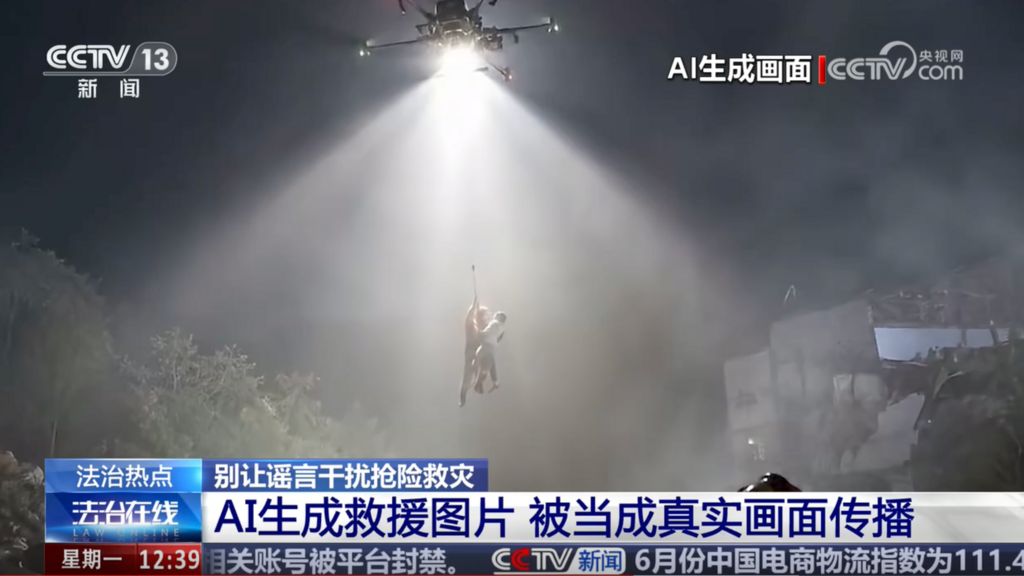
As China mobilizes response and recovery efforts following the weekend landfall of Typhoon Noul, authorities are confronting a growing, man-made secondary hazard that is complicating emergency work: AI-fueled disinformation flooding social media platforms. In recent months, widespread storm and flood events across the country have been accompanied by a tidal wave of fabricated AI content, ranging from false depictions of mass casualties and severe flooding in unaffected regions to altered clips that distort the reality of official emergency response operations.
This tidal wave of false content has already triggered tangible harm. In multiple affected regions, AI-generated videos spreading baseless claims about widespread power outages have sparked panic buying of emergency essentials, straining local supply chains and adding unnecessary pressure to rescue operations. Bad actors have also weaponized real disaster events to amplify misleading content, capitalizing on public anxiety to drive engagement. When early July flooding in Guangxi’s Hengzhou City forced hundreds of captive snakes to escape a local breeding farm, bad actors quickly circulated fake images claiming crocodiles had been released into a public river, stoking widespread fear across local communities.
For Chinese authorities, who are working to manage mass evacuations and complex, life-saving rescue operations during active disasters, the top priority is preventing unnecessary public panic. What makes this challenge especially acute is the growing accessibility of AI technology – a sector China has invested billions of dollars into to advance its global tech leadership goals – which now gives bad actors low-cost, simple tools to deceive mass audiences.
“Many of these content creators exploit disaster news to grow their follower bases, knowing sensational, exaggerated content earns more likes and views. They deliberately fabricate information to grab public attention,” Huang Zhihua, Deputy Chief of online public security for the Zhejiang Provincial Police Department, told Chinese state media. In recent weeks, law enforcement has already carried out dozens of arrests and issued penalties ranging from administrative fines to pre-trial detention for creators of bogus disaster-related content, but experts warn an unprecedented national misinformation crisis is on the horizon.
In a recent article published by the Communist Party Central Party School’s newspaper, Professor Chen Bin noted that AI has dramatically lowered the technical barriers to creating convincing false content. “Individuals no longer require advanced technical skills. By entering a simple text prompt into an AI tool, they can rapidly generate highly realistic but entirely fabricated text, images, audio and video at scale,” Chen explained.
Speaking to the BBC, Professor Gao Fuping of the East China University of Political Science and Law outlined the wide range of motivations driving the spread of this content, from casual creators looking to make a joke without considering downstream harm to bad actors seeking to drive web traffic for profit, and even those intent on deliberately inciting public panic and social unrest. “Many users incorrectly assume the internet is an anonymous, unregulated space where they cannot be traced,” Gao added.
Policy experts have floated a range of potential solutions, from mandatory watermarking for all AI-generated content to more rigorous geographic and timestamp verification for disaster-related media, but the core challenge remains: detection technology still lags far behind AI content generation tools. “We are stuck in a constant cat-and-mouse game. We cannot assume technology alone will be able to identify all AI-generated content with a single click,” warned Professor Xu Xiaoke of Beijing Normal University.
China has positioned itself as a global leader in AI development, first naming the sector a “core driving force” for national economic and technological progress in 2017. Billions in public and private investment has fueled rapid growth, with state news agency Xinhua reporting the country is now home to more than 6,000 active AI companies. Professor Xu argues that in the face of growing misinformation risks, China must build a national “trusted information infrastructure” that includes centralized, official disaster early warning systems and verified data interfaces that news organizations and the public can access during crises.
However, a legacy of official underreporting and downplaying of disaster severity has created a public trust vacuum that bad actors have been quick to exploit. Earlier in July, local officials in the Nanning area instructed journalists to soften language describing a major breach of the Liulan Dam, referring to it instead as an “opening” or “gap.” The intentional downplaying of the risk had deadly consequences: water surging through the breached dam killed at least 26 people in downstream communities. This incident is not an outlier: in 2021, local officials in Henan Province were arrested on charges of concealing or underreporting 139 deaths from catastrophic flooding.
Despite these trust issues, law enforcement is urging the public to rely only on accredited official sources during emergencies. “When you encounter disaster-related information from an unknown source, approach it with skepticism and prioritize official announcements,” said Gao Kai of the Ningbo Public Security Bureau. He stressed that the internet is not a lawless space, noting “Public security authorities will continue to intensify efforts to crack down on illegal online activity.” Authorities have established a specialized task force to monitor social media, particularly short video platforms, to investigate and penalize fake content creators rapidly. Penalties can range from small fines to up to seven years of prison for cases where misinformation causes severe harm.
On July 23, China’s national Cyberspace Administration launched a nationwide crackdown on disaster-related fake internet content, ordering local regulators to prioritize cracking down on fabricated data, maliciously edited content, staged disaster scenes, misrepresented historical events, and impersonation of government officials. The regulator also ordered social media platforms to strengthen pre-publication content screening for disaster-related material.
Professor Gao Fuping argues that the most effective solution combines targeted public education with strict law enforcement, noting “We need to widely publicize real cases of people who have been penalized for creating fake content.” He added that “The harm caused by AI-generated fake content is ultimately the result of how people choose to use the technology – not the technology itself,” and argued existing Chinese laws are sufficient to address the problem when enforced consistently.
Other experts are less optimistic. Professor Chen pointed out that AI technology is evolving far faster than national legal frameworks, meaning new regulatory challenges are constantly emerging, leaving AI misinformation a persistent and growing challenge. Peter Pang, a Shanghai and Washington D.C.-based international lawyer, notes legal systems around the world are already seeing an explosion in cases related to AI-generated misinformation. He argues that AI app developers and social media platforms that host fake content should share legal liability alongside the individual creators of false content.
“Platforms are the first line of responsibility, because they are the enablers that allow this harmful content to reach mass audiences,” Pang told the BBC. He used a hypothetical example of a car crash that kills a pedestrian after a driver panicked while fleeing a danger falsely reported in a viral AI post: “The content creator might claim the crash is the driver’s problem, not theirs. But they created the false narrative that triggered the panic, and they should be held responsible for the resulting harm.”
Looking ahead, experts warn AI-generated misinformation will only grow in both volume and speed of spread. “Natural disasters, political elections, public health emergencies, armed conflicts, and key livelihood issues will all become high-risk targets for large-scale AI disinformation,” Professor Xu said. “Instead of waiting for false content to go viral before trying to contain it, governments and platforms need to put proactive prevention systems in place now.”