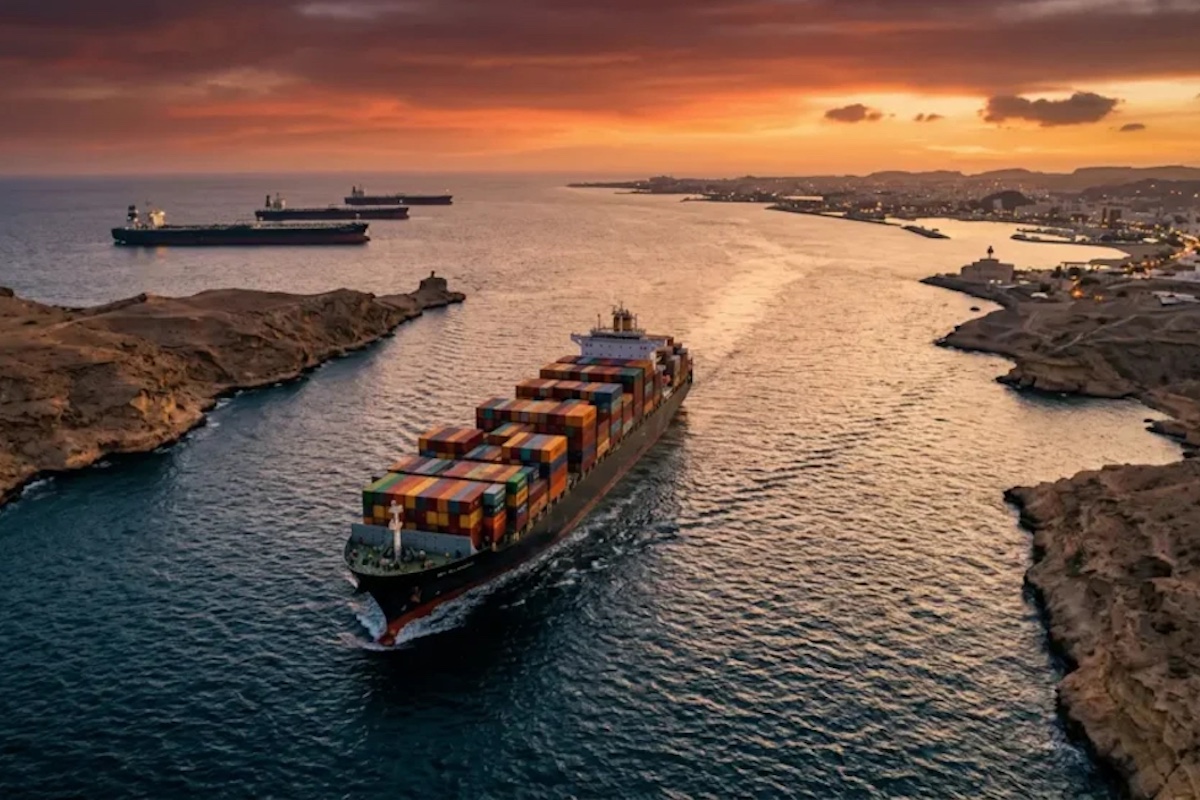
Over the past two decades, China has built a massive economic stake across the Middle East, committing roughly $145 billion to cross-regional investments and infrastructure construction contracts. Alone, Iranian crude oil makes up 13 to 14 percent of China’s total annual oil imports, and in 2024 alone, Arab and Gulf Cooperation Council states received $39 billion in direct Chinese investment. Today, Chinese state and private firms operate deep-water ports, special industrial zones, and critical energy infrastructure from Oman to Iran, embedding regional economies into Beijing’s sprawling global trade networks. One flagship example is the $10 billion China-Oman Industrial Park at Duqm, a project designed to serve as a key hub for Chinese trade and energy access along the Arabian Sea.
Alongside this deep economic integration, Beijing has built its regional influence around a second core pillar: diplomatic mediation. Its most high-profile success came in 2023, when it brokered a historic rapprochement between longtime regional rivals Iran and Saudi Arabia, positioning Beijing as a neutral alternative to Western-aligned powers. This two-pillar strategy has allowed China to expand its regional footprint dramatically without engaging in direct military confrontation or triggering widespread pushback from local states.
Yet this strategy carries a fundamental, structural flaw: Beijing has no permanent military presence in the Middle East. Its only overseas military installation is located thousands of kilometers away in the Horn of Africa nation of Djibouti, leaving the $145 billion in economic assets and critical energy supply lines that China depends on entirely protected by a U.S.-led security architecture that Beijing does not control.
This mismatch was laid bare in stark terms following recent U.S. and Israeli airstrikes on Iran, which triggered a near-total shutdown of the Strait of Hormuz — the strategic chokepoint through which roughly 20 percent of the world’s daily oil and gas supplies transit. Tehran’s blockade cut normal traffic through the strait by more than 90 percent, stranding more than 600 vessels, including hundreds of oil tankers, inside the Persian Gulf. Iran implemented a selective transit regime, granting passage only to ships from what it terms “friendly nations” including China, Russia, and India, while barring vessels linked to Western states. The disruption sent global energy markets into chaos, with some European and Asian refiners paying close to $150 per barrel for scarce crude grades. The head of the International Energy Agency called the blockade more impactful than the combined oil market disruptions of 1973, 1979, and 2022. The crisis has become a core agenda item for upcoming U.S.-Iran peace negotiations set to take place in Pakistan.
For China, the crisis laid bare just how exposed its interests are to regional volatility. While Beijing was granted conditional access for its flagged vessels, that access depended entirely on Iranian goodwill — not on China’s own ability to secure its supply lines. Unlike the United States, which now meets most of its energy needs through domestic production and imports from Canada and Mexico, China is the world’s largest crude importer, with 70 percent of its total oil imports transiting through vulnerable chokepoints like the Strait of Hormuz. As U.S. dependence on Middle Eastern energy continues to decline, Washington’s strategic priorities in the region are increasingly misaligned with Beijing’s growing need for unimpeded energy flows and regional stability, leaving China in a precarious position.
This exposure has forced a long-simmering dilemma into the open for Beijing: should it continue relying on a U.S.-led security system it cannot control, or should it build out its own regional security architecture to protect its expanding interests? The choice is heavily constrained by China’s long-held foreign policy doctrine. A 2019 Chinese government white paper formally outlines Beijing’s commitment to an “independent foreign policy of peace”, which rejects formal military alliances and emphasizes non-interference in other nations’ internal affairs. President Xi Jinping has repeatedly framed China’s rise as a peaceful one, and the country’s Global Security Initiative explicitly criticizes Cold War-era military blocs and great power interventionism.
Beyond doctrinal commitments, a more assertive security role in the Middle East would also undercut the global narrative Beijing has built around its peaceful rise, risking backlash from regional states that have deep historical sensitivity to foreign military intervention and great power competition. Even if Beijing chose to move past these constraints, establishing a sustained permanent military presence in the region would face steep political headwinds, a reality reflected in China’s very limited and cautious track record of establishing overseas bases to date.
These constraints mean Beijing has very limited room to convert its massive economic influence into a corresponding military and security role. As China’s global economic footprint continues to expand and U.S. commitments to Middle East security grow increasingly unpredictable, the costs of this structural mismatch are expected to rise, putting growing pressure on Beijing to reassess its approach.
To date, Beijing has given no public signal of a major strategic shift, but escalating risks to its overseas interests may force incremental adjustments. Analysts broadly expect any adjustment to fall into one of two categories: a modest expansion of Chinese naval patrols, or deeper security partnerships with host regional states.
Since 2008, the People’s Liberation Army Navy has maintained continuous anti-piracy deployments in the Gulf of Aden, completing more than 1,600 escort missions for thousands of commercial vessels from across the globe. Extending these patrols into the Arabian Sea and closer to the Strait of Hormuz would allow China to take a more active role in protecting its own commercial shipping. Even this limited expansion would require additional logistical support and basing access, however, and China’s existing base in Djibouti has already generated repeated diplomatic friction with the United States, underscoring the high political sensitivity of any further expansion of China’s overseas military footprint. What is more, anti-piracy patrols are not designed to protect inland infrastructure or manage interstate conflict, meaning even a modest expansion would leave most of China’s regional exposure unaddressed.
The second option, strengthening host-state security arrangements, aligns more closely with Beijing’s existing doctrine of non-interference. Beijing has already tested this model in Pakistan, where the Pakistani government established a dedicated 15,000-strong security force to protect Chinese personnel and infrastructure linked to the $62 billion China-Pakistan Economic Corridor. This approach allows China to reduce its exposure to threats against its projects at a relatively low political and financial cost, while remaining consistent with its public commitment to non-interference. However, host-state security forces are poorly equipped to counter large-scale interstate conflict or regime instability, leaving critical gaps in protection.
Taken together, these two partial solutions amount to a strategy of risk management, not fundamental resolution of the core dilemma. For the foreseeable future, China is expected to continue expanding its economic presence in the Middle East while only taking incremental steps to boost its security capacity, leaving a growing gap between its economic stakes and its ability to protect them.
History suggests that no rising power has been able to sustain a massive global economic footprint without eventually taking on the security responsibilities that come with it. As Beijing’s regional exposure deepens, many analysts expect it will ultimately be forced to break with its current doctrine to address the growing risk.