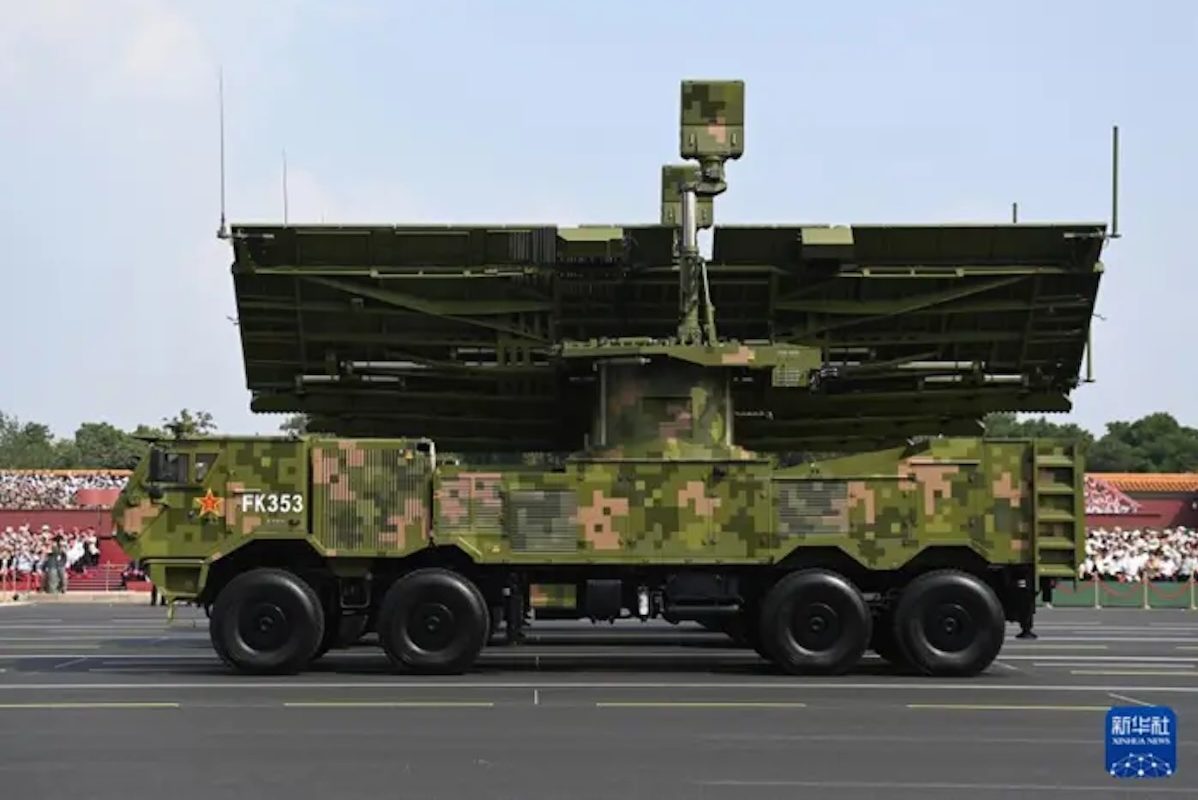
China’s recent unveiling of its advanced Hurricane 3000 high-power microwave (HPM) weapon system marks a significant evolution in electromagnetic warfare capabilities, particularly in the context of escalating drone competition across the Taiwan Strait. Developed by state-owned defense contractor Norinco, this truck-mounted system represents a strategic shift from traditional platform-centric warfare to cost-effective electromagnetic domain control.
The Hurricane 3000, first showcased during Beijing’s September 2025 military parade, demonstrates an impressive operational range exceeding 3 kilometers against small unmanned aerial vehicles (UAVs). According to Norinco expert Yu Jianjun, the system’s capability surpasses comparable American technologies, enabling it to transition from short-range point defense to broader area denial operations. The weapon employs radar detection and electro-optical targeting before emitting concentrated microwave beams that instantly disable drone electronics through both antenna-based and circuit-level electromagnetic coupling.
This technological advancement addresses the critical challenge of drone swarm saturation attacks by offering a low-cost-per-shot solution with minimal collateral damage and virtually unlimited firing capacity. The system can operate independently or integrate with laser and artillery systems within layered defense networks, reflecting China’s comprehensive approach to enhancing air, border, and urban security amid rapidly evolving drone warfare technologies.
Research published in the January 2024 edition of Electronics journal details how HPM systems disrupt UAV operations by overwhelming electronic subsystems through multiple pathways. Even autonomous and fiber-optic drones, designed to avoid traditional jamming techniques, become vulnerable to HPM-induced electronic noise and overheating that compromises their operational capabilities.
Strategic analysts from the Belfer Center (January 2025) and Center for a New American Security (September 2025) note that HPM weapons serve as critical point-defense tools for protecting invasion forces and key installations during potential Taiwan contingencies. These systems function as a ‘final force field’ against drones penetrating outer defensive layers, though their effectiveness depends on integration within broader counter-drone architectures due to range limitations and potential friendly electronic interference.
The development carries particular significance for the US Replicator initiative, a Department of Defense project aiming to deploy thousands of low-cost autonomous systems to deter Chinese aggression toward Taiwan. While drone hardening techniques exist—including shielding, reflective surfaces, and obscurants—these countermeasures increase weight, complexity, and production costs, potentially undermining the economic rationale behind attritable drone swarms.
Military analysts suggest that future drone effectiveness will depend on adapting tactics to exploit HPM limitations through maneuver, dispersion, multi-axis approaches, and environmental exploitation rather than relying solely on numerical superiority. This evolving dynamic shifts the strategic competition toward cost-exchange management and system resilience rather than simple technological superiority.