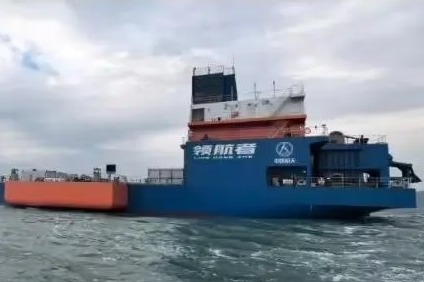
China has achieved a significant milestone in its commercial space ambitions with the recent delivery of its inaugural seaborne rocket recovery platform. This groundbreaking infrastructure, officially named “Linghangzhe” (Pathfinder), represents the nation’s first certified marine-based system designed specifically for retrieving rocket components using advanced net technology.
The platform received formal certification from the China Classification Society, marking its compliance with all necessary class and statutory requirements for maritime rocket recovery operations. This development provides crucial support infrastructure for China’s rapidly expanding reusable launch vehicle programs, potentially revolutionizing how space companies recover and reuse rocket stages.
This achievement follows i-Space’s August launch of their specialized landing vessel “Xingjiguihang” (Stellar Return), featuring an expansive 40-by-60-meter recovery deck engineered to retrieve the first stage of the company’s SQX-3 reusable methane-liquid oxygen rocket. The simultaneous progress across multiple Chinese aerospace entities indicates a coordinated national push toward reusable space technology.
The same period witnessed China’s new-generation manned launch vehicle, the Long March-10, successfully complete its initial static fire test. This vehicle family includes two configurations: the standard Long March-10 and the reusable Long March-10A variant, demonstrating China’s parallel development of both government and commercial space capabilities.
Chinese aerospace companies are accelerating reusable vehicle development through competitive innovation. LandSpace conducted successful ground ignition tests for its Zhuque-3 rocket’s first-stage propulsion system in June, while multiple entities have completed essential vertical takeoff and landing demonstrations—critical validation steps for reusable rocket technology.