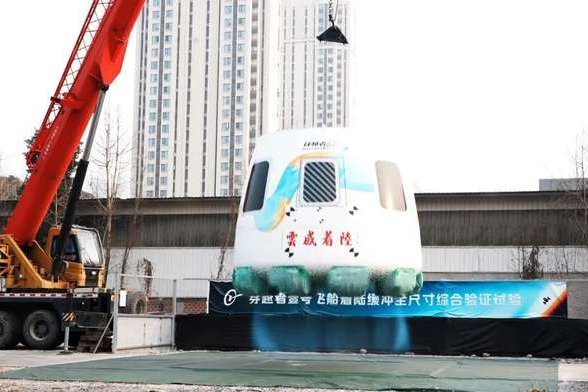
In a significant advancement for China’s commercial space sector, the test module of the CYZ1 crewed spacecraft has successfully completed comprehensive landing-buffering system verification trials. The spacecraft developer InterstellOr announced the breakthrough on Sunday, confirming all performance metrics not only met but exceeded design specifications.
The rigorous testing simulated actual re-entry landing conditions with remarkable precision. Engineers elevated a 5-tonne test capsule to over three meters above ground level before executing an instantaneous release command. This carefully orchestrated free-fall maneuver replicated the steady descent velocity equivalent to a capsule under fully deployed main parachute.
During the critical landing phase, the spacecraft’s buffering system activated seamlessly. The integrated retro-thruster expelled high-pressure gas to generate consistent reverse thrust while coordinating perfectly with the energy-absorbing structure at the capsule’s base. This sophisticated synchronization achieved effective deceleration and impact cushioning within an extremely limited stroke distance.
Post-test examination revealed an impeccably executed buffering sequence with completely intact capsule structure and fully operational onboard equipment. These results demonstrate exceptional system reliability and technical feasibility for human spaceflight applications.
The InterstellOr research team is now conducting exhaustive analysis of the test data to refine system parameters further. This successful verification establishes a robust technical foundation for subsequent development phases of the CYZ1 spacecraft, marking substantial progress toward China’s ambitions in commercial human spaceflight capabilities.