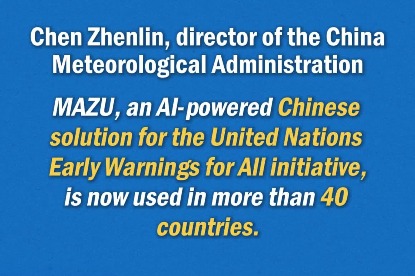
China has emerged as a pivotal contributor to global climate resilience through its artificial intelligence-powered meteorological platform MAZU. The sophisticated early warning system, developed as part of China’s commitment to the United Nations’ Early Warnings for All initiative, has now been deployed across more than 40 countries worldwide.
Chen Zhenlin, Director of the China Meteorological Administration, revealed the system’s expanding global footprint during an exclusive interview with China Daily preceding World Meteorological Day observations. The MAZU platform represents a significant technological advancement in predictive meteorology, leveraging artificial intelligence to enhance disaster preparedness and climate adaptation capabilities.
China’s meteorological contributions have undergone a substantial transformation, evolving from participant status to becoming a primary provider of global public goods in weather governance. The nation currently supplies high-quality meteorological data to 153 countries and regions, establishing itself as a crucial partner in international climate risk management.
The expansion comes amid escalating climate-related risks globally, with extreme weather events increasing in frequency and intensity. MAZU’s AI-driven analytics provide vulnerable nations with enhanced predictive capabilities, enabling earlier evacuations, better resource allocation, and improved disaster response coordination.
This technological initiative forms part of China’s broader commitment to international climate cooperation and sustainable development goals. The system’s deployment across diverse geographical regions demonstrates its adaptability to various climate patterns and disaster profiles, from tropical cyclones to drought prediction.
Meteorological authorities indicate that MAZU’s continued expansion will focus on regions with limited early warning infrastructure, particularly developing nations facing disproportionate climate impacts. The technology transfer represents one of the most comprehensive international collaborations in meteorological science, combining China’s technological innovation with global climate security needs.