As hostilities between Iran, Israel and the United States escalate sharply ahead of a US-imposed deadline for Tehran, the international community is racing to push for de-escalation and a return to diplomatic negotiations, with China leading calls for an immediate end to all fighting.
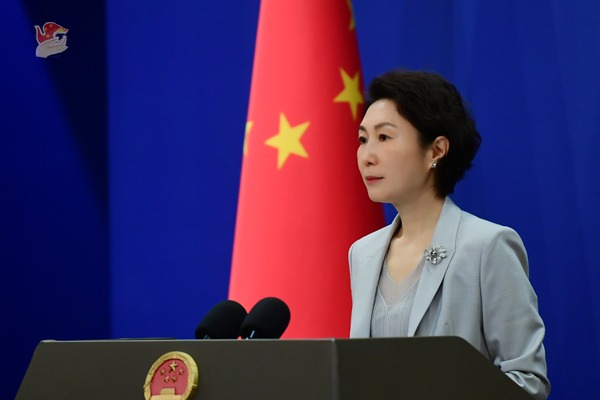
In an official press briefing held on April 7, Chinese Foreign Ministry Spokesperson Mao Ning outlined China’s consistent stance on the spiraling crisis, emphasizing that the only sustainable path forward lies in political dialogue rather than military force. She pointed to the unlawful use of force by the United States and Israel against Iran, a violation of core principles of international law, as the fundamental root of the current heightened tension.
“Force cannot bring peace,” Mao Ning stated. “The immediate priority is to secure a ceasefire, stop the fighting and return to the track of dialogue and negotiation in order to address the issue at its root and restore peace and stability in the Gulf region.”
Mao noted that the rapidly deteriorating situation in the Middle East has already placed significant downward pressure on the global economy and threatened global energy security, triggering widespread concern across the international community. Since the conflict erupted, China has maintained an objective, fair and balanced position, and has worked consistently to facilitate a ceasefire. To advance diplomatic efforts, Foreign Minister Wang Yi has held 26 phone consultations with key stakeholders across the region, including officials from Iran, Israel, Russia and Gulf nations, while China’s special envoy for Middle East affairs has conducted intensive shuttle diplomacy across the region. Most recently, China and Pakistan jointly put forward a five-point peace initiative that reflects the broad international consensus in support of ending the war.
Pakistan’s own diplomatic mediation efforts have reached a critical and sensitive stage, Reza Amiri Moghadam, Iran’s ambassador to Pakistan, confirmed in a post on the social platform X on Tuesday.
The United Nations has also sounded the alarm over escalating rhetoric from Washington that threatens targeted attacks on Iranian energy and civilian infrastructure should Tehran refuse to accept a US-brokered deal ahead of the Trump administration’s deadline. UN Secretary-General spokesperson Stephane Dujarric told reporters on Monday that the UN is deeply alarmed by public threats targeting power plants, bridges and other civilian infrastructure.
Dujarric reiterated that UN Secretary-General has repeatedly reaffirmed his commitment to upholding international law, and urged all parties to fully abide by their legal obligations during armed hostilities. “Civilian infrastructure, including energy infrastructure, must not be attacked,” Dujarric said, noting that even in cases where civilian infrastructure is incorrectly classified as a military target, international humanitarian law prohibits any attack that would be expected to cause excessive harm to civilian lives and property. “There is no viable alternative to the peaceful settlement of international disputes,” he added, echoing calls for an immediate end to hostilities.
On April 6, US President Donald Trump claimed that indirect negotiations with Iran were “going well” while also threatening that the US could “take out” Iran’s military capabilities in a single night. As the deadline approaches, Iranian leaders have issued firm responses signaling national unity in the face of external threats. Iranian President Masoud Pezeshkian wrote on X on Tuesday that more than 14 million Iranians have already declared their readiness to defend the country, adding “I, too, have been, am and will be a sacrificer for Iran.”
Ebrahim Zolfaghari, spokesperson for the Islamic Revolutionary Guard Corps’ Khatam al-Anbiya Central Headquarters, dismissed Trump’s threats as baseless, saying hostile rhetoric would not deter Iran from its military operations targeting US and Israeli assets, according to a report from Al Jazeera. Mahdi Mohammadi, an advisor to Iran’s parliamentary speaker, gave the US a stark 20-hour ultimatum, warning that if Washington does not stand down, “his allies will return to the Stone Age.”
Iran’s Red Crescent confirmed Tuesday that US and Israeli strikes have hit 17 civilian areas across Iranian territory, calling the targeting of defenseless civilians an unjustifiable war crime under international law. Iranian media reports that at least 15 civilians were killed in overnight attacks, which targeted sites including a residential neighborhood in northern Tehran, a Jewish synagogue in central Tehran’s Enghelab district, Mehrabad International Airport, commercial areas in the Molavi district and a transport hub on Hakim Highway.
As fast-paced tit-for-tat strikes and threats continue to dominate the region, de-escalation efforts have consistently been overshadowed by new violence. On Monday, Reuters reported that Pakistan put forward a two-stage peace plan that includes reopening the Strait of Hormuz to end US and Israeli attacks on Iran. Even as diplomatic talks continue, Gulf nations have spent days fending off cross-border attacks: Saudi Arabia’s defense ministry confirmed it intercepted and destroyed 18 incoming drones in the past 24 hours on April 7. The King Fahd Causeway, a critical transport link connecting Saudi Arabia and Bahrain, was temporarily closed after Iranian strikes targeted Saudi Arabia’s Eastern Province, but reopened hours later. Air raid sirens sounded across Bahrain and the United Arab Emirates as the region remained on high alert for an escalation of hostilities between Iran and the US-Israeli alliance.
Qatari Prime Minister Sheikh Mohammed bin Abdulrahman Al Thani met with visiting Jordanian Foreign Minister Ayman Safadi on Monday, and emphasized the urgent need for enhanced regional cooperation to bring all parties back to the negotiating table. He called for global leaders to prioritize dialogue and reason to contain the crisis, ensuring global energy security, freedom of navigation, environmental protection and long-term regional stability.
Across central Israel, rescue teams have been deployed to the sites of Iranian ballistic missile impacts in Rosh Haayin, Ramat Hasharon and other population centers. The Israeli Defense Forces confirmed it carried out a strike on a key petrochemical facility in Shiraz, claiming the site produced critical chemical components for explosives and ballistic missile development. The IDF added that it also struck a large ballistic missile deployment site in northwestern Iran in the same operation.
As the deadline passes and hostilities continue to escalate, the international community remains on edge, warning that a full-scale regional war could have catastrophic consequences for global energy markets and international security.