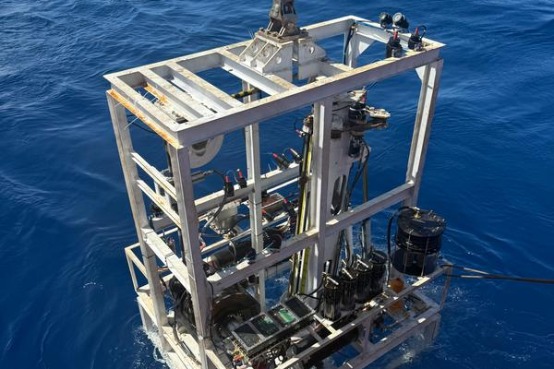
China has achieved a significant technological milestone with the successful deployment of its first domestically developed undersea drilling robot, capable of performing three-dimensional drilling operations and real-time monitoring within seabed formations. The groundbreaking system recently completed its inaugural trial in the South China Sea at an impressive depth of 1,264 meters, demonstrating exceptional performance across all operational parameters.
Developed by the Guangzhou Marine Geological Survey (GMGS) under the China Geological Survey, this advanced robotic system represents a quantum leap in deep-sea exploration technology. According to GMGS officials, the robot possesses unprecedented capabilities for autonomous navigation through complex underwater terrain, intelligently avoiding obstacles including rock formations and biological debris while dynamically calculating optimal operational pathways.
Engineer Zhu Yangtao, deputy leader of the robotic project, emphasized the system’s sophisticated sensor array that enables comprehensive long-term monitoring across multiple parameters deep within seabed strata. During its trial mission, the robotic platform captured over 2,000 distinct data sets measuring critical variables including methane concentration, dissolved oxygen levels, and detailed stratigraphic structures.
This technological advancement addresses longstanding challenges in deep-sea exploration, where extreme conditions—including crushing pressure, low temperatures, high salinity, and geological instability—have traditionally hampered effective resource assessment. Conventional drilling and monitoring technologies have struggled with mobility limitations, inadequate spatial coverage, and insufficient real-time data transmission capabilities.
The newly deployed robot incorporates cutting-edge technologies including modular multi-section design, inertial navigation systems, magnetic beacon-assisted positioning, and artificial intelligence algorithms that significantly enhance both its operational intelligence and environmental adaptability. This technological framework enables low-disturbance, real-time in-situ monitoring that was previously unattainable in deep-sea environments.
The development holds particular significance for accessing valuable deep-sea resources including gas hydrates, rare-earth elements, and polymetallic nodules—resources critical to national energy security and sustainable development. Beyond resource exploration, the robotic system is expected to support China’s comprehensive deep-sea scientific drilling initiatives, contributing to the nation’s broader marine science strategy and maritime development objectives.
Research teams indicate plans for further enhancements to the robot’s operational capabilities to accommodate increasingly complex underwater environments, positioning China at the forefront of deep-sea exploration technology.