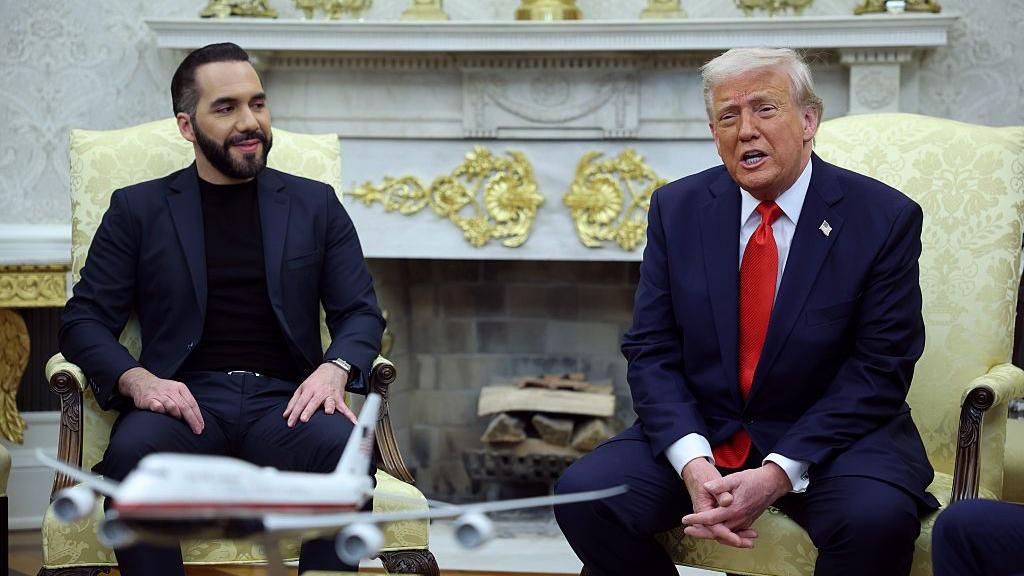
In a strategic move to reassert U.S. influence across the Western Hemisphere, former President Donald Trump is convening a high-profile gathering of Latin American and Caribbean leaders at his golf club this Saturday. Dubbed the ‘Shield of the Americas Summit,’ this event marks a concerted effort to rally regional allies around U.S. national security interests while actively countering China’s expanding economic and political footprint.
The geopolitical landscape has shifted dramatically over the past decade, with China emerging as the region’s predominant trading partner and infrastructure financier. From the massive $3.5 billion Chancay megaport development in Peru to Bogotá’s metro system in Colombia, Beijing has cemented its presence through substantial investments totaling approximately $153 billion between 2014-2023—triple the U.S. contribution during the same period.
Trump’s diplomatic offensive features Kristi Noem as special envoy, despite her recent dismissal as Homeland Security Secretary. She will engage with conservative leaders from eight nations including Argentina, Paraguay, El Salvador, and Ecuador—all sharing ideological alignment with Trump’s administration. Notably absent are regional heavyweights Brazil, Mexico, and Colombia.
According to security analysts, the summit agenda will prioritize combating drug trafficking, managing migration flows, counter-terrorism cooperation, and most significantly, curbing Beijing’s hemispheric influence. Professor Evan Ellis of the U.S. Army War College characterizes the event as essentially ‘a Latin American CPAC,’ referencing the Conservative Political Action Conference that gathers right-leaning U.S. politicians.
The Trump administration has explicitly stated its objectives: to ‘enlist and expand’ U.S. partnerships while limiting Chinese engagement throughout the Americas, including preventing strategic military footholds. This approach has already yielded tangible results, from Venezuela’s political upheaval to Panama’s Supreme Court revoking a Hong Kong company’s canal contracts earlier this year.
However, experts caution that meaningful relationship-building requires more than military posturing and economic pressure. Enrique Dussel Peters, economics professor at Mexico’s National Autonomous University, notes that U.S. policies like ‘America First,’ foreign aid reductions, and tariffs have inadvertently driven regional governments closer to China, which has pursued a decades-long strategic vision for Latin America.
China’s economic penetration extends beyond traditional infrastructure into next-generation technologies including 5G networks, electric vehicles, and artificial intelligence. Twenty nations have joined Beijing’s Belt and Road Initiative, while free trade agreements with Chile, Costa Rica, Ecuador, Nicaragua, and Peru have fueled commercial exchanges that skyrocketed from under 2% of regional exports in 2000 to over $450 billion by 2021.
Despite concerns about debt diplomacy and lower environmental standards, China continues investing strategically in resources like the ‘lithium triangle’ spanning Argentina, Bolivia, and Chile—home to 56% of global lithium reserves. President Xi Jinping recently announced a 9 billion yuan credit line for this mineral-rich corridor.
As regional nations attempt to balance relationships between competing powers, Professor Facundo Robles of Argentina’s National Defense University suggests the optimal outcome would be diversified economic partnerships rather than binary alignment. With Trump scheduled to meet Xi Jinping on March 31st, Latin American countries hope to avoid becoming casualties in a great-power competition that constrains their strategic options.