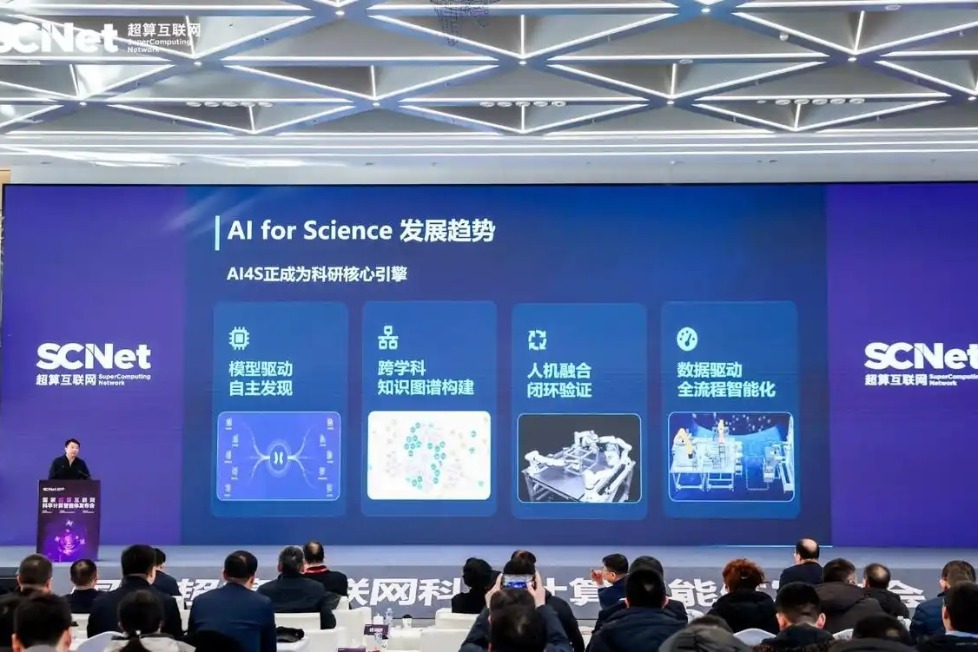
China has achieved a significant breakthrough in computational science with the official launch of an advanced scientific-computing intelligent agent for its national supercomputing network. The unveiling took place in Tianjin on December 24, 2025, marking a transformative development in research methodology.
This sophisticated AI system represents a paradigm shift in scientific computation, capable of interpreting natural language instructions to autonomously execute complex research workflows. The intelligent agent demonstrates remarkable capabilities including task decomposition, computational resource allocation, simulation package invocation, result analysis, and comprehensive report generation.
The technological advancement delivers extraordinary efficiency improvements, compressing research processes that traditionally required full-day computations into approximately one hour. Currently, the system supports nearly 100 high-frequency scientific computing applications across diverse research domains.
Supported by an extensive AI community and repository infrastructure, the platform integrates over 120 specialized knowledge bases spanning seven critical scenarios: artificial intelligence, scientific intelligence, industrial simulation, materials science, and additional research fields. This integration significantly lowers the technical barrier for scientific computing while dramatically accelerating research productivity.
Academician Qian Depei of the Chinese Academy of Sciences emphasized the historical significance of this development, noting that scientific research is undergoing a fundamental transition from computational science to intelligent science. He explained that the emergence of scientific-computing agents represents a convergence of previously fragmented computational resources, toolchains, and knowledge assets, providing researchers with unprecedented accessibility and innovation support.