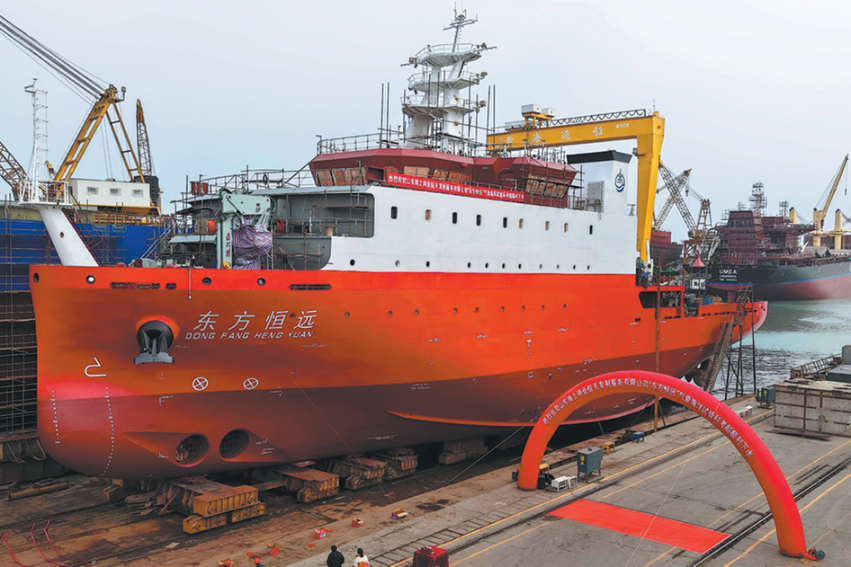
China has inaugurated a new era in its commercial space operations with the commissioning of the Dongfang Hengyuan, the nation’s pioneering marine engineering vessel exclusively designed for full-lifecycle maritime rocket launch missions. The specialized ship represents a strategic advancement in China’s space capabilities, engineered to overcome the unique challenges of open-sea satellite deployments.
Constructed at Huanghai Shipbuilding in Weihai, Shandong province, the 77-meter vessel was launched on March 11 as a stationary mobile command center at sea. Unlike converted research ships previously used for space support, the Dongfang Hengyuan was specifically designed by Harbin Engineering University as a dedicated command and measurement hub.
The vessel’s technical specifications include a width of 17.8 meters, depth of 7.6 meters, and displacement capacity of 3,200 metric tons. It incorporates an all-electric propulsion system enabling a cruising speed of 15 knots, complemented by a dynamic positioning system that maintains station-keeping accuracy for precise launch operations and scientific observations.
According to Chief Engineer Zhang Guochang of the university’s Yantai Research Institute, the ship will serve multiple functions beyond its primary launch command role, operating as both a floating laboratory and educational facility. The vessel is scheduled for June delivery, when it will integrate with the Oriental Spaceport launch vessel and collaborate with the Dongfang Hengjing maritime test platform to enhance China’s comprehensive maritime launch capabilities.
The project originates from a successful May 2024 bid by Harbin Engineering University for a hydrological detection platform initiative focusing on marine meteorological surveys critical for space launch operations. The program encompasses comprehensive studies of meteorological elements including wind patterns, visibility conditions, cloud coverage, and electromagnetic environment characteristics, alongside marine geological and hydrological assessments.
Project leadership confirms that despite technical complexities and demanding timelines, the venture has overcome numerous challenges through coordinated efforts with consortium partners including Shanghai Merchant Ship Design and Research Institute, Hunan Guotian Technology, and Huanghai Shipbuilding. The advancement leverages the university’s decades of research in ship and ocean engineering, incorporating technological innovations such as DP2 dynamic positioning, ultra-short baseline underwater positioning systems, and real-time vibration monitoring technologies.