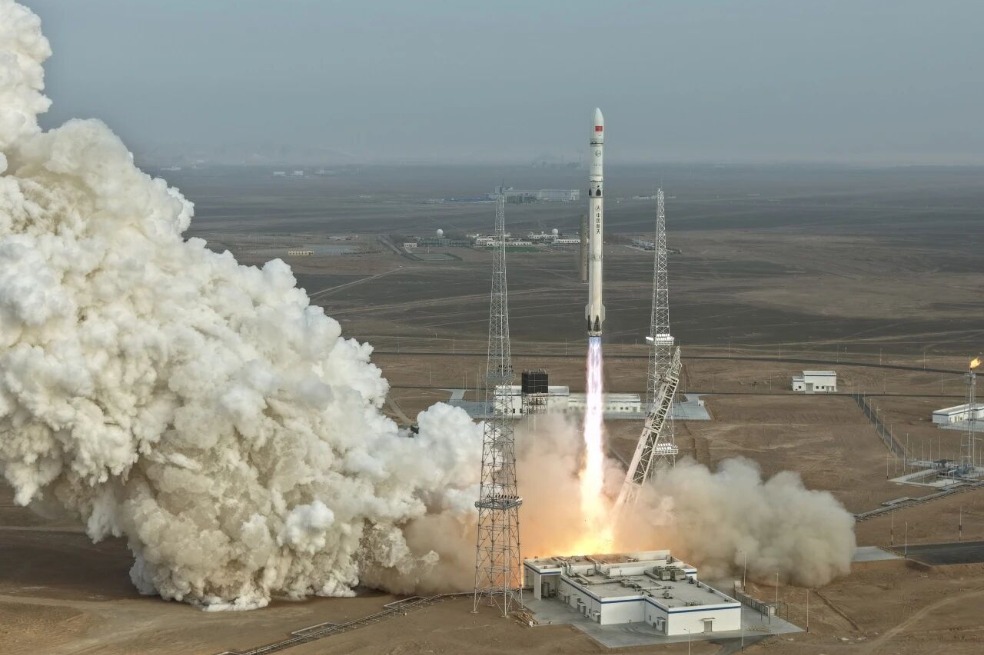
China achieved a significant milestone in its space program with the inaugural flight of the Long March 12A carrier rocket on Tuesday, December 23, 2025. The launch from the Jiuquan Satellite Launch Center in Inner Mongolia marked both a technical achievement and a learning opportunity for reusable rocket technology.
The 70.4-meter rocket, China’s tallest space vehicle to date, lifted off at 10:00 AM from a newly constructed service tower. While the second-stage booster successfully reached its predetermined orbital position, the mission encountered a setback when the first-stage booster failed to land at the designated recovery site in Gansu province.
Engineers from the China National Space Administration have initiated a comprehensive investigation into the recovery failure. Despite this partial setback, the administration emphasized that critical technical data was obtained during the flight, providing valuable insights for future reusable rocket development.
Developed by the Shanghai Academy of Spaceflight Technology, a subsidiary of state-owned China Aerospace Science and Technology Corp, the Long March 12A represents China’s latest advancement in space transportation. The rocket features a 3.8-meter-wide main body and a 4.2-meter-diameter fairing, with a liftoff weight of 437 tons and capacity to deliver at least 6 tons of payload to low-Earth orbit.
This launch occurs within the context of China’s broader strategy to develop reusable rocket technology, which promises to dramatically reduce launch costs while increasing mission frequency and efficiency. The recent attempt follows similar developments in the global space industry, where reusable rockets have become a focal point for major spacefaring nations and commercial entities.
Earlier in December, Chinese commercial space company LandSpace experienced a comparable outcome with its ZQ 3 reusable rocket, which reached orbit but failed to recover its first-stage booster. These developments mirror the early experiences of American companies SpaceX and Blue Origin, both of which endured multiple recovery failures before achieving successful booster landings.
The Long March 12A mission demonstrates China’s growing capabilities in space technology while highlighting the technical challenges inherent in developing reusable launch systems. As the global space industry continues to evolve, such missions contribute valuable data and experience that will shape the future of cost-effective space access.