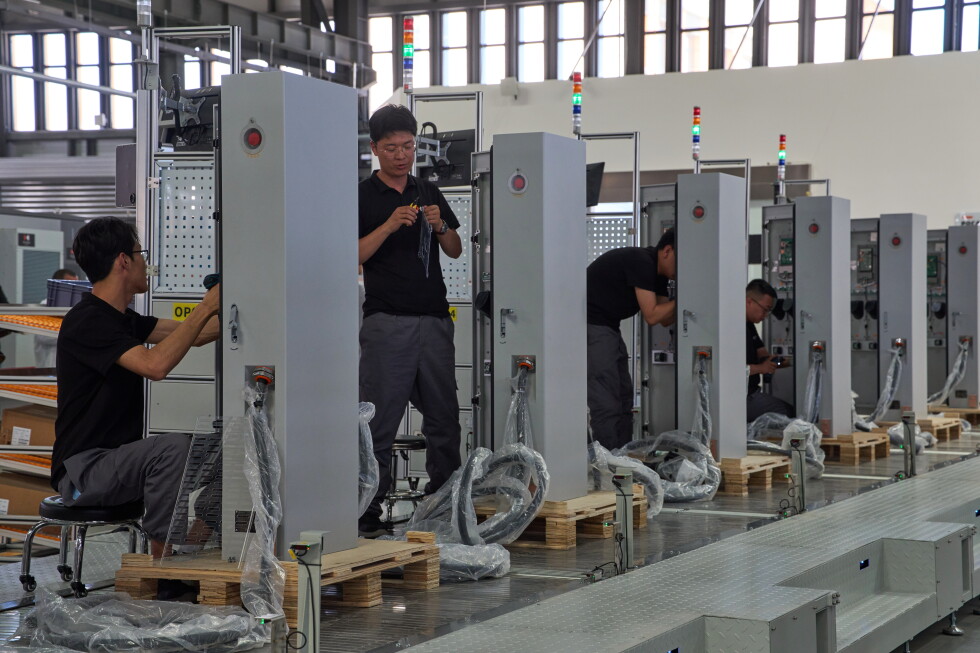
As anticipation builds for the release of a U.S. government investigation into alleged industrial overcapacity that could pave the way for steep new import tariffs, Beijing has issued a formal rebuttal of international claims that it is flooding global markets with excess output from key manufacturing sectors. For years, major trading partners have raised growing alarms about oversized production capacity across a swath of Chinese industries, from electric vehicles and steel to cement and solar panel manufacturing. While Chinese policymakers have long prioritized rebalancing the domestic economy to shift away from over-reliance on exports and heavy industry, slowing domestic consumer and infrastructure demand in recent years has pushed many Chinese firms to ramp up sales to overseas markets. This export surge drove China’s annual trade surplus to an unprecedented $1.2 trillion in 2023, stoking further criticism from trading partners.
In a position paper titled *China’s Position on the So-called Excess Capacity Issue* released Tuesday, China’s Ministry of Commerce rejected accusations that Beijing intentionally pursues oversized industrial capacity and large trade surpluses. The paper specifically pushed back against growing international discourse around a purported “China Shock 2.0,” a narrative that frames China’s current industrial expansion as a new disruptive threat to manufacturing sectors in Western economies, echoing the upheaval many advanced markets experienced when China rose to become the world’s top manufacturing exporter in the 2000s. The ministry argued that this claim is entirely unsupported by empirical evidence and factually baseless, noting that Western accusations incorrectly frame China’s industrial progress as a threat to established Western industrial monopolies.
China’s official position aligns with comments made last month by Premier Li Qiang, China’s second-highest ranking official, during the World Economic Forum’s Summer Davos gathering in Dalian. Li pushed back on the “China Shock 2.0” framing, arguing that global markets should instead interpret China’s current industrial and trade trends as a “China Opportunity 2.0” that drives global economic growth.
The U.S. investigation, which examines manufacturing production and capacity across 16 major economies including China, is widely projected to conclude that excess capacity justifies new punitive tariffs on targeted imports. This potential tariff move follows just weeks after the U.S. imposed additional 10% to 12.5% tariffs on imports from more than 60 economies including China, citing a failure to enforce bans on goods produced with forced labor — a measure that drew widespread protest from affected nations including China.
Speaking at a Beijing press conference Tuesday, Lin Weilong, director of the Commerce Ministry’s policy research office, emphasized that the U.S. has no legitimate authority to unilaterally declare that trading partners have excess capacity and impose punitive trade restrictions. Lin argued that it is unfair for the U.S. to narrowly label any production that exceeds a country’s domestic demand as problematic “overcapacity” and slap punitive trade measures on that basis.
Tensions over overcapacity have already spread to other major trading blocs: earlier this month, the European Union, which has prioritized rebalancing its lopsided trade relationship with China, implemented new trade measures including enhanced protective tariffs for its domestic steel industry and new restrictions on low-value e-commerce parcels imported from China.
Many industry analysts expect Beijing’s formal pushback to do little to change the trajectory of trade policy in Western capitals. Alfredo Montufar-Helu, a China-focused expert at global business consultancy Ankura, noted that weak economic growth and political pressures in Western markets make inaction on rising Chinese imports politically impossible, particularly for high-value added manufacturing sectors that have long been dominated by Western firms. “Current economic conditions in Western markets have made it politically untenable to do nothing in the face of rising Chinese imports, especially in high value added sectors that Western firms used to dominate,” Montufar-Helu said.