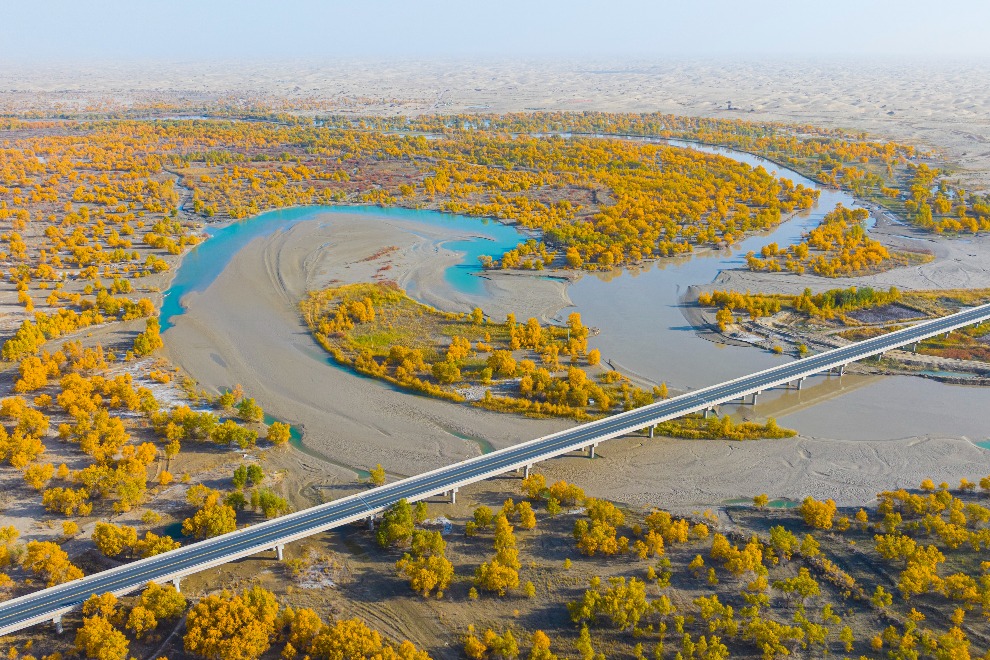
China’s monumental ecological achievement surrounding the Taklimakan Desert—the nation’s largest desert—has reached a significant milestone after its first year of operation. The 3,046-kilometer green barrier, recognized globally as an engineering marvel, has successfully contained desert expansion while creating new economic opportunities for local communities.
The ambitious project, which encircles the desert like a protective scarf, was recently honored among the ‘2025 Top 10 Global Engineering Achievements’ by the World Federation of Engineering Organizations. Over the past year, 21 counties and cities along the desert’s edge have expanded the barrier by approximately 593,400 hectares, increasing its width to 7,500 meters while simultaneously improving critical infrastructure including water supply systems, electricity networks, and transportation routes.
Local residents have emerged as key participants in this ecological transformation. Couples like Tursunbaq Mahmuthet and Sudiumay Tursun from Hotan county have returned to their hometowns to lead restoration initiatives. ‘When we were young, this entire area was nothing but desert,’ they recalled while examining thriving sand date tree saplings. ‘We never imagined we’d be able to cultivate these trees here.’ Their cooperative, comprising 18 households, now cultivates sand dates on 1,000 mu of reclaimed desert land.
The project employs cutting-edge technologies including photovoltaic systems that harness solar power to extract brackish groundwater for drip irrigation. Innovative techniques such as grass checkerboard stabilization and drought-resistant vegetation have effectively controlled mobile sand dunes. In Yutian county, frequently battered by gales, the ‘terraced desert’ model has reduced land leveling costs by 82 percent while achieving 85 percent vegetation survival rates.
The Tarim Desert Highway, China’s first desert road, features a 436-kilometer shelterbelt with over 20 million drought-tolerant plants. Smart pipeline systems along this route are undergoing upgrades, offering a pioneering ‘Tarim solution’ for desertification control.
This ecological effort has catalyzed a remarkable economic transformation. Desertification control has evolved into a sustainable economic model, spawning industries including rose farming, cistanche cultivation, and eco-tourism. In Yutian, expansive rose fields supply high-value ingredients for cosmetics and pharmaceuticals while producing 80 percent of China’s cistanche output, generating employment for over 10,000 residents.
Enterprises like Xinjiang Silu Guobao Agriculture Co. have invested in desert areas, cultivating roses and pistachios on reclaimed land. Public-private partnerships allow land rentals to benefit villagers, fostering shared wealth. Across the region, sand-based industries now cover 10.8 million mu of desert land, generating approximately $4.1 billion in annual output value and engaging over 360 processing enterprises.
Tourism has emerged as a key growth sector, with attractions such as the Shaya Poplar Forest and Yuli Lop Nur village attracting over 15 million visitors annually. By 2025, the sand industry’s expansion had increased average annual incomes of 300,000 farmers and herders by 3,000 to 4,500 yuan.
International experts have praised the project’s comprehensive approach. Peter Gilruth, senior advisor at World Agroforestry, emphasized that ‘this represents a profound long-term commitment, blending financial investment, political will, and multi-stakeholder collaboration.’ Mohamed Elfleet, consultant researcher at King Abdulaziz University, noted the model’s transferability: ‘We need to consider local conditions. Transfer this model, apply it, but adopt it to the local conditions.’
The project marks a paradigm shift from traditional ‘desert advancing, people retreating’ scenarios to a new era of ‘green advancing, desert retreating,’ offering scalable models for arid regions worldwide while demonstrating how ecological restoration can fuel economic prosperity.