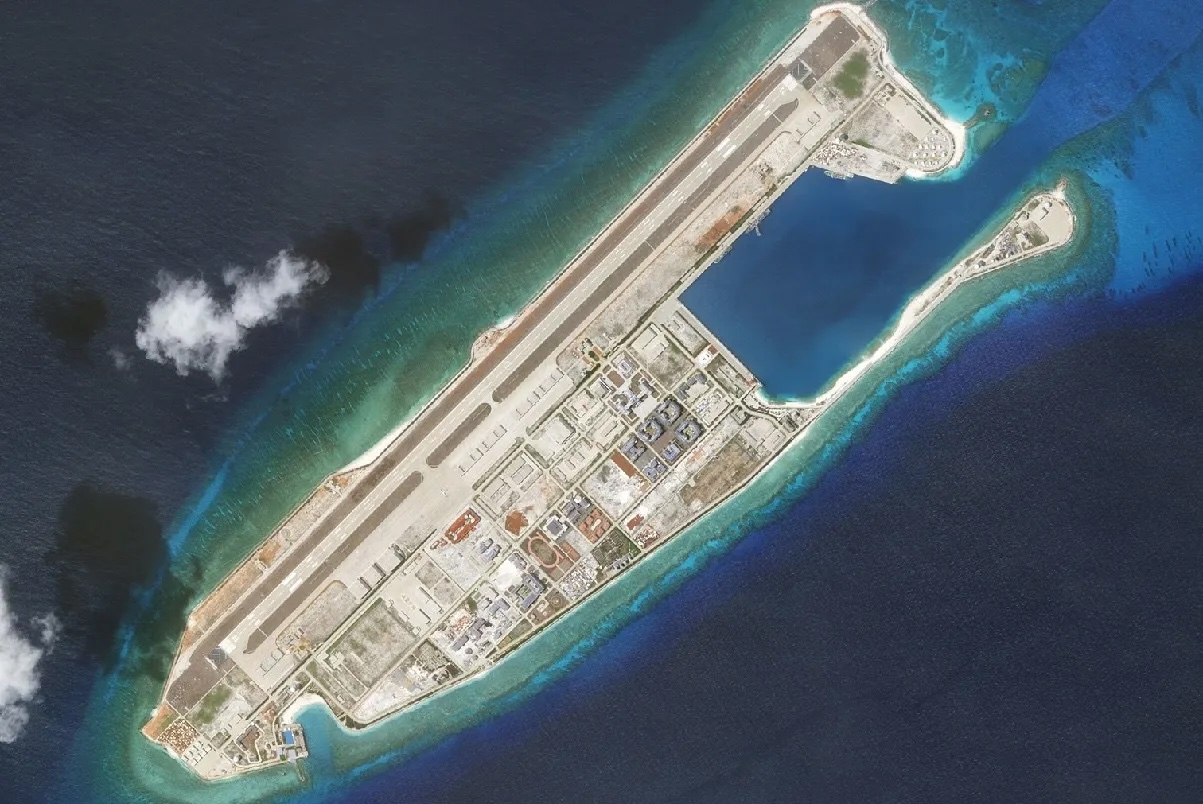
China has significantly enhanced its electronic warfare capabilities across the Spratly Islands, transforming the South China Sea into a strategically contested electromagnetic battlespace according to recent analyses. Between 2023 and 2025, Beijing has quietly deployed advanced surveillance and jamming infrastructure on its artificial island bases, fundamentally altering the regional security balance.
Satellite imagery analysis by the Asia Maritime Transparency Initiative reveals sophisticated antenna arrays and mobile electronic warfare vehicles positioned on Fiery Cross, Mischief, and Subi reefs. The installations include at least six purpose-built sites with monopole antennas oriented seaward, complemented by vehicle-mounted jamming systems targeting specific electromagnetic frequencies. Infrastructure developments include specialized shelters at Subi Reef and a circular concrete platform at Mischief Reef designed for rapid antenna deployment.
The technological upgrades extend to two new radomes at Subi Reef, creating overlapping intelligence, surveillance, and reconnaissance (ISR) coverage patterns matching previous installations on other reefs. These developments are complemented by fortified coastal emplacements capable of hosting artillery or mobile weapons systems.
A November 2025 US-China Economic and Security Review Commission report highlights how these capabilities directly threaten the networked systems that form the core of US military operations. The People’s Liberation Army has developed sophisticated capacity to disrupt, degrade, or paralyze US reconnaissance, communications, and targeting systems—potentially impairing access to satellites and networked sensors during both peacetime and conflict scenarios.
Technical assessments indicate China could utilize these outposts as regional electronic warfare hubs, enabling communications jamming, radar disruption, and geolocation of foreign forces. Mobile jammers, high-frequency direction-finding arrays, and satellite communication interception sites provide triangulation capabilities and sensor overwhelming capacity.
Operational concepts reportedly focus on crippling US Navy carrier strike groups by targeting critical sensors and data-sharing systems. Priority targets include the AN/SPY-1 phased-array radar on Aegis ships, vulnerable to jamming and drone-generated false returns. China also aims to disrupt the E-2C Hawkeye’s coordination role and exploit signal transponders to compromise the Cooperative Engagement Capability network.
Recent incidents suggest these capabilities may already be operational. The October 2025 loss of a US Navy MH-60R Sea Hawk helicopter and F/A-18 Super Hornet fighter from the USS Nimitz within 30 minutes of each other potentially resulted from electronic warfare interference with aircraft systems, though official investigations remain inconclusive.
Strategically, these developments support China’s efforts to establish a submarine bastion in the South China Sea, creating a protective reconnaissance and defensive network for its nuclear ballistic missile submarines. This system enables submarine maneuverability while evading foreign tracking and maintaining nuclear deterrence patrols.
In contrast, US Lieutenant General John Caine acknowledged in April 2025 congressional testimony that US joint forces remain inadequately protected against advanced electronic warfare capabilities, noting America has ‘lost some muscle memory’ after decades operating in permissive electromagnetic environments.