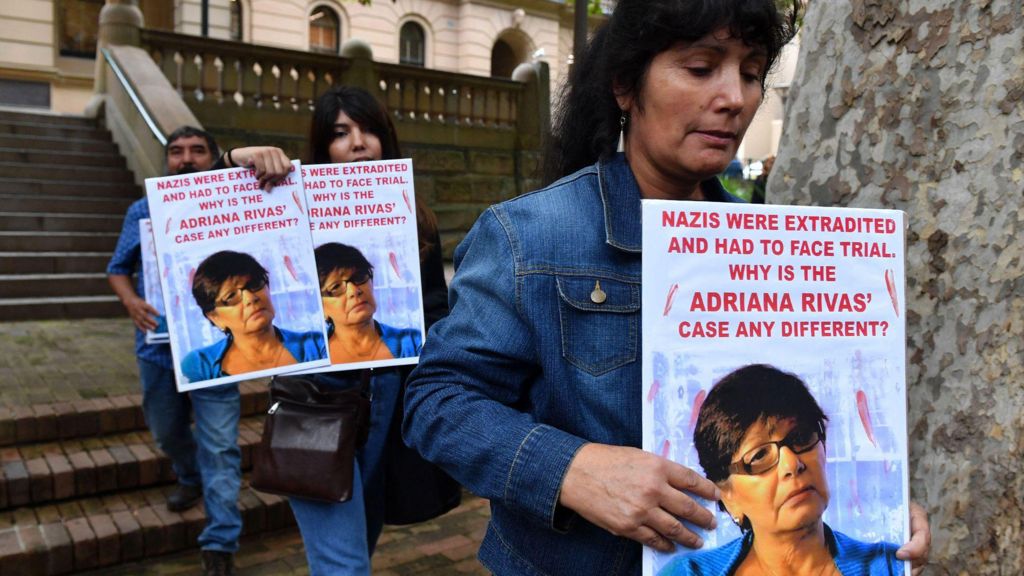
After 12 years of drawn-out legal challenges, a 72-year-old Chilean woman accused of grave human rights abuses under former dictator Augusto Pinochet has failed to block her extradition from Australia, clearing the way for her to face trial for crimes committed nearly half a century ago.
Adriana Rivas, who has lived in Australia’s Sydney suburb of Bondi since 1978 where she worked as a domestic cleaner and nanny, has long denied involvement in the enforced disappearance and torture of seven left-wing dissidents during Pinochet’s 1973 to 1990 military rule. Before resettling in Australia, Rivas served as the personal secretary to Manuel Contreras, the head of Pinochet’s notoriously brutal secret police force, the National Intelligence Directorate, widely known by its Spanish acronym DINA.
Human rights campaigners and relatives of the regime’s victims have spent decades pushing for Rivas to face justice. DINA was created immediately after Pinochet seized power in a 1973 military coup specifically to hunt down and eliminate political opponents of the new dictatorship. Over its years of operation, the agency carried out thousands of abductions, extrajudicial killings, enforced disappearances, and systematic acts of torture, before being replaced by another equally violent military intelligence unit, the CNI.
Chilean authorities first took Rivas into custody when she returned to her home country for a visit in 2006, but she was released on bail and returned to Australia before proceedings could advance. The Chilean government formally filed an extradition request with Australian officials in 2014, alleging that Rivas was an active DINA operative who directly participated in the 1976 abduction of Víctor Díaz, secretary-general of the Chilean Communist Party, and six other party members. Among the seven missing victims was 29-year-old Reinalda del Carmen Pereira Plaza, who was pregnant at the time of her abduction. All seven are widely presumed to have been killed while in DINA custody, and Chilean extradition documents accuse Rivas of serving as a guard and taking on operational roles during the detainees’ capture. Multiple witnesses interviewed for a documentary have labeled Rivas one of DINA’s most brutal torturers and a key member of the Lautaro Brigade, an elite hit squad tasked with eliminating the leadership of Chile’s underground communist movement. The documentary was directed by Rivas’ own niece, Lissette Orozco, who spent five years investigating her aunt’s past, and the film premiered at the 2017 Berlin International Film Festival.
Rivas has consistently rejected all accusations of wrongdoing. In a 2013 interview with Australian public broadcaster SBS, she described her time working for DINA as “the best of my life,” and when asked about the widespread torture carried out by the agency, she claimed that “they had to break the people – it has happened all over the world, not only in Chile.”
On Monday, an Australian federal judge rejected all arguments from Rivas’ legal team that the extradition request was legally invalid, bringing an end to the latest phase of her legal fight. According to local Australian media reports, Rivas still has the option to launch an appeal against the ruling before the full Federal Court, though it remains unclear whether she will be able to meet the legal requirements to proceed with an appeal.
If Rivas does not launch a successful appeal, she will be deported back to Chile to stand trial on charges of aggravated kidnapping. Lawyers representing the families of the seven victims said relatives were overcome with joy by Monday’s ruling. The case comes amid a decades-long global push to hold surviving perpetrators of Pinochet-era human rights abuses accountable. Under Pinochet’s rule, official records confirm more than 40,000 people were subjected to political persecution, and close to 3,000 people were killed or forcibly disappeared.