分类: technology

  • UAE: Sheikh Mohamed meets Elon Musk, discusses latest AI developments

    UAE: Sheikh Mohamed meets Elon Musk, discusses latest AI developments

    In a significant high-level meeting in Abu Dhabi, UAE President Sheikh Mohamed bin Zayed Al Nahyan hosted tech visionary Elon Musk, CEO of Tesla and owner of X, to explore collaborative opportunities in artificial intelligence and advanced technologies. The December 21, 2025, gathering brought together top UAE leadership including Abu Dhabi Crown Prince Sheikh Khaled bin Mohamed bin Zayed Al Nahyan and Dubai Crown Prince Sheikh Hamdan bin Mohammed bin Rashid Al Maktoum.

    The discussions centered on harnessing cutting-edge technological innovations to enhance global quality of life and accelerate worldwide progress. Both parties emphasized the critical importance of international partnerships in the rapidly evolving AI landscape, highlighting how cross-border collaboration and knowledge exchange can accelerate the implementation of transformative digital solutions.

    The leadership meeting underscored how such strategic alliances enable nations and specialized institutions to drive comprehensive digital transformation while effectively preparing for future challenges. The presence of multiple senior ministers and officials demonstrated the UAE’s commitment to positioning itself at the forefront of technological innovation through partnerships with global industry leaders.

    This engagement represents the latest in a series of moves by the UAE to establish itself as a hub for technological advancement and artificial intelligence development, leveraging international expertise while contributing to the global technology ecosystem.

  • Dubai: Sheikh Hamdan takes Elon Musk for a drive in the city

    Dubai: Sheikh Hamdan takes Elon Musk for a drive in the city

    In a significant meeting of global visionaries, Dubai Crown Prince Sheikh Hamdan bin Mohammed bin Rashid Al Maktoum hosted tech magnate Elon Musk for an extensive discussion on technological innovation and future development strategies. The high-profile encounter, which took place in the royal majlis at Nad Al Sheba, featured candid moments including a personal drive through the city, with Sheikh Hamdan behind the wheel and Musk as passenger.

    The Crown Prince documented the meeting through social media channels, expressing particular enthusiasm about their wide-ranging dialogue concerning space exploration, technological advancement, and humanity’s future trajectory. “I thoroughly enjoyed our comprehensive discussion on space, technology, and humanity,” Sheikh Hamdan stated. “We are genuinely excited to witness what the future holds through such collaborative efforts.”

    Through his official X account, Sheikh Hamdan emphasized the strategic importance of international partnerships, noting: “We take pride in the collaborations that unite the UAE with global economic leaders and change-makers. This reflects our fundamental belief that cooperation serves as the genuine catalyst for progress, and that the coming era demands integrated partnerships between government and private sectors.”

    The meeting notably focused on the groundbreaking Dubai Loop project, which Musk initially unveiled during the World Governments Summit earlier this year. This revolutionary transportation system, scheduled for operational launch in 2026, will feature a 17-kilometer network with 11 stations capable of transporting 20,000 passengers hourly. Utilizing electric vehicles reaching speeds of 160 km/h, the system represents a transformative approach to urban mobility.

    Sheikh Hamdan characterized the project as one that will “revolutionize transportation” throughout the emirate, establishing Dubai as a global capital for digital economy through sustainable future systems. “In Dubai, we are working to consolidate the emirate’s position as a global capital for the digital economy through a sustainable future system that places people at the heart of development,” he affirmed.

    The Dubai Loop constitutes a crucial component of the city’s long-term infrastructure expansion plan, aiming to provide rapid, efficient transportation without intermediate stops while promoting sustainable, electric-powered mobility solutions. This development aligns with Dubai’s broader ambition to redefine transportation paradigms both above and below ground, setting international benchmarks for innovation and urban planning.

  • UAE residents can watch, vote for the best AI-generated film; top 12 revealed

    UAE residents can watch, vote for the best AI-generated film; top 12 revealed

    Dubai has become the epicenter of cinematic innovation with the revelation of twelve finalists for the world’s most valuable AI-generated film award, boasting a monumental $1 million prize. Organized by the 1 Billion Followers Summit in collaboration with Google Gemini, this groundbreaking competition has drawn global attention to the rapidly evolving landscape of artificial intelligence in filmmaking.

    The shortlisted films, selected from an astonishing 3,500 submissions across 100 countries, represent two distinct thematic categories: “Rewrite Tomorrow,” exploring futuristic narratives, and “The Secret Life of Everything,” revealing untold stories of existing characters. The selection process involved rigorous evaluation by a 40-member expert jury and advanced technical review using Google Gemini’s AI systems, ensuring each entry met stringent criteria including minimum 70% usage of Google’s generative AI tools.

    Notable finalists include Egyptian filmmaker Mohamed Gomaa Rizk’s ‘Heal,’ set in 2030 where emotional AI helps a traumatized woman access her comatose mother’s memories, and South Korean director Lee Su Yeol’s ‘Cats Like Warmth,’ about a data-driven robot discovering emotional connection. Palestinian filmmaker Omar Rammal’s ‘Dreams Don’t Die’ presents a poignant narrative of children escaping war through magical storybooks, while German director Daniel Titz’s ‘Roots of Tomorrow’ addresses microplastic pollution through interplanetary exploration.

    The public voting window opens December 21-25 through the summit’s official website, allowing global audiences to participate in determining the future of AI-generated cinema. The top five films will screen on January 10, 2026, during the fourth edition of the 1 Billion Followers Summit at Emirates Towers, Dubai International Financial Centre, and Museum of the Future, with the ultimate winner announced on January 11.

    This initiative, hosted by the UAE Government Media Office under the theme ‘Content for Good,’ represents a significant milestone in legitimizing AI-generated content as a formidable force in the creative economy, potentially reshaping how stories are told and consumed worldwide.

  • Abu Dhabi builds AI network to support farmers across climate-hit regions

    Abu Dhabi builds AI network to support farmers across climate-hit regions

    Abu Dhabi has launched a comprehensive artificial intelligence initiative to transform agricultural practices across climate-affected regions worldwide. This ambitious project addresses the paradoxical global food crisis: while sufficient food exists to feed the entire global population, approximately 720 million people faced hunger in 2024 according to recent data.

    The UAE’s approach centers on developing an integrated AI ecosystem through collaboration between Mohamed bin Zayed University of Artificial Intelligence (MBZUAI), NYU Abu Dhabi, ai71, and the CGIAR AI Hub. These institutions collectively span research, product development, and field deployment capabilities. The network has already reached 38 million farmers with AI-powered advisory services and aims to triple that number to 100 million by 2030.

    Fatima Al Mulla, senior specialist at the UAE Presidential Court, explained the nation’s unique perspective: ‘The UAE understands food security challenges intimately. We face harsh weather conditions, water scarcity, and high soil salinity. This lived experience naturally positioned us to develop technological solutions for global agricultural challenges.’

    The initiative employs multiple interconnected strategies. MBZUAI’s Institute for Agriculture and Artificial Intelligence serves as a digital advisory hub providing tools and training to governments and NGOs supporting 43 million smallholder farmers. The CGIAR AI Hub leverages 50 years of agricultural data from 13 global research centers, while AgriLLM—an open-source AI model developed by ai71—was trained on 150,000 agricultural documents to deliver crop-specific guidance.

    Crucially, the program utilizes SMS-based delivery to overcome connectivity barriers in rural areas. ‘Many farmers have basic phones,’ Al Mulla noted. ‘The SMS delivery method ensures critical information about weather patterns and planting schedules reaches those who need it most.’

    The UAE-Gates Foundation partnership, through its AIM for Scale program, has mobilized $1 billion to expand weather forecasting services across climate-vulnerable regions. India successfully delivered AI-powered monsoon forecasts via SMS to 38 million farmers in 2025, demonstrating the model’s viability.

    Beyond technology deployment, the initiative emphasizes capacity building. MBZUAI and the University of Chicago launched an AI Weather Forecasting Training Program in Abu Dhabi, currently training officials from Bangladesh, Chile, Ethiopia, Kenya, and Nigeria, with plans to expand to 25 countries by 2027.

    Al Mulla highlighted the urgent need for these interventions: ‘One-third of greenhouse gas emissions comes from our food systems, while one-third of all produced food gets wasted. Yet over 700 million people go hungry. This indicates an efficiency problem, not a quantity problem.’

    The ultimate goal is to establish Abu Dhabi as a global hub where technology and AI converge to provide practical solutions for farmers worldwide, transforming agricultural decision-making on an unprecedented scale.

  • Long March 5 rocket deploys tech demo satellite into space

    Long March 5 rocket deploys tech demo satellite into space

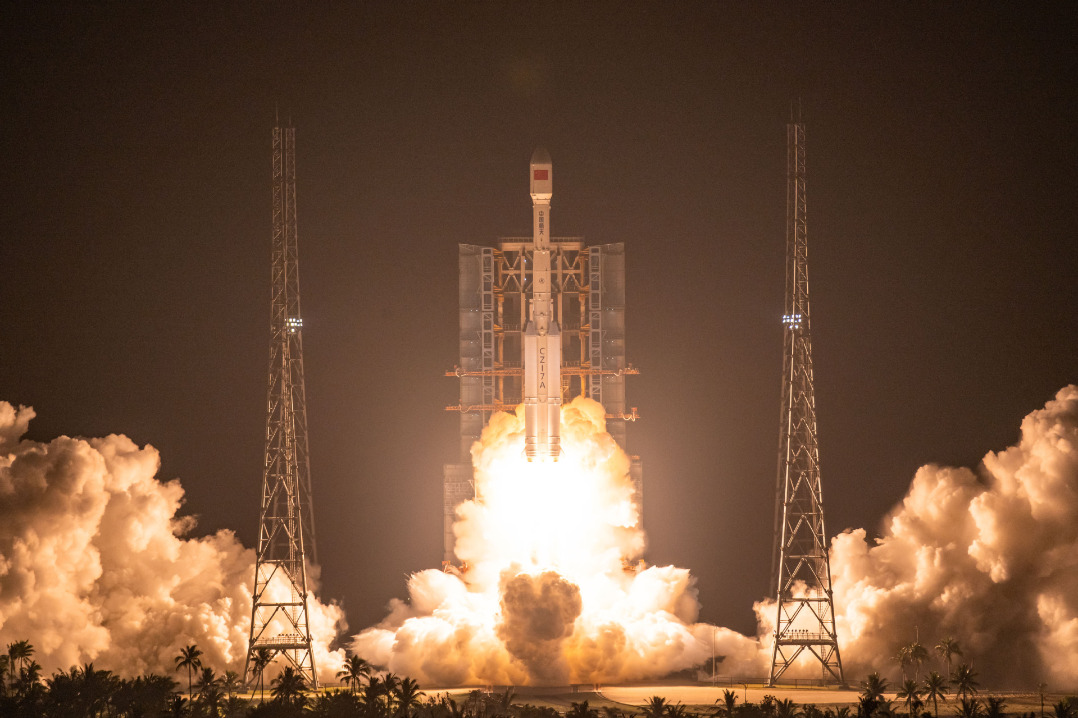
    China Aerospace Science and Technology Corporation (CASC) has successfully launched a modified Long March 5 heavy-lift carrier rocket from the Wenchang Space Launch Center in Hainan province. The Saturday evening launch at 8:30 pm local time deployed the Communications Technology Demonstrator 23 satellite into its designated orbit, marking another milestone in China’s ambitious space program.

    The mission featured a specially configured Long March 5 rocket with an extended fairing measuring 18.5 meters tall—significantly larger than the standard 12.3-meter fairing typically used. This modification resulted in an overall rocket height of 63.2 meters, establishing it as China’s tallest rocket configuration to date. The extended fairing design provides enhanced payload capacity for larger satellites and experimental equipment.

    Developed by the China Academy of Space Technology, a CASC subsidiary, the Communications Technology Demonstrator 23 satellite is designed to validate advanced multi-band high-speed satellite communications technologies. This demonstration mission represents significant progress in China’s satellite communications capabilities, potentially enabling faster data transmission and more robust space-based networking systems.

    This launch constitutes the 88th space mission conducted by China and the 618th flight of the Long March rocket series. Specifically, it represents the 17th mission for the Long March 5 family, which ranks among the world’s most powerful operational launch vehicles. The successful deployment demonstrates China’s growing expertise in heavy-lift launch capabilities and advanced satellite technology development.

  • China launches new communication technology test satellite

    China launches new communication technology test satellite

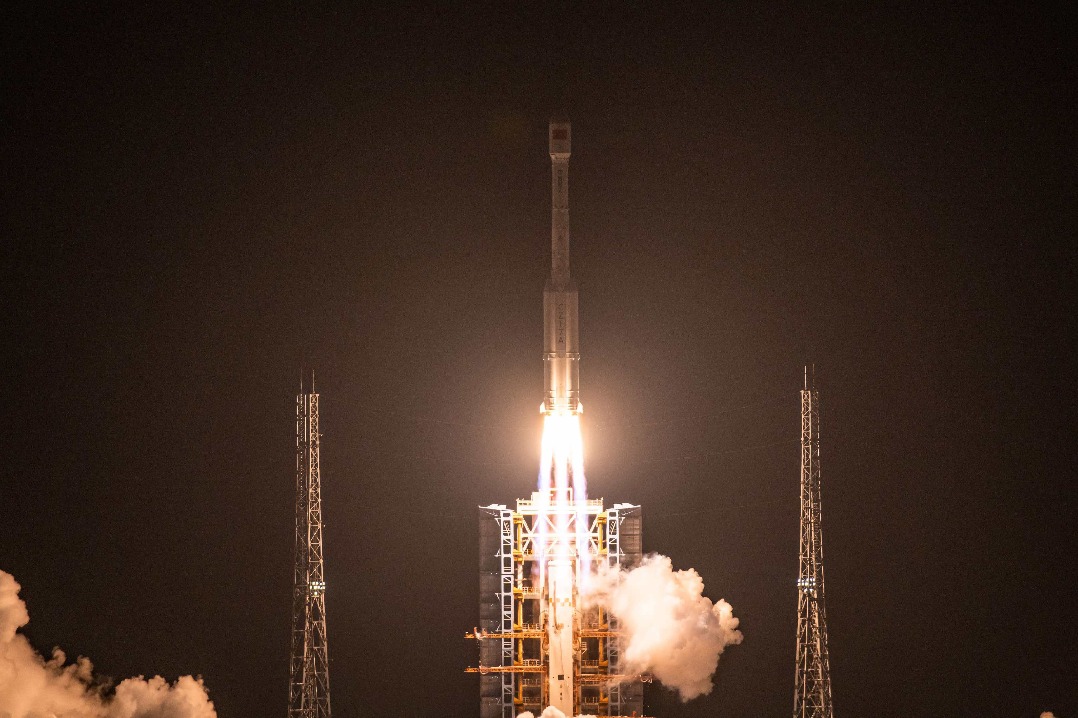
    China has successfully deployed an advanced communication technology test satellite from the Wenchang Space Launch Center in Hainan province. The launch occurred at 8:30 PM Beijing Time on Saturday, utilizing a Long March-5 carrier rocket to transport the satellite into its predetermined orbit.

    This newly deployed satellite represents a significant step forward in China’s space communication infrastructure development. The primary mission objective involves conducting comprehensive validation tests for multi-band, high-speed communication technologies that could potentially enhance future space-based communication systems.

    This launch constitutes the 618th mission in the Long March rocket program’s extensive history, demonstrating China’s continuing commitment to expanding its space capabilities. The successful deployment underscores the technical proficiency of China’s aerospace industry and represents another milestone in the nation’s ambitious space exploration agenda.

    The Wenchang Space Launch Site, strategically located on Hainan Island, has become increasingly important for China’s space missions due to its favorable equatorial position, which provides additional launch capacity for heavy payload missions requiring precise orbital insertion.

  • AI for farmers: UAE builds free tool trained to answer crop specific issues

    AI for farmers: UAE builds free tool trained to answer crop specific issues

    The United Arab Emirates has unveiled a groundbreaking artificial intelligence system specifically engineered to address agricultural challenges worldwide. Developed by ai71 in collaboration with 15 global organizations including CGIAR and the Gates Foundation, the AgriLLM platform represents a significant advancement in agricultural technology.

    Unlike commercial AI tools such as ChatGPT, AgriLLM operates on an open-access model, allowing free usage, modification, and development by users globally. This initiative addresses a critical gap identified by the UN’s Food and Agriculture Organization, which reports that 75% of family farmers worldwide lack reliable agricultural support systems.

    According to Mehdi Ghissassi, Chief Product and Technology Officer at ai71, the system distinguishes itself through specialized training on high-quality agricultural datasets. “While general models like ChatGPT are trained on broad, multi-domain data, AgriLLM is trained on meticulously curated agricultural information from our global partners,” Ghissassi explained.

    The system’s effectiveness is demonstrated through rigorous testing, with internal evaluations showing AgriLLM delivers factually correct responses approximately 30% more frequently than GPT-4o when addressing agricultural queries. The model prioritizes accuracy over response length, providing concise, evidence-based guidance rather than potentially misleading comprehensive answers.

    AgriLLM’s training incorporates an extensive knowledge base including over 350,000 agricultural documents, 50,000 research papers, and 120,000 validated farming questions and answers. This specialized training enables the system to address crop-specific issues, regional growing conditions, and climate-related challenges that typically challenge general-purpose AI systems.

    The platform’s functionality adapts to user specificity, with broad queries generating general advice while follow-up questions regarding soil type, location, or climate conditions trigger increasingly targeted responses drawn from its verified agricultural knowledge base.

  • Tally launches TallyPrime 7.0 to support the UAE’s SME-led digital transformation vision

    Tally launches TallyPrime 7.0 to support the UAE’s SME-led digital transformation vision

    Tally Solutions has unveiled TallyPrime 7.0 in the United Arab Emirates, introducing significant technological enhancements specifically designed to accelerate digital adoption among small and medium enterprises. This release arrives at a critical juncture as UAE SMEs—comprising over 94% of the nation’s business landscape—seek advanced solutions for compliance readiness, operational automation, and sustained growth in alignment with national initiatives like UAE Vision 2030 and the Dubai Economic Agenda D33.

    The latest version introduces major security upgrades to TallyDrive, featuring robust encryption protocols and enhanced integrity verification mechanisms. This cloud-based backup solution now provides automated local and remote data protection while ensuring businesses maintain complete control over their financial information. The system’s architecture guarantees that connectivity never compromises data privacy, enabling SMEs to transition to digital workflows with absolute confidence.

    Notably, TallyPrime 7.0 incorporates full compliance with the UAE’s new national currency symbol, seamlessly integrating the updated character across all financial documents, invoices, and reporting statements. The implementation follows Central Bank guidelines and functions perfectly within both English and Arabic interfaces, ensuring regulatory adherence without disrupting business operations.

    Additional innovations include Smart Find technology—an advanced universal search capability that allows users to locate entries across multiple company databases using partial information. The platform also prepares businesses for upcoming e-invoicing frameworks while simplifying VAT return upload processes.

    Vikas Panchal, General Manager for MENA at Tally Solutions, emphasized the company’s alignment with UAE’s digital transformation goals: ‘Our enhanced security features, automated backups, and intelligent search capabilities deliver both confidence and operational efficiency. We remain committed to reducing complexity for SMEs operating in the UAE’s rapidly evolving economic landscape.’

    The release reinforces Tally’s longstanding partnership with the GCC region through its extensive network of local partners and dedicated support infrastructure, marking another milestone in the company’s mission to empower business resilience through technological innovation.

  • New optical chip can help advance generative AI

    New optical chip can help advance generative AI

    Researchers at Shanghai Jiao Tong University have unveiled a groundbreaking optical computing chip that promises to transform the landscape of generative artificial intelligence. Dubbed LightGen, this innovative all-optical chip represents a significant leap forward in addressing the enormous computational and energy challenges facing next-generation AI systems.

    The research breakthrough, published as a featured paper in the prestigious journal Science on December 20, 2025, marks the first successful development of an all-optical computing chip capable of supporting large-scale semantic and visual generative models. This achievement comes at a critical juncture when generative AI applications are expanding into increasingly complex real-world scenarios, from instant text-to-image conversion to rapid video creation.

    Unlike conventional electronic chips that process information using electrons within transistors, LightGen harnesses the natural properties of light to achieve unprecedented processing speeds and parallelism. The technology fundamentally reimagines computational architecture by overcoming three previously insurmountable bottlenecks: integrating millions of optical neurons on a single chip, achieving comprehensive all-optical dimensional transformation, and developing specialized training algorithms for optical generative models that operate independently of ground truth data.

    According to lead researcher Chen Yitong, assistant professor at Shanghai Jiao Tong University’s School of Integrated Circuits, LightGen’s architecture enables a complete ‘input-understanding-semantic manipulation-generation’ cycle entirely through optical processes. The system can extract and represent semantic information from input images, then generate new media data under semantic control—effectively enabling light to both ‘understand’ and ‘cognize’ complex information patterns.

    Experimental results demonstrate LightGen’s capability to perform high-resolution image semantic generation, 3D modeling, high-definition video generation, and sophisticated semantic control operations. The chip supports diverse large-scale generative tasks including advanced denoising and feature transfer applications.

    Performance evaluations conducted under rigorous computational standards revealed that LightGen achieves generation quality comparable to leading electronic neural networks like Stable Diffusion and NeRF, while delivering staggering efficiency improvements. Testing showed computational and energy efficiency enhancements of two orders of magnitude compared to top-tier digital chips, even when using relatively outdated input devices. Theoretical projections suggest that with advanced devices, LightGen could achieve computational power improvements of seven orders of magnitude and energy efficiency improvements of eight orders of magnitude.

    This development signals a potential paradigm shift in the post-Moore’s law era, where global research efforts are increasingly focused on next-generation computing solutions. As generative AI becomes more deeply integrated into production systems and daily life, LightGen opens new pathways for developing high-speed, energy-efficient generative intelligent computing systems that could fundamentally reshape AI implementation across industries.

  • ‘LeBron James of spreadsheets’ wins world Microsoft Excel title

    ‘LeBron James of spreadsheets’ wins world Microsoft Excel title

    LAS VEGAS – In a stunning upset that transformed spreadsheet mastery into sporting drama, Irish competitor Diarmuid Early captured the Microsoft Excel World Championship title, dethroning three-time champion Andrew Ngai of Australia. The 2025 finals, held at the HyperX Arena, featured the intensity of traditional esports with a $60,000 prize pool elevating office software into a competitive spectacle.

    Under dazzling arena lights with roaring crowds and live commentary, Early faced off against 255 global competitors whittled down to 24 finalists. The Galway-born, Waterford-raised champion described the transition from solitary practice to the electrifying Vegas environment as ‘outrageous’ and ‘hectic,’ with non-noise-canceling headphones failing to fully isolate competitors from the roaring stands.

    The competition structure employs brutal timed eliminations, removing last-place contestants every five minutes during final rounds. Early, previously known for ‘choking’ in major tournaments despite his financial Excel championship wins, finally delivered under pressure. His victory earned him the championship belt, $5,000 prize, and the unofficial title ‘LeBron James of Excel spreadsheets.’

    Now residing in New York where he operates a financial business, Early has gained client attention through his competitive success. The competition itself has evolved beyond its financial origins over two decades, now testing general problem-solving through challenges like maze navigation, poker hand scoring, and historical battle sorting – all executed within 30-minute timed sessions with escalating difficulty.

    The emerging esport maintains an active global community through WhatsApp groups and YouTube tutorials, though Early remains hesitant about short-form social media platforms. With the next ‘Road to Las Vegas Battle’ scheduled for January 2026, competitive spreadsheeting continues growing as both spectacle and serious test of rapid analytical thinking within Microsoft’s ubiquitous software.