分类: society

  • Blended travel model eases rush

    Blended travel model eases rush

    China’s national transport network has successfully navigated its first major peak travel period of 2026, with integrated air-rail and land-air intermodal services playing a key role in easing congestion amid an 842 million surge in cross-regional passenger trips over the three-day Qingming holiday, held from April 4 to 6 this year.

    New data released by China’s Ministry of Transport on April 7 shows that total cross-regional trips rose 5.6% year-on-year, with railway trips climbing 8.4% to 57.7 million. Road travel retained its position as the most popular mobility option for holidaymakers, while the first day of the break alone recorded more than 62.67 million highway vehicle trips — including over 14 million trips in new energy vehicles, a clear indicator of strong, sustained growth in domestic self-drive tourism and related consumer spending.

    Industry analysts note the higher travel volume this year was partially driven by overlapping spring break schedules at schools across multiple Chinese regions, which boosted demand for family getaways and short-distance leisure trips. Beyond the raw numbers, this holiday rush has also highlighted a rapid, ongoing transformation of China’s passenger transport ecosystem: national authorities are rolling out a new seamless travel model that enables single booking, unified payment, and uninterrupted journeys, anchored by the fast expansion of cross-modal connectivity between air, rail and road networks.

    Transport Minister Liu Wei explained that 2026 has seen accelerated investment in improving travel convenience by expanding these integrated services and simplifying end-to-end passenger journeys. To date, more than 80 major transport hub cities and over 2,000 national routes have activated formal air-rail interconnection, with 81% of China’s largest airports offering direct rail access to city and long-distance networks. During the 2026 Spring Festival travel rush that concluded in March, dozens of key hubs also launched a pilot program for mutual security check recognition between intercity rail and urban public transit systems, cutting average transfer waiting times dramatically.

    For frequent travelers, these infrastructure and service upgrades have already produced tangible changes to daily travel routines. A frequent business traveler based in Beijing, identified only as Wang, shared that he now regularly takes the subway to Beijing West Railway Station after work on Fridays, then transfers directly to a high-speed train bound for Shijiazhuang Zhengding International Airport for onward flights. “If I book my ticket far enough in advance, I can get a combined fare to Chongqing for less than 500 yuan ($73),” he explained. “Most of the time, it’s just as fast as fighting rush-hour traffic to one of Beijing’s major downtown airports, and it’s far cheaper.”

    Major transport hubs are continuing to refine their intermodal services to cut friction for transferring passengers. Cui Lin, deputy Party secretary of Beijing West Railway Station, noted the hub operates 24 daily direct train services connecting to Beijing Daxing International Airport, with roughly 1,000 passengers transferring from high-speed rail to flights via the station every day. “By moving flight check-in services forward to the railway station, we aim to create a far more convenient one-stop air-rail travel experience for all passengers,” Cui said.

    Chinese commercial airlines are also deepening their integration with national rail networks to streamline end-to-end journeys. Cai Yingzhu, general manager of marketing and sales at China Eastern Airlines’ Beijing branch, explained that passengers can now complete full airline check-in procedures directly at the connecting railway station via the carrier’s digital terminal system. “In the near future, travelers will be able to check their luggage at Beijing West Railway Station and only collect it again at their final flight destination after landing,” Cai said. “That will drastically cut down on travel time and improve overall journey efficiency.”

    Currently, passengers can already book combined “flight + high-speed rail” tickets in a single transaction through China Eastern’s official digital platform, with the system automatically matching the fastest and most convenient connecting options. “What used to require multiple independent searches and separate bookings on different platforms can now be completed in one step,” Cai added. “For families traveling together, we also offer more flexible offline seat arrangement services to meet group needs.”


  • ‘Ketamine Queen’ to be sentenced for selling Matthew Perry the drugs that killed him

    ‘Ketamine Queen’ to be sentenced for selling Matthew Perry the drugs that killed him

    LOS ANGELES — More than two years after beloved “Friends” actor Matthew Perry died from an accidental ketamine overdose at his Los Angeles home, the woman who admitted to supplying him with the lethal dose is set to face sentencing Wednesday in federal court.

    Jasveen Sangha, 42, marks the third defendant to be sentenced among five people who have all pleaded guilty to charges connected to Perry’s October 2023 death. The 54-year-old actor, who found global fame and cultural icon status playing sarcastic, endearing Chandler Bing on NBC’s hit sitcom “Friends” across its 10-season run from the 1990s to early 2000s, had long struggled publicly with substance addiction. Unlike the other four co-defendants, Sangha’s plea deal requires her to acknowledge her direct role in causing Perry’s death, a distinction that legal experts say makes her likely to receive the harshest sentence of the group by a wide margin.

    Federal prosecutors have formally requested that U.S. District Judge Sherilyn Peace Garnett hand Sangha a 15-year prison term. In court filings, prosecutors have portrayed Sangha as a so-called “Ketamine Queen” who ran a sophisticated, large-scale drug trafficking operation that catered exclusively to wealthy, high-end clients. The proceeds from her illegal business, prosecutors argue, allowed her to fund a luxury, jet-setting lifestyle that far outpaced what she could earn through legal work.

    Sangha’s defense team has pushed back aggressively against the prosecution’s request, arguing that the time she has already served in jail since her August 2024 indictment is sufficient punishment for her crimes. They have challenged the prosecution’s calculation of federal sentencing guidelines, claiming the arithmetic is factually incorrect, and have highlighted mitigating factors including Sangha’s lack of any prior criminal record, her exemplary conduct while incarcerated, and expert assessments that she is extremely unlikely to reoffend or return to drug dealing if released.

    Members of Perry’s family are expected to deliver victim impact statements to the court ahead of the sentencing. For context, Perry was found unresponsive and dead in the hot tub at his Los Angeles residence in 2023. An official autopsy from the Los Angeles County Medical Examiner ruled that the primary cause of death was acute ketamine toxicity; the drug, originally developed as a surgical anesthetic, had been prescribed legally to Perry off-label by his regular physician as a treatment for depression, but Perry sought larger doses than his doctor was willing to provide.

    That search for additional ketamine first led Perry to Dr. Salvador Plasencia, who pleaded guilty to illegally supplying the actor with the drug and was sentenced to 2.5 years in prison earlier, after prosecutors requested a three-year term. When Perry continued to seek more, he ultimately connected with Sangha, who prosecutors say sold him 25 vials of ketamine — including the batch that contained the fatal dose — for $6,000 in cash just four days before his death.

    Two other co-defendants have already been sentenced: a second physician who admitted to supplying Plasencia with the ketamine he sold to Perry received an eight-month home detention sentence. The remaining two defendants — Perry’s personal assistant and a close friend, who both admitted to acting as middlemen to connect Perry with the drug suppliers — are still awaiting their sentencing hearings. Judge Garnett has previously stated that she intends to structure all five sentences to create a cohesive, proportionate outcome for the entire conspiracy.

    Sangha’s legal team has laid out a detailed personal backdrop to argue for leniency. A dual U.S.-United Kingdom citizen, she moved to the U.S. from England at age 3 and settled in Southern California with her family as a pre-teen. She holds a bachelor’s degree from the University of California, Irvine, and a master’s degree in business from Hult International Business School in the U.K. Her attorneys note that while she has had difficult personal losses — including the recent deaths of her grandfather and stepfather, two key male influences in her life after she lost contact with her biological father — she remains close to her mother and grandmother, who would provide a stable support system if she is released. While incarcerated, she has maintained complete sobriety, organized and led regular Narcotics Anonymous meetings for other inmates, and has been classified as a model inmate, her team says. All of this, they argue, proves she is an otherwise upstanding, educated citizen who made a one-time, devastating mistake, not a career drug trafficker.

    Prosecutors reject that framing, arguing that Sangha’s stable background and education confirm she did not turn to drug dealing out of economic desperation. Instead, they say, she made a conscious, voluntary choice to traffic illegal drugs solely to fund the elite, high-end lifestyle she desired. They also note that even after she pleaded guilty to the charges connected to Perry’s death, Sangha continued to engage in illegal drug dealing, a pattern they say demonstrates a complete lack of remorse for her actions. Sangha also admitted to selling ketamine to a second man, 33-year-old Cody McLaury, who died of an overdose in 2019, a fact prosecutors have emphasized as a demonstration of her ongoing, dangerous criminal activity.

  • Cross-border travel hit by second day of fuel protests

    Cross-border travel hit by second day of fuel protests

    For the second straight day, widespread fuel price protests driven by skyrocketing energy costs linked to Middle East conflict have thrown travel and transportation across the Republic of Ireland into chaos. The slow-moving vehicle convoys, which launched early Tuesday morning, have spread beyond Dublin’s core urban area to major arterial routes leading into the capital and key transport corridors near other large population centers across the country.

    Organized in response to dramatic fuel price surges triggered by the ongoing conflict between the US, Israel and Iran, the demonstrations have brought some of Dublin’s busiest central locations to a complete standstill. Ireland’s national police force, Gardaí, confirmed that both O’Connell Street and O’Connell Bridge — two critical thoroughfares in the heart of the capital — are completely blocked by protest activity. The disruption has extended to major intercity routes across multiple counties, with slowdowns and blockages reported on the N21 from Adare to Limerick city, Limerick’s Ballysimon Road, the Macroom bypass in County Cork (in both directions), Galway Docks in Galway city, the northbound M8 between junctions 6 and 9 in County Tipperary, and the M8 at Junction 18 in Glanmire, County Cork.

    The root cause of the price spike traces back to escalating tensions in the Middle East, which have disrupted global energy markets. The closure of the Strait of Hormuz, a critical chokepoint that carries roughly 20% of the world’s total oil trade, has cut off global supplies of the crude oil used to produce both petrol and diesel, sending costs soaring across Ireland. Current average prices now sit at approximately €2.14 (£1.86) per litre for diesel and €1.91 (£1.66) per litre for petrol, with some regional locations recording even higher rates.

    The travel disruption has hit cross-border services particularly hard, with public transport operator Translink confirming ongoing delays and service alterations for its cross-border routes. Until further notice, all of Translink’s X1, X2, X3 and X4 services will terminate at Dublin Airport rather than completing their full routes into the city center. Dublin Airport has also issued an advisory for all passengers departing or arriving at the facility, urging people to add significant extra travel time to their itineraries to account for unexpected delays along access routes.

    In response to the growing crisis, Irish Tánaiste (Deputy Prime Minister) Simon Harris has scheduled a dedicated emergency meeting focused on energy issues to take place later on Wednesday, as government officials work to address public anger over rising costs and resolve the transport disruption across the country.

  • Students play sports to welcome spring

    Students play sports to welcome spring

    As spring paints China’s landscapes in shades of blooming wildflowers and fresh green foliage, thousands of primary and secondary school students across the country are trading chalkboards and textbooks for hiking trails, sports fields and open wilderness, taking advantage of a newly expanded national spring break initiative designed to prioritize youth wellness over classroom time.

    Ten-year-old Zhang Zijian, a fourth-grade student from Nanjing, is among the millions of young people embracing the shift. Over a rare six-day holiday created by aligning the new regional spring break with the annual Qingming Festival, Zhang spent five straight days outdoors, exploring the scenic hills of eastern China, harvesting spring tea and digging for wild bamboo shoots alongside his friends. “It was exhausting, but the experience felt fresh and rewarding,” Zhang explained of his time away from textbooks.

    Zhang’s holiday is not an isolated exception, but part of a growing national policy experiment. Earlier this year, a national government work report called on regions with suitable geographic and logistical conditions to introduce formal spring and autumn breaks for K-12 students. In response, multiple provinces including Jiangsu, Zhejiang, Sichuan and Hunan have rolled out mandatory three-day spring breaks, which were coordinated this year with the three-day Qingming Festival public holiday to create an extended six-day window for outdoor recreation. The initiative follows a similar model to the “snow holidays” launched in several northern Chinese regions in recent years, which encourage students to hit ski slopes and embrace winter outdoor activity.

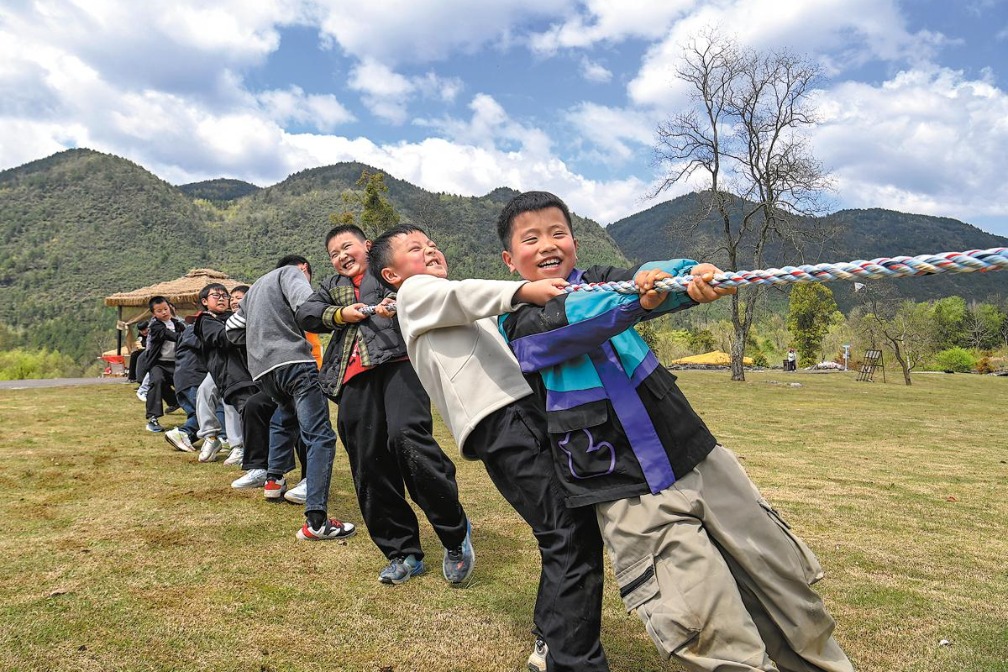
    Today, instead of sitting in crowded classrooms, students across participating regions are flocking to open fields and forested trails to take part in hiking, cycling, frisbee, tug-of-war, rock climbing and a wide range of other outdoor sports, working up a sweat under the mild spring sun.

    Local governments have moved quickly to support the new policy with structured programming and expanded access to public resources. Jiangsu’s provincial sports bureau launched a catalog of student-focused spring activity itineraries, featuring options ranging from kayaking and cycling to tactical simulation games. A kite-flying carnival held in Yangcheng as part of the initiative drew more than 1,000 participating families. In the southwestern province of Guizhou, organized youth sports events during the break included traditional team competitions like football, basketball and volleyball, alongside newer recreational activities such as rock climbing, martial arts and roller skating, drawing tens of thousands of participating students. In Huainan, Anhui province, local schools integrated spring outdoor excursions and campus sports meets into the holiday schedule, prioritizing family-focused activities including group rope skipping and community tug-of-war matches.

    The push to get students outdoors comes amid growing national concern over rising rates of childhood nearsightedness and obesity across China. Spring’s mild, comfortable temperatures make it an ideal season for sustained physical activity, which experts note can boost cardiovascular health, build muscle strength, improve motor coordination and support overall mental well-being for young people.

    Even in regions that have not yet formally adopted a regional spring break, such as Beijing, the Qingming holiday saw a sharp surge in outdoor, hands-on learning activities, with families taking children into nearby mountains to forage for wild plants, practice tree climbing and try slacklining. In the Inner Mongolia Autonomous Region, education officials have encouraged middle school students to combine physical activity with cultural learning, inviting them to practice traditional grassland sports including wrestling and archery.

    Public sports venues across participating regions have also expanded access to support the initiative. Across Jiangsu, public sports facilities extended operating hours and offer free or heavily discounted entry for student visitors during the break. At Nanjing’s iconic Olympic Sports Center, select tennis courts, badminton halls and public swimming pools opened entirely free of charge to young visitors for the duration of the holiday.

    Beyond physical health benefits, the new spring break policy is also designed to address growing concerns over excessive academic pressure and poor mental health among Chinese youth. Schools across participating regions are instructed not to assign written homework during the break, and unauthorized group tutoring and off-campus academic training are strictly prohibited for the duration of the holiday. “Without homework, my child just comes out to play football,” said Nanjing parent Wang Junjun, who watched his son play from the sidelines of a community pitch. “As long as he’s happy and healthy, we parents are happy too.”

    Researchers note that the new spring break initiative aligns with broader national efforts to strengthen physical education in China’s K-12 education system, which currently mandates a minimum of two hours of daily physical activity for all primary and secondary school students.

    “Holidays like this do more than improve children’s well-being,” said Wang Shuhua, a senior researcher at the Jiangsu Academy of Social Sciences. “They also stimulate the integration of sports and tourism, encourage spending on sporting equipment, and energize the broader sports economy. Some regions are already preparing to introduce autumn breaks as well,” she added, pointing to the potential for the policy to expand across the country in coming years.

  • Old photo spurs unlikely meeting three decades on

    Old photo spurs unlikely meeting three decades on

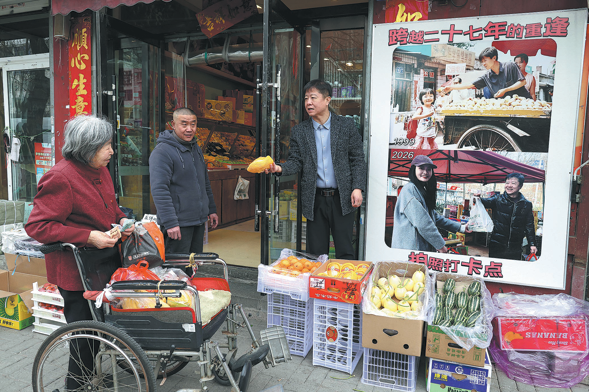
    Across the bustling northern Chinese city of Taiyuan, two photographs separated by nearly three decades have recently gone viral, touching the hearts of millions of online users across the country. The first is a faded, candid snapshot taken in 1999; the second, a sharp modern portrait captured in early 2026. Together, they tell an extraordinary story of chance connection, the passage of time, and quiet human resilience, centered around a reunion between 49-year-old veteran fruit vendor Yang Guoping and Henan-based children’s art educator Wang Mango.

    The unlikely chain of events began when Wang, a native of Jiaozuo in Henan province, was sorting through boxes of childhood belongings earlier this year. Tucked between old drawings and hand-me-down toys, she found the 1999 photo, snapped by her father during a family trip to Taiyuan when she was just 3 years old. In the frame, a lean young vendor stands behind a fruit-heavy tricycle, his face youthful and unfamiliar to Wang decades later.

    That vendor was Yang. To Wang’s surprise, her cousin, who lives locally in Taiyuan, immediately recognized Yang in the snapshot. Even 27 years after the original photo was taken, Yang still ran his fruit business within blocks of the spot where the image was captured. Wang arranged a visit, bringing the faded old photograph with her, and Yang greeted her with a mix of shock and joy — he barely recognized his own younger self in the worn shot.

    The pair returned to the approximate location of the original photo to take a new side-by-side portrait, freezing in time both the slow march of years and the unexpected, enduring bond that linked them across a generation. After Wang shared the pair of comparison photos on Douyin, China’s leading short-video platform, the content spread rapidly, drawing thousands of comments from netizens reflecting on how much both the city and the people within it had changed.

    For Yang, however, the decades of change have simply unfolded as part of his steady daily routine. He recalled to China Daily how different life was back when the first photo was taken: “Back then, hardly anyone had mobile phones, and cameras were rare. That photo was quite a novelty.”

    Yang’s journey in Taiyuan began in the early 1990s, when he left his rural hometown in Xinzhou, Shanxi, to seek work in the provincial capital. He started out as a restaurant waiter, slowly saving every extra yuan until he could afford a secondhand tricycle, and launched a mobile fruit stall on Yijing Street. By 2009, he had worked hard enough to open his own fixed brick-and-mortar fruit shop, a milestone he had spent years working toward.

    Looking back, Yang remembers old Yijing Street as a crowded, vibrant thoroughfare, buzzing with the energy of a traditional farmers’ market. Today, the street has been reborn as a trendy culinary destination, one of the most visited spots in Taiyuan. Reflecting on the changes captured in the two photos, Yang noted: “Time has left its marks, the era has progressed, and technology has developed. The old phone booth that stood in the background back then is now a 5G service center, and the entire street has been transformed. But what remains unchanged is the simplicity and kindness of people’s hearts.”

    Today, Wang runs her own small art studio for children back in Henan. She describes the cross-decade reunion as not just a magical twist of fate, but a powerful reminder of the steady perseverance that drives ordinary people. “I hope to be like him, steadfastly pursuing what I love and doing every little thing with heart,” she said.

    A closer look at the 1999 snapshot reveals another warm, untold detail: the woman standing just behind Yang is his wife, Li Xiuying. For more than 30 years, the couple has built their life around their fruit business, raising two children and helping them put down roots in the city. Over the decades, their tiny mobile stall grew into an 80-square-meter retail shop, and the beat-up secondhand tricycle was replaced by a modern delivery van. “I’m incredibly grateful for my wife’s companionship,” Yang said. “When I had nothing and started this venture, she endured hardships without complaint. Without her, we wouldn’t have what we have today.”

    Remarkably, Yang’s shop has stayed in the same neighborhood for all these years. Many of his loyal customers are people who grew up buying fruit from him as children, and now they bring their own kids to his store — a tradition Yang cherishes deeply. Even after the story went viral and drew crowds of new curious customers to his shop, Yang has remained humble. “I’m just an ordinary fruit seller. Being noticed and appreciated by everyone is already very touching. I will continue to serve each customer with care and sell the best fruits,” he said.

    Following their heartwarming reunion, Wang and Yang have already planned a future meeting: they agreed to gather again on Yijing Street for the next Chinese New Year, continuing the connection that a 27-year-old photograph first made possible.

  • Adelaide couple charged with child abuse, bestiality and running ‘brothel’

    Adelaide couple charged with child abuse, bestiality and running ‘brothel’

    A joint law enforcement operation targeting suspected online criminal activity has led to the arrest of two Adelaide residents in their 30s, who now face a series of extraordinarily serious charges including bestiality, animal cruelty, child exploitation offences, and operating an unlicensed brothel. The raid, carried out on Wednesday by South Australia Police in partnership with the Australian Federal Police and animal welfare organisation RSPCA Australia, targeted an undisclosed property in Adelaide’s northern suburbs. The operation grew out of an ongoing investigation into the distribution and possession of online child exploitation material, law enforcement officials confirmed.

    Following the entry to the property, investigators seized a number of electronic devices for forensic analysis. Initial examination of those devices uncovered what detectives describe as damning evidence: material confirming the possession of child exploitation content, plus proof linking the two suspects to acts of bestiality. Beyond the digital evidence, authorities allege the private residence was being secretly operated as an illegal commercial brothel, in violation of South Australian state regulations.

    The 39-year-old male suspect faces four separate charges: possession of child exploitation material, managing an illegal brothel, committing bestiality, and ill treatment of an animal. His 33-year-old co-accused, a woman, has been charged with two counts: bestiality and animal ill treatment. Both suspects were granted bail following their arrests, and are scheduled to make their first court appearance at Elizabeth Magistrates Court in the coming weeks.

    Detective Chief Inspector George Fenwick, the senior officer leading the joint investigation, spoke publicly about the severity of the allegations following the arrests. “These allegations represent a heinous and blatant breach of the law and a profound violation of community standards and expectations,” Fenwick said. “We will continue to work with our partners to identify, investigate and prosecute anyone who seeks to exploit or harm those in the community who cannot protect themselves.”

    Law enforcement officials are continuing to analyze additional seized electronic devices to uncover any further evidence of criminal activity, and are appealing for public assistance. Any member of the public with information about suspected child abuse or exploitation is urged to contact Crime Stoppers Australia confidentially on the national hotline 1800 333 000.

  • Homegrown police dog bred for success

    Homegrown police dog bred for success

    On a sun-drenched early March afternoon at the Ministry of Public Security’s Kunming Police Dog Base in Yunnan Province, China’s leading training and research facility for this specialized working breed, senior trainer Long Ling and his 2-year-old Kunming dog Kunkun moved in flawless sync to complete three high-level training drills.

    Kunkun, a demonstration canine at the base, embodies the ideal temperament that breeders and trainers have spent decades refining in China’s indigenous police dog. Around civilians, he is even-tempered, gentle and playful, especially with children, but shifts instantly to a sharp, intimidating stance when confronting hostile suspects. Long describes this balanced demeanor as an “Eastern temperament” — naturally reserved and restrained, yet able to switch to intense focus and assertiveness when duty calls.

    A small moment during the on-site interview revealed just how attuned Kunkun is to his trainer’s feedback. When Long praised the dog for his sharp instincts and strong working capabilities, Kunkun settled calmly on the ground, wagging his tail in quiet contentment. But when Long brought up the young dog’s earlier incident of biting another dog and noted that he still required closer supervision, Kunkun instantly stood alert, ears perked straight up, clearly understanding he was being called out.

    The close bond between Long and Kunkun dates back to a puppy suitability assessment in 2024, when Kunkun was just 10 weeks old. While other puppies hesitated, the young Kunkun scampered straight over to Long and nipped playfully at his pant leg, displaying a fearless curiosity that caught the trainer’s eye. That natural confidence convinced Long to select the puppy for training, and he named him Kunkun in honor of the breed’s Yunnan origins.

    Over the past two years, Long has raised Kunkun like a member of his own family, personally overseeing his feeding and care even during national holidays, and treating the dog to a weekly reward of home-cooked beef. That consistent, attentive care and targeted training has turned Kunkun into an outstanding all-around working dog, excelling in tactical coordination, close-quarter reconnaissance, and long-distance obedience — the full range of skills modern security operations demand.

    As a homegrown breed developed exclusively in China, Kunming dogs have gained growing recognition for their superior adaptability to China’s diverse climates and terrain, as well as their well-balanced character traits that make them uniquely suited to domestic public security and law enforcement work. Kunkun’s development from a curious puppy to a top-performing police dog stands as a powerful example of the breed’s decades-long success as a working dog developed for China’s specific security needs.

  • Perth parents jailed for allegedly starving ballerina have convictions quashed after appeal

    Perth parents jailed for allegedly starving ballerina have convictions quashed after appeal

    In a dramatic late development that has upended a high-profile child mistreatment case in Western Australia, the convictions of two Perth parents found guilty of starving their 16-year-old aspiring ballerina daughter have been overturned on appeal, and the couple has been released on bail ahead of a planned retrial.

    The pair, who cannot be identified publicly due to ongoing legal restrictions, were found guilty by a jury in November 2024 following a two-year investigation that traced back to an alarming hospital admission in early 2021. The case first came to authorities’ attention on April 7, 2021, when the teenager was brought to Perth Children’s Hospital in a state of extreme severe malnourishment. At 16 years old, she weighed just 28 kilograms — a body mass roughly matching the average weight of an 8-year-old child, half her chronological age.

    During the original trial, the mother was convicted on charges that she failed to protect her daughter from harm between 2019 and 2021, and willfully deprived the teen of adequate support for her emotional, social and physical development. The father faced separate conviction for two offences: reckless child care that led to the teen’s suffering, and forging his daughter’s birth certificate to falsely record her as younger than her actual age. Throughout the entire legal process, both parents have maintained their innocence, claiming there was nothing abnormal about their daughter’s health or physical appearance.

    The appeal ruling, handed down Tuesday by the Western Australian Court of Appeal, reversed the guilty verdict and ordered the couple’s release on bail, with a fresh retrial scheduled to begin later this month. The parents appeared for the appeal hearing via video link; reporters in court noted that the mother broke down in tears when the quashing of her conviction was read aloud.

    “The two accused have been released on bail, and there will be a retrial,” the couple’s defence lawyer Tom Percy told 9News following the ruling.

    While the mother had previously argued in her bail application that she was denied a fair trial because she suffered illness that left her unwell for multiple days during the original proceeding, that initial appeal for bail was rejected by the court before this week’s full overturning of convictions. As of Wednesday, full written reasons for the appeal court’s decision to quash the convictions have not yet been published by the judiciary.

  • Rwanda tries to protect farmland in Africa’s most densely populated nation

    Rwanda tries to protect farmland in Africa’s most densely populated nation

    On a crisp chilly morning in Kigali, the hum of bulldozers and rhythmic clatter of construction work drown out the soft thud of farmers’ hoes against the soil. For Rwanda, a nation that holds the title of Africa’s most densely populated country, this sensory clash represents a growing crisis: how to balance booming urban expansion with the critical need to safeguard shrinking agricultural land and shore up long-term food security.

    For 84-year-old Mukarusini Purisikira, the crisis is deeply personal. A lifelong farmer who fled to neighboring Congo to escape the 1994 Rwandan genocide, she returned home to find her family’s sprawling hillside farm seized for residential and commercial development. Today, she cultivates maize and sweet potatoes on a plot barely larger than a small cottage, a patch that barely produces enough to put food on her table. Standing near her crops, she glances nervously at construction idling on a nearby ridge: “It is all I have,” she says.

    Now, Purisikira and other small-scale Rwandan farmers have a new layer of protection. Starting in September 2024, the Rwandan government launched an ambitious initiative to map all officially designated agricultural land across the country, leveraging satellite imagery to track unauthorized development that encroaches on protected farm and forest land. With Rwanda’s national population projected to hit 22 million within the next two years, and global fertilizer prices spiking sharply following the outbreak of the Iran war that has disrupted global supply chains, food security has become a top policy priority for the government.

    In Kigali, the nation’s capital, city planners have already locked in 22% of the total land area specifically for agricultural use under the city’s updated master development plan. To enforce the new protections, authorities have imposed strict penalties for unauthorized encroachment: fines of up to $3,000 and prison sentences of as long as six months for violators. Multiple unapproved construction projects have already been demolished to enforce the rules, though stakeholders connected to the buildings declined to speak publicly over fears of government retaliation. Moving forward, the government plans to add drone surveillance to its monitoring toolkit, enabling real-time tracking of unauthorized land use across the country.

    City officials acknowledge that unmet housing demand creates strong economic pressure to approve new construction projects, but they argue that prioritizing agriculture will deliver greater long-term value. “Farming will be even more productive” than unplanned urban expansion, city data projections show, especially as domestic food demand continues to climb alongside population growth. City leaders argue that with targeted innovation, productive farming can thrive on smaller, more efficiently managed plots of land.

    Emma-Claudine Ntirenganya, a spokeswoman for the Kigali mayor’s office, explained that the pressure on farmland extends far beyond the capital. While most of Kigali’s current food supply is sourced from other districts across Rwanda, those rural agricultural areas are also losing land to development at a rapid pace. Over the past year, the national government has printed and publicly distributed detailed maps across all Rwandan districts, clearly marking land zoned for agriculture and land open for construction, to bring transparency to land use rules.

    Ntirenganya says the initiative is rooted in a new vision of “urban agriculture” that redefines how Rwandans think about farming within city limits. “We will be able to show Kigalians that they can also do agriculture and be productive,” she explained. To model this approach, the city administration is already building a demonstration greenhouse on the roof of its headquarters, and now requires all developers applying for new building permits to integrate green spaces and community gardens into their project designs.

    Beyond protecting existing open land, Kigali has become a testing ground for innovative, space-efficient urban farming techniques. Vertical farms, which grow leafy greens, strawberries and other produce in stackable modular plastic containers, have gained traction among local entrepreneurs. Christian Irakoze is the co-founder of Eza Neza, which translates to “grow well,” a local startup that installs small-scale vertical farms across Kigali. During a visit by the Associated Press, reporters saw one vertical farm growing 600 plants in vertical rows stretched along just 50 meters of perimeter wall, proving the model can produce significant amounts of food in minimal space.

    Irakoze describes his work as a fundamental shift from traditional large-scale rural farming to a flexible, accessible system that fits urban contexts. “It is a different way of thinking about farming, from traditional large-scale upcountry farming to something smaller, modular, and that anyone can really do,” he said. To reduce reliance on volatile imported agricultural inputs, Irakoze’s company uses locally sourced manure and volcanic sediment in place of commercial potting soil, adapting farming practices to buffer against global market shocks. “We really have to find ways to find our own solutions, whether through inputs like fertilizers or seeds. Some of these global events are always a reminder that we should definitely have some alternatives,” he added.

    A group of young Rwandan agronomists are also working to spread adoption of hydroponics, a soil-free farming technique that uses nutrient-infused water to grow crops, maximizing output per square meter of land. “The population is increasing, yet our land is not increasing. We make sure that we find solutions that can help farmers to overcome that, and then they produce more,” explained Richard Bucyana, one of the agronomists leading the training program. Bucyana echoed Irakoze’s view that local, homegrown solutions like those being rolled out in Rwanda help insulate the country from global supply chain disruptions, and called on other African governments to prioritize agricultural self-sufficiency. “African governments should start thinking how they can be self-sustainable,” he said.

  • Nurse describes horror of 11yo’s fatal scooter crash

    Nurse describes horror of 11yo’s fatal scooter crash

    On a routine Monday evening in the coastal Western Australian city of Mandurah, an ordinary drive turned into a desperate fight for a child’s life when off-duty nurse Nicole Jones witnessed a devastating traffic collision unfold right in front of her. At approximately 5:10 p.m. along Mandurah Terrace, 11-year-old boy on a scooter lost control and veered directly into the path of an oncoming moving car.

    Jones, who was passing the scene moments after the crash, did not hesitate to act. She immediately pulled her vehicle over, rushed to the boy’s side, and took command of the chaotic situation. Speaking to local outlet 7News later, Jones recalled the panic and uncertainty that gripped the gathering crowd of bystanders when she arrived. “There was a lot of blood and a lot of people around kind of not sure what to do,” she described. Stepping into her professional role even off duty, Jones cleared onlookers from the road, positioned the unconscious child, and immediately started cardiopulmonary resuscitation (CPR) after confirming he had no pulse and had stopped breathing. She continued life-saving efforts until emergency paramedics arrived to take over care.

    Despite the rapid response from Jones and first responders, the boy’s injuries were too severe. He was rushed to Peel Health Campus for emergency treatment, but medical teams were unable to save his life. Initial investigations into the crash have confirmed that the child was not wearing a safety helmet at the time of the incident, a detail that adds another layer of tragedy to the outcome.

    For Jones, the traumatic experience has left a lasting mark. She shared that the sounds of the boy’s grieving parents will stay with her for a long time, adding that her deepest sympathies remain with the family in their devastating loss. “My thoughts go out to his mum and dad mostly. I don’t think I’ll forget their cries for a good while now,” she said.

    This fatal crash marks the fifth road fatality recorded in Western Australia over the 2024 Easter holiday break, a statistic that has prompted state Premier Roger Cook to issue a urgent, stark reminder to all road users about the critical importance of road safety. Cook outlined the Western Australian government’s ongoing commitment to reducing road deaths across the state, noting that efforts would continue across multiple fronts. “We will continue to make sure we do what we can as a government and that goes to making sure our roads are safer, making sure we’ve got targeted messaging to change driver behaviour, and continue to educate the community about the importance of road safety,” he stated. The tragedy has reignited public conversation about road user awareness, safety gear requirements for micro-mobility users, and ongoing efforts to cut preventable deaths on Australian roads.