分类: politics

  • Trump insists Joint Chiefs chair on board for Iran military move

    Trump insists Joint Chiefs chair on board for Iran military move

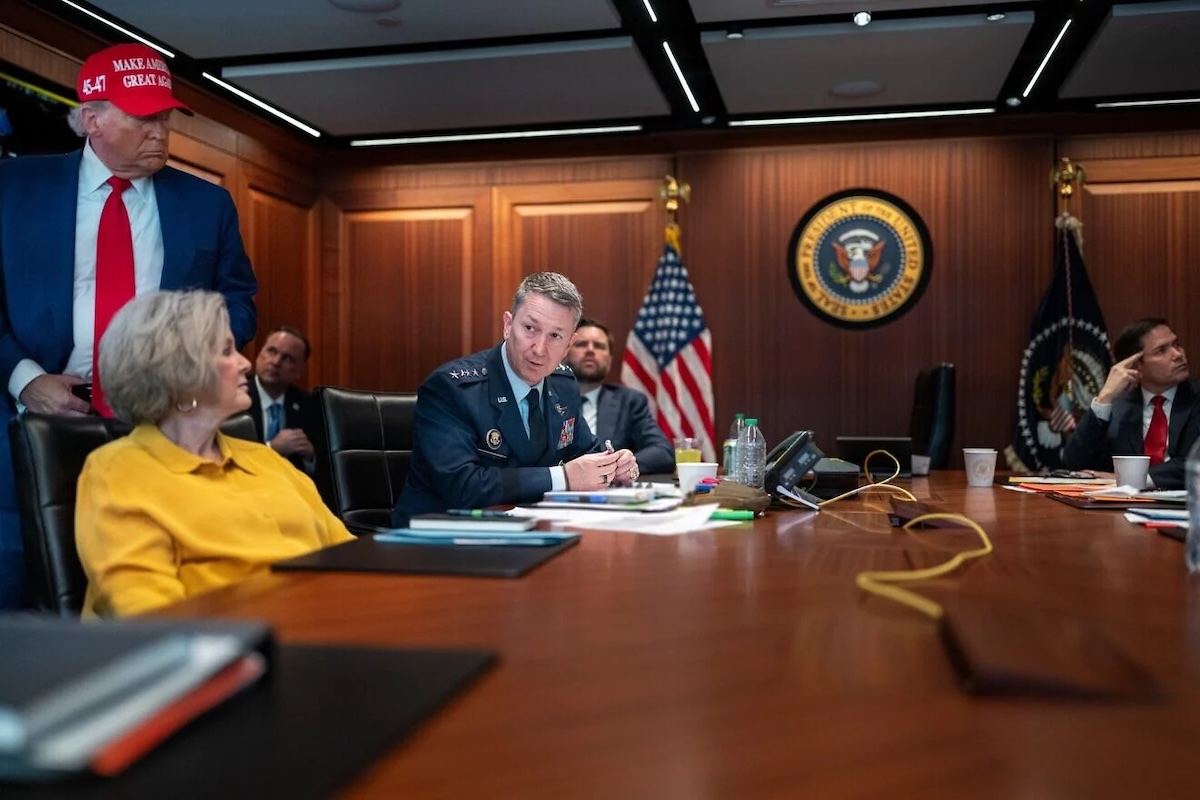
    President Donald Trump conceded Monday that a U.S. military offensive against Iran would prove catastrophic for the Middle Eastern nation’s civilian population, even as his administration actively contemplates assault options. This admission emerged alongside reports indicating private cautions from General Dan Caine, Chairman of the Joint Chiefs of Staff, regarding the substantial risks associated with attacking Iran—a country of over 90 million inhabitants.

    In a Truth Social post, Trump contested media narratives suggesting General Caine expressed reservations about potential military engagement. Contrary to these reports, Trump asserted that the general maintains a steadfast focus on victory, stating Caine would “lead the pack” if commanded to execute military operations. The president—who terminated a landmark diplomatic agreement with Iran during his initial term—added that failure to secure a new accord would result in “a very bad day for that Country and, very sadly, its people.”

    This recognition of potential civilian devastation contrasts sharply with the rhetoric of war advocates who promote regime change as beneficial for Iran’s population. The National Iranian American Council emphasized the urgency of the situation, noting Trump’s own acknowledgment of dire consequences for Iranian civilians.

    Legislative efforts are underway to prevent unauthorized military action, with the House of Representatives preparing to vote on a resolution requiring congressional approval for Iran engagement. However, the measure faces slim prospects of reaching the president’s desk. Recent polling indicates minimal public support for initiating conflict, with only 21% of Americans endorsing military action against Iran.

    According to New York Times reporting, the administration is considering a phased approach involving initial targeted strikes followed by expanded operations if Iran refuses to abandon its nuclear program. Behind-the-scenes negotiations explore a potential compromise allowing limited nuclear enrichment exclusively for medical research purposes. This diplomatic initiative unfolds as U.S. military assets, including aircraft carrier groups and strike aircraft, mass within operational range of Iranian territory.

    General Caine’s reported concerns extend beyond humanitarian considerations to practical military limitations. The Washington Post revealed the general warned that munitions stockpiles have been significantly depleted by ongoing support for Israel and Ukraine, potentially complicating any major operation against Iran.

    The administration’s trajectory toward potential conflict has drawn substantial criticism from policy experts. Matt Duss of the Center for International Policy condemned prospective military action as “an illegal act of war,” noting the abandonment of previous justifications related to protecting Iranian protesters. Duss urged congressional intervention to clarify that the president lacks authorization for employing armed forces against Iran.
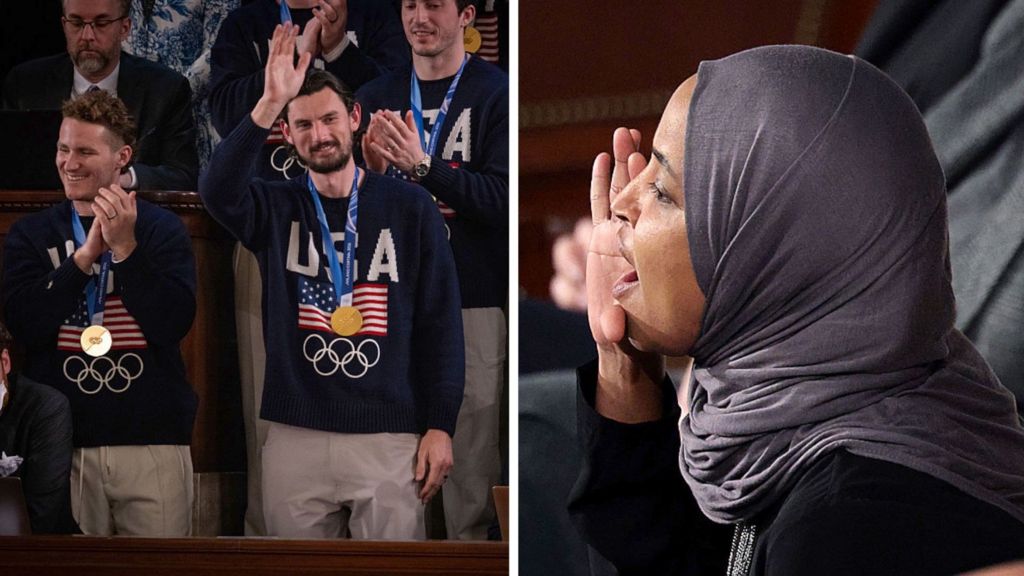
  • Watch: Iran, Olympics and partisan divisions among takeaways from Trump speech

    Watch: Iran, Olympics and partisan divisions among takeaways from Trump speech

    President Trump’s highly anticipated address to a joint session of Congress became a multifaceted political spectacle that highlighted both international tensions and domestic divisions. The speech, delivered before the nation’s highest legislative body, featured several notable confrontations with political rivals alongside carefully staged moments with special guests.

    The administration’s hardline stance toward Iran emerged as a significant foreign policy focus, with the President articulating a confrontational approach toward Tehran’s regional activities. This position signals continued strain in U.S.-Iran relations following the collapse of the nuclear agreement and increasing Middle East tensions.

    In a notable departure from security matters, the address also touched upon international sports diplomacy, specifically addressing Olympic participation. This unexpected inclusion demonstrated the administration’s broader approach to leveraging international sporting events within its foreign policy framework.

    The proceedings revealed deep partisan fractures, with visible divisions between Republican and Democratic responses throughout the address. These political schisms were particularly evident during exchanges between the President and opposition lawmakers, creating a stark visual representation of the current polarized political climate in Washington.

    The carefully orchestrated event included both planned and spontaneous moments that underscored the ongoing political tensions within the Capitol. Special guests provided symbolic backing to certain policy positions, while the presence of political adversaries created several tense exchanges that highlighted the challenges of governance in a divided government.

  • Ejections, shouting and hockey players – Key moments from Trump’s big speech

    Ejections, shouting and hockey players – Key moments from Trump’s big speech

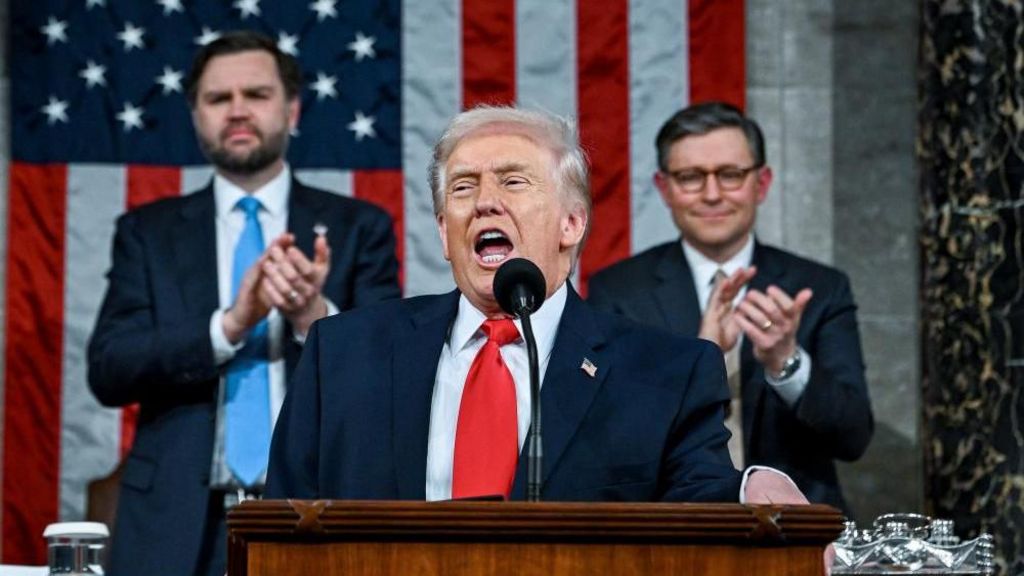
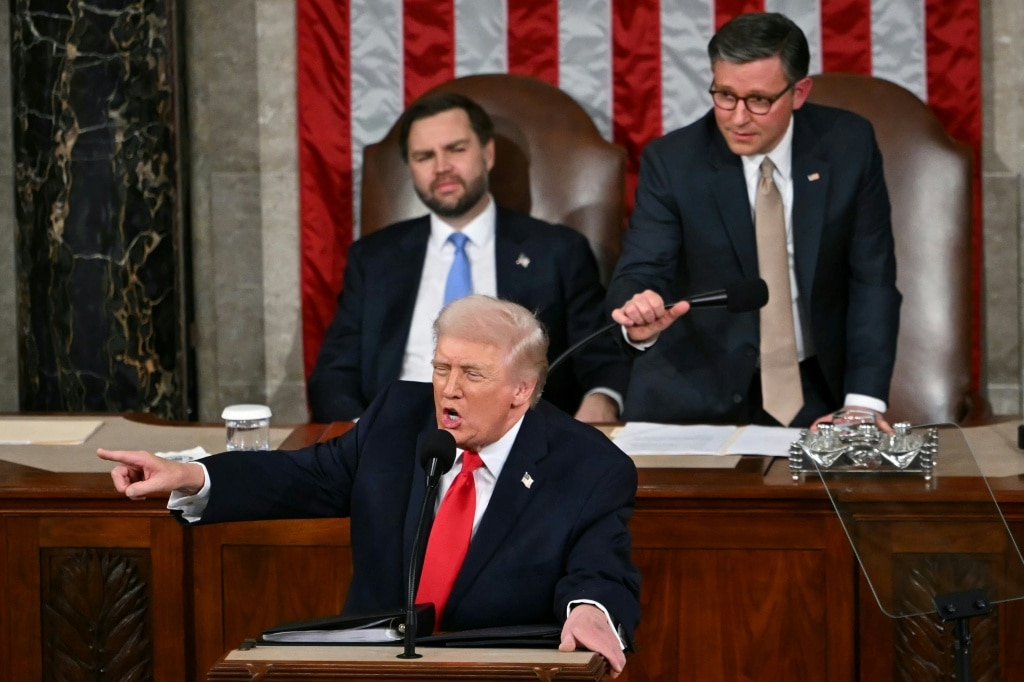
    President Donald Trump delivered the longest State of the Union address in history, presenting a mixture of triumphant rhetoric and confrontational remarks before a sharply divided Congress. The speech occurred during a critical period marked by escalating tensions with Iran, significant legal setbacks for the administration’s tariff policies, and growing concerns about economic affordability that could impact upcoming midterm elections.

    The event showcased remarkable tensions between the executive and judicial branches. Notably absent were five of the nine Supreme Court justices, following Trump’s previous criticism of their decision to strike down his global tariffs. During the address, Trump shared a visibly strained moment with Chief Justice John Roberts before directly criticizing the Court’s ruling on tariffs as “disappointing” and “unfortunate.” The president announced alternative measures using Section 122—a rarely invoked law allowing 15% tariffs for 150 days without immediate congressional approval—while suggesting these tariffs might eventually replace income taxes.

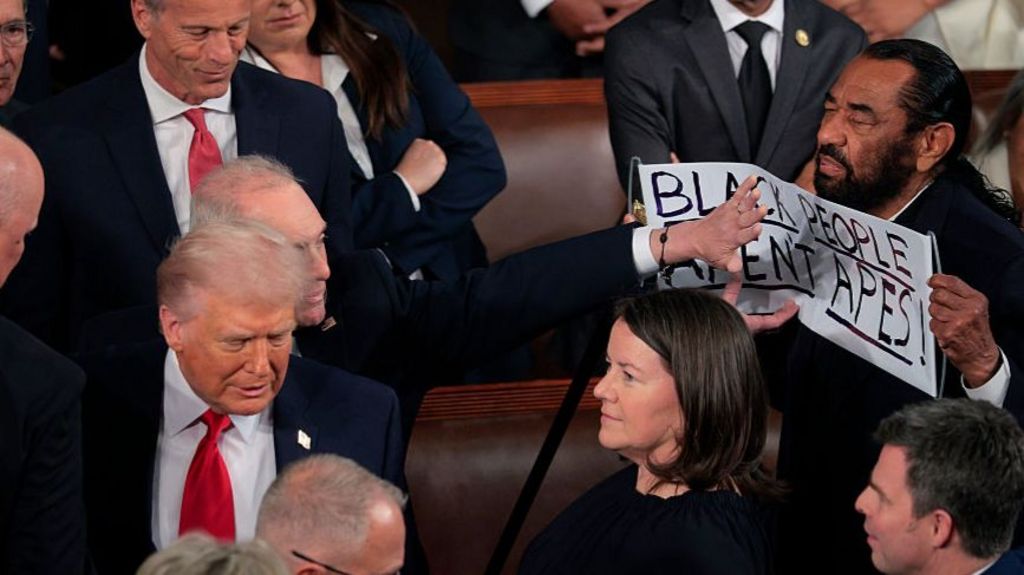
    Partisan divisions dominated the chamber atmosphere. Dozens of Democrats boycotted the event entirely, while remaining opposition members staged vocal protests. Representative Al Greene was escorted out for displaying a sign referencing racist social media content previously shared by Trump. Congresswomen Ilhan Omar and Rashida Tlaib repeatedly shouted accusations of lying during the president’s remarks on immigration and Somali-American communities.

    The address featured patriotic highlights including the celebration of the U.S. men’s hockey team’s Olympic gold medal victory. Goalie Connor Hellebuyck received the Presidential Medal of Freedom announcement, though Trump sparked controversy by joking about potential impeachment if he didn’t invite the women’s team—later extending that invitation during his speech.

    Throughout the evening, Trump emphasized national protection themes, deliberately highlighting partisan divides by asking Republicans to stand for policies opposed by Democrats, whom he called “crazy” for their lack of support. The event culminated with plans for America’s 250th anniversary celebrations while underscoring the profound political polarization characterizing current American politics.

  • German leader arrives in China to press for fair trade and help ending Ukraine war

    German leader arrives in China to press for fair trade and help ending Ukraine war

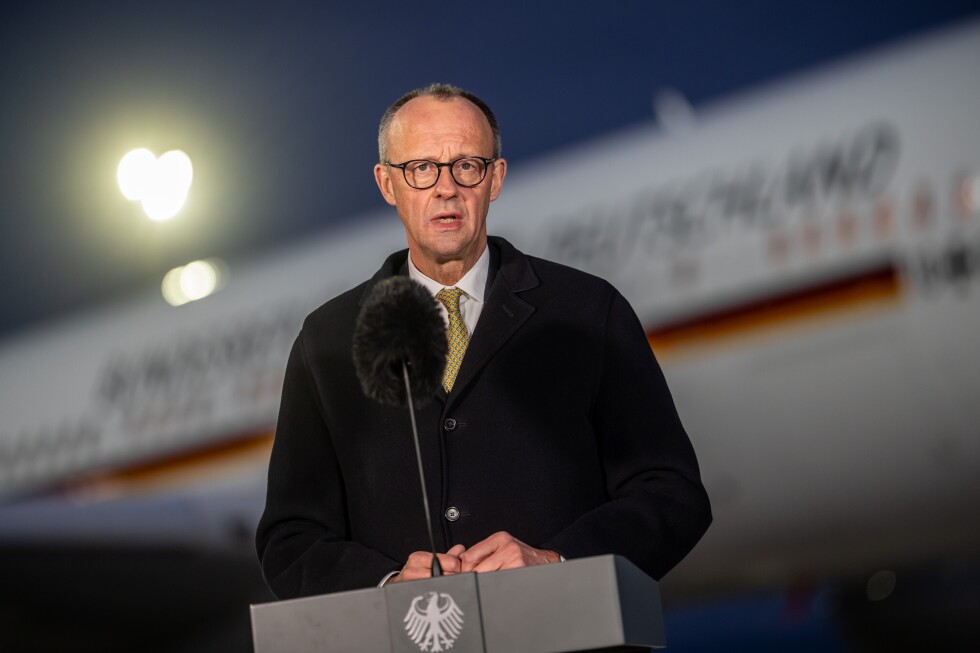
    German Chancellor Friedrich Merz commenced a pivotal two-day diplomatic mission to Beijing on Wednesday, engaging with China’s senior leadership to address critical issues spanning economic equity and global security. The visit marks Merz’s inaugural trip to China since assuming office in May 2023, occurring amidst a flurry of Western diplomatic engagements with Beijing.

    Merz emphasized the European consensus approach to China relations prior to departure, stating: “Our message from a European perspective remains consistent: We seek a partnership with China that is balanced, reliable, regulated, and equitable. This represents both our proposal and our expectation from Chinese counterparts.”

    The Chancellor’s agenda focuses on two primary concerns: ensuring fair market access for German corporations within China’s economy and soliciting Beijing’s influence to help resolve the ongoing conflict in Ukraine. Merz acknowledged China’s indispensable role in global governance, noting that “major international political challenges cannot be addressed today without Beijing’s involvement.”

    This diplomatic engagement occurs against a backdrop of growing European apprehension regarding China’s economic practices. Germany witnessed an 8.8% surge in Chinese imports reaching €170.6 billion ($201 billion) last year, while German exports to China declined by 9.7% to €81.3 billion ($96 billion). European leaders seek increased Chinese manufacturing investment within their territories while urging China to address industrial overcapacity affecting sectors like electric vehicles and solar panels.

    Xinhua News Agency characterized the relationship as vital, stating: “As major economies championing multilateralism during turbulent times, China and Germany bear shared responsibility for maintaining global supply chain stability and opposing protectionism.” The visit represents another chapter in China’s diplomatic outreach as it seeks allies to counter former President Trump’s tariff policies and challenges to established international institutions.

  • US embassy in Israel will provide consular services to settlers in occupied West Bank

    US embassy in Israel will provide consular services to settlers in occupied West Bank

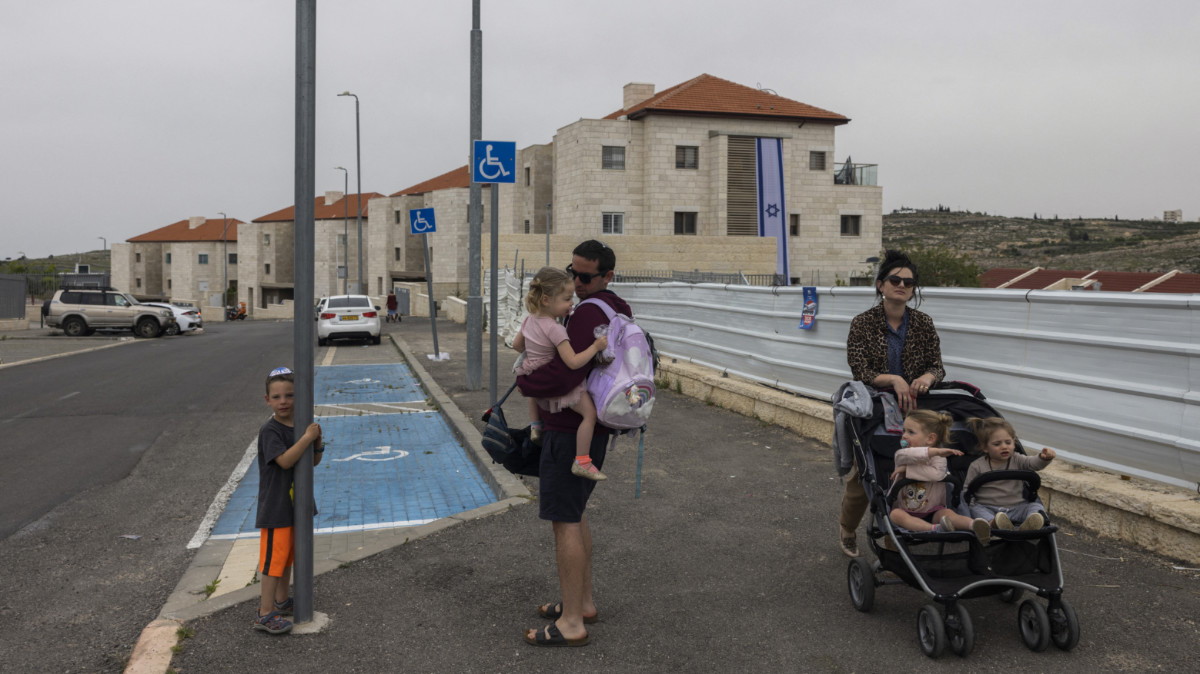
    In a significant policy development, the US State Department has announced it will begin providing on-site consular services to Israeli settlers residing in West Bank settlements for the first time. The US Embassy in Jerusalem confirmed that consular officers would offer routine passport services in Efrat, an Israeli settlement south of Bethlehem in the occupied West Bank, on February 27.

    The embassy further revealed plans to expand these services to additional Israeli cities, the West Bank city of Ramallah, and the settlement of Beitar Illit near Bethlehem. This move represents a notable departure from previous US diplomatic practice, marking the first public offering of consular services directly to settlers in territory considered illegal under international law.

    The announcement follows controversial remarks by US Ambassador to Israel Mike Huckabee during an interview with Tucker Carlson. Ambassador Huckabee stated he would be “fine” with Israeli control extending across much of the Middle East, including Syria, Jordan, Saudi Arabia, Iraq, and Egypt. More significantly, he asserted that Area C of the occupied West Bank constitutes part of Israel, directly contradicting longstanding US policy that recognizes no Israeli sovereignty over these territories.

    This diplomatic shift coincides with increased Israeli efforts to consolidate control over the West Bank. The Israeli government recently approved plans to extend its civilian authority into Areas A and B, directly challenging Palestinian Authority control established under the Oslo Accords. These agreements originally designated Area A under full PA control, Area B under shared control, and Area C under Israeli military occupation pending final status negotiations.

    Approximately 400,000 Israeli settlers currently reside in Area C, which comprises about 60% of the West Bank, enjoying services and political representation denied to Palestinians. Analysts view the US consular services expansion as potentially signaling acceptance of de facto Israeli annexation, despite official US statements supporting a two-state solution and refusing recognition of Palestinian statehood absent a final agreement.

  • Rubio flies into the Caribbean for talks with leaders unsettled by Trump policies

    Rubio flies into the Caribbean for talks with leaders unsettled by Trump policies

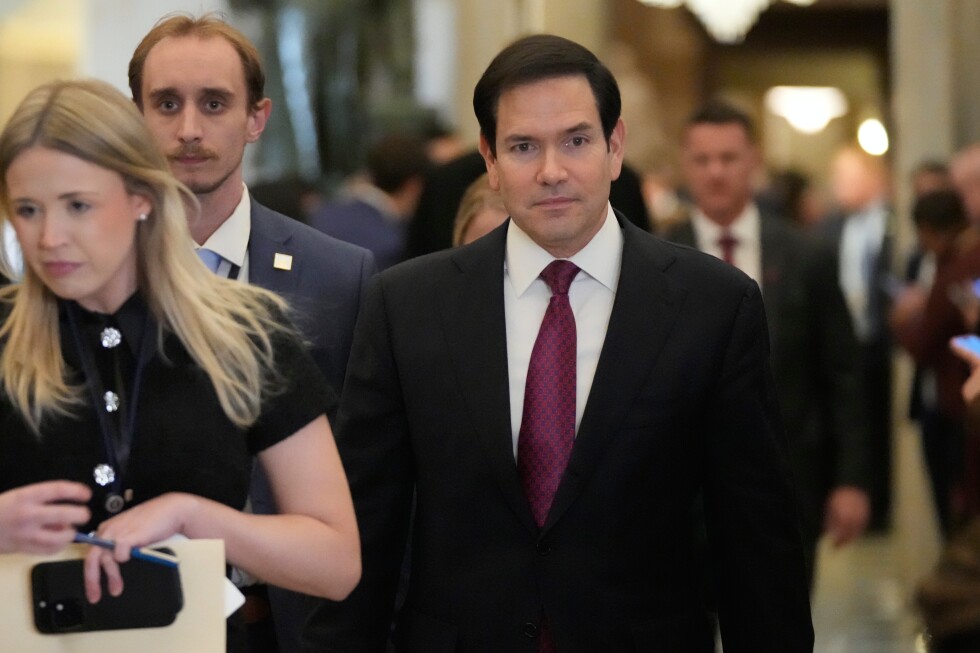
    U.S. Secretary of State Marco Rubio arrived in St. Kitts and Nevis on Wednesday for high-stakes discussions with Caribbean Community (CARICOM) leaders, marking a pivotal moment in regional diplomacy. The visit follows a series of aggressive Trump administration policies that have created widespread uncertainty among Caribbean nations.

    The diplomatic mission comes precisely one month after President Trump ordered the military capture of Venezuela’s former leader Nicolás Maduro, whom Trump hailed during his State of the Union address as “an absolutely colossal victory for United States security.” This operation forms part of a broader strategy that includes intensified anti-narcotics operations, increased pressure on Cuba, and a renewed assertion of the Monroe Doctrine principles to ensure Western Hemisphere dominance.

    Caribbean leaders expressed deep concerns about shifting U.S. policies during the CARICOM summit opening. Terrance Drew, Prime Minister of St. Kitts and Nevis and current CARICOM chair, noted that the region “stands at a decisive hour” amid global order transformations, uncertain supply chains, and intensifying climate shocks.

    The administration’s demands for accepting third-country deportees, rejecting Cuban medical missions, and cooling relations with China have particularly troubled regional partners. Godwin Friday, newly elected Prime Minister of St. Vincent and the Grenadines, echoed European leaders’ apprehensions, stating that international rules “have changed in troubling ways.”

    Jamaican Prime Minister Andrew Holness emphasized the Cuba situation’s regional implications, warning that “a prolonged crisis in Cuba will not remain confined to Cuba” but would affect migration, security, and economic stability throughout the Caribbean basin. While affirming Jamaica’s support for democracy, Holness advocated for “constructive dialogue between Cuba and the U.S. aimed at de-escalation, reform and stability.”

    The U.S. State Department indicated Rubio would discuss regional security, stability, and economic growth in both group and bilateral meetings. Meanwhile, Caribbean leaders planned to address additional concerns including security, climate financing, reparations, and single market economy development.

    Background operations include U.S. drug interdiction efforts that have resulted in 151 fatalities since September, though evidence of drug smuggling remains undisclosed. Trinidad and Tobago’s Prime Minister Kamla Persad-Bissessar notably praised these operations, thanking Trump and Rubio for “standing firm against narcotrafficking.”

    Humanitarian concerns emerged regarding Cuba’s recovery from Hurricane Melissa, with U.N. officials citing the U.S. oil embargo as hindering aid distribution. The energy blockade and fuel shortages reportedly affect “the entire logistics chain” of recovery operations throughout the island nation.

  • Analysis: Trump issues patriotic rallying cry as he faces political headwinds

    Analysis: Trump issues patriotic rallying cry as he faces political headwinds

    In a characteristically defiant State of the Union address on Tuesday night, President Donald Trump proclaimed an American “turnaround for the ages,” delivering a sharply partisan speech that celebrated his administration’s achievements while taunting political opponents. Facing persistently low approval ratings hovering around 40%, the president offered a vigorous sales pitch to the nation rather than signaling any policy course corrections.

    The address opened with triumphant declarations of national revival, with Trump asserting “Our nation is back” and labeling the United States the “hottest” country globally. He cataloged economic indicators including rising incomes, bullish stock markets, reduced fuel prices, subdued inflation, and significantly decreased undocumented border crossings as evidence of his administration’s success.

    Notably absent were substantial new policy initiatives. Instead, Trump repackaged previous proposals including retirement savings accounts for working-class Americans, healthcare plans featuring direct premium subsidies, voter citizenship verification requirements, and restrictions on commercial driver’s licenses for undocumented migrants. He announced an agreement with AI companies to ensure sufficient power generation without burdening consumers with higher utility bills.

    The president reaffirmed his commitment to expansive tariff regimes despite recent Supreme Court decisions striking down many previously imposed duties. Three justices who ruled against the administration watched expressionlessly from the front row during this portion of the speech.

    Immigration provoked particularly intense reactions, with Trump’s characterization of “illegal aliens” as threats generating thunderous Republican applause while drawing angry shouts and icy stares from Democratic legislators. This focus represented an attempt to reclaim political advantage on immigration following recent enforcement operations in Minneapolis that resulted in fatal shootings of American citizens by federal agents—incidents notably omitted from the address.

    Foreign policy received comparatively minimal attention despite significant military buildups near Iran, with Trump offering little justification for potential sustained military action. The speech instead emphasized patriotic themes through recognition of military heroes and Olympic athletes in attendance, possibly signaling a political strategy centered on national pride during upcoming 250th birthday celebrations.

    The address concluded with Trump’s declaration that “Our country is winning again,” setting the stage for midterm elections that will determine Congressional control and test whether the president’s unwavering confidence can shift public sentiment currently running against him.

  • ‘Safer’ to return ISIS brides, Albanese not helping, says Sydney doctor

    ‘Safer’ to return ISIS brides, Albanese not helping, says Sydney doctor

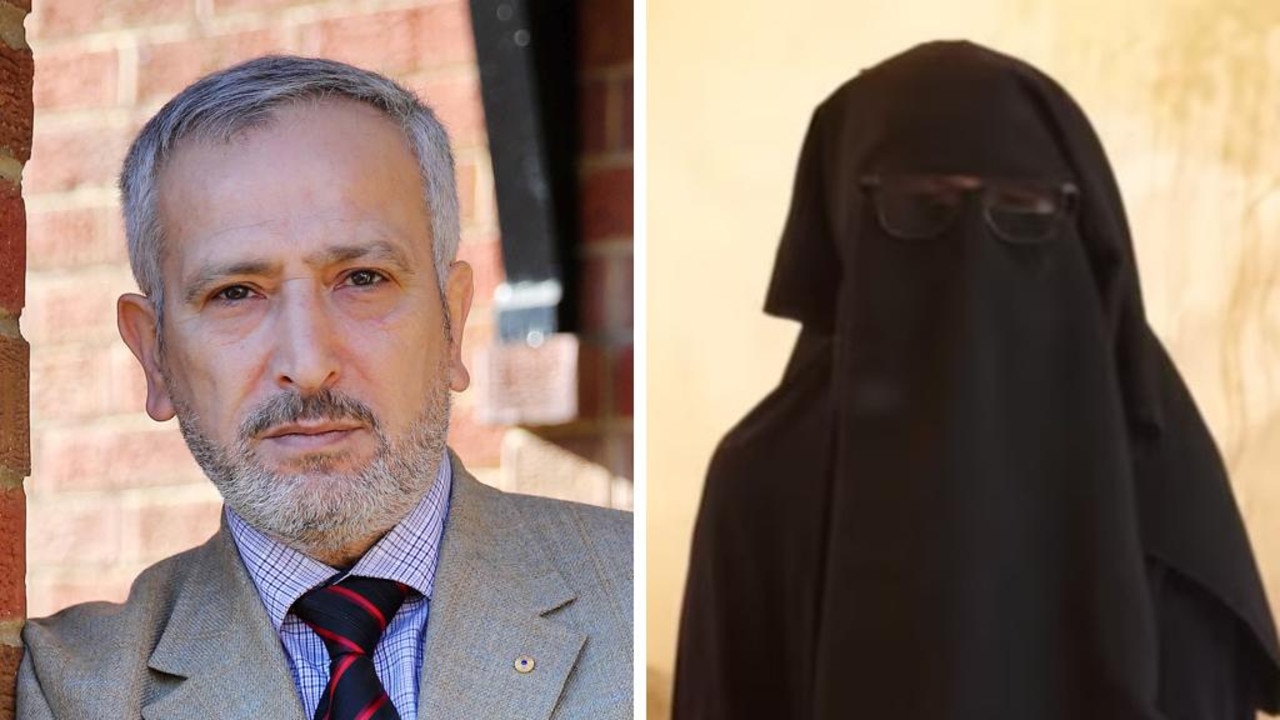
    A distinguished Sydney-based physician has emerged as a central figure in the contentious debate surrounding the potential repatriation of Australian women and children with connections to ISIS fighters from Syrian detention camps. Dr. Jamal Rifi, a Lebanese-born general practitioner, has broken his silence regarding his involvement with 34 detainees previously held at al-Hol prison in northeastern Syria.

    In a detailed account published by the Sydney Morning Herald, Dr. Rifi refuted claims that the Albanese government has provided assistance to the group, clarifying that his humanitarian efforts have been conducted independently without official support. The medical professional revealed he has served as an informal consultant addressing various health concerns among detainees, ranging from psychological trauma to physical ailments including asthma attacks, tonsillitis, and chilblains.

    The controversy has intensified as Opposition Leader Angus Taylor proposed legislative reforms that would criminalize assistance to these individuals. Dr. Rifi expressed particular concern about this proposal, drawing parallels to judgments issued by Lebanese tribunals under Hezbollah’s influence.

    Addressing the security implications, Dr. Rifi presented a counterintuitive perspective: “In the long run, Australia will be safer if the families can return in an orderly fashion to our shores.” He emphasized that children should not bear responsibility for their parents’ actions and advocated for proper support systems for returnees, with mothers facing appropriate legal consequences under existing legislation.

    The doctor also revealed the personal cost of his involvement, noting that his workplace has received bomb and death threats amid what he described as ‘dog-whistling’ from certain political quarters.

  • Security threat against Australian PM linked to banned Chinese dance group

    Security threat against Australian PM linked to banned Chinese dance group

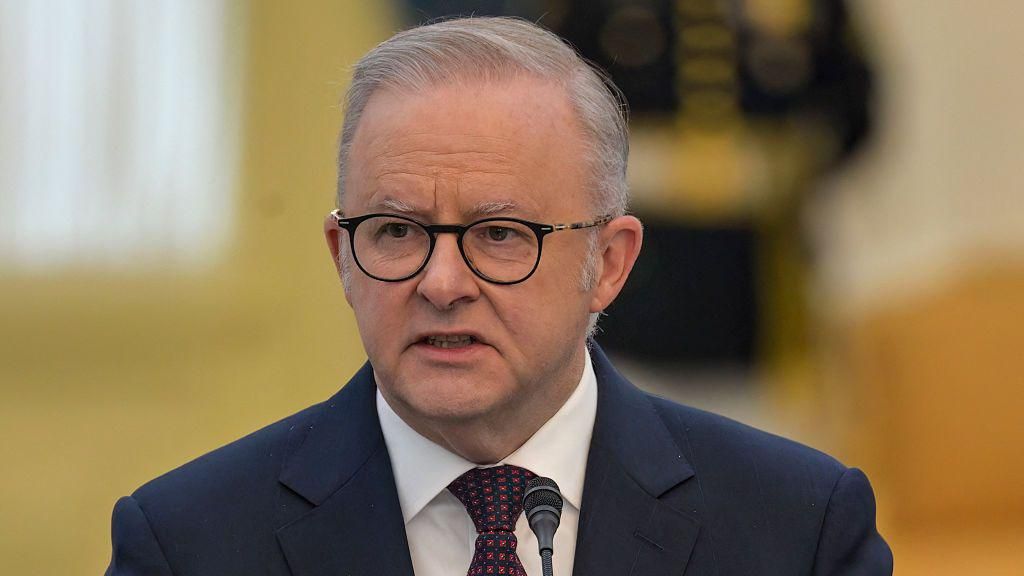
    Australian Prime Minister Anthony Albanese was forcibly evacuated from his official Canberra residence on Tuesday evening following a sophisticated bomb threat targeting a Chinese cultural performance group. The incident, which triggered a high-level security response, originated from threatening emails written in Chinese that demanded the cancellation of upcoming Australian performances by Shen Yun—a dance and music ensemble with connections to the Falun Gong movement, which is prohibited in mainland China.

    Local media reports indicate that the messages contained explicit threats to detonate nitro-glycerine explosives around The Lodge, the Prime Minister’s official residence, unless Shen Yun’s shows were called off. One communication ominously warned that the residence would be “blown into ruins” and that “blood will flow like a river” if performances proceeded.

    Authorities, including the Australian Federal Police, executed a full security sweep of the property beginning at 6:00 PM local time. After several hours of investigation, police confirmed that no suspicious devices were found. Albanese was temporarily relocated as a precautionary measure during the operation.

    The threats were initially reported by media outlets affiliated with Falun Gong, though Australian law enforcement has declined to comment on the authenticity or origin of the emails. In a statement, police officials only acknowledged responding to an “alleged security incident” and emphasized that no threat was substantiated.

    In a lighthearted social media update following the incident, Albanese shared a photo of his cavoodle, Toto, standing guard at the residence’s door, accompanied by a message thanking well-wishers and confirming that all was well.

  • Division, theater and one golden moment as Trump addresses Congress

    Division, theater and one golden moment as Trump addresses Congress

    The annual State of the Union address transformed into a stark display of American political division as former President Donald Trump delivered his speech before a deeply fractured Congress. The event, traditionally a ceremonial gathering of the nation’s governing bodies, instead highlighted the profound ideological rifts characterizing contemporary U.S. politics.

    Trump entered the chamber six minutes behind schedule, projecting an air of unwavering confidence despite potential hostility over his unconventional presidential approach. The reception was immediately polarized: Republicans repeatedly rose in enthusiastic standing ovations while numerous Democrats remained conspicuously seated with expressions of stern disapproval.

    The Supreme Court justices, including Chief Justice John Roberts Jr. and Justices Elena Kagan, Brett Kavanaugh, and Amy Coney Barrett, observed from their customary front-row positions. Their black robes contrasted sharply with the political theater unfolding before them, their recent judicial rebuke of Trump’s signature tariff policies creating palpable tension in the chamber.

    Attendance numbers reflected the event’s contentious nature, with dozens of Democratic members staging a boycott. The resulting empty seats provided visual evidence of the address’s disputed legitimacy while creating spatial breathing room absent during Trump’s protest-marred 2025 appearance.

    The presidential narrative emphasized economic achievements and national strength, with Trump claiming credit for falling inflation, rising employment, and a thriving stock market. When addressing the Supreme Court’s tariff decision, however, the president openly criticized the ruling as mistaken, causing visible discomfort throughout the chamber.

    Emotional depth was provided by carefully selected guests whose expressions conveyed complex human stories. These included survivors of Jeffrey Epstein’s sexual crimes and members of the victorious U.S. Olympic ice hockey team, who appeared momentarily overwhelmed by the ceremony’s grandeur. The Olympians’ recognition prompted the evening’s sole unifying moment, with the entire chamber rising to chant “USA!” in rare bipartisan celebration.

    Democratic resistance manifested through subtle protests rather than overt disruption. Many members wore white suffragette homage or accountability-demanding pins referencing Epstein. Congressman Al Green’s display of a sign criticizing Trump for sharing racist content resulted in his swift ejection, continuing his history of address disruptions.

    The primary Democratic protest weapon became strategic silence—the deliberate withholding of applause during Republican standing ovations. Outside the Capitol, alternative narratives emerged simultaneously through activist-led “People’s State of the Union” events and preemptive Democratic rebuttals, reflecting modern media’s preference for instant response over ceremonial tradition.

    As the address reached its climactic assertion of American strength, the physical chamber embodied national division: Republicans standing, Democrats seated, and Supreme Court justices maintaining judicial neutrality through studied impassivity.