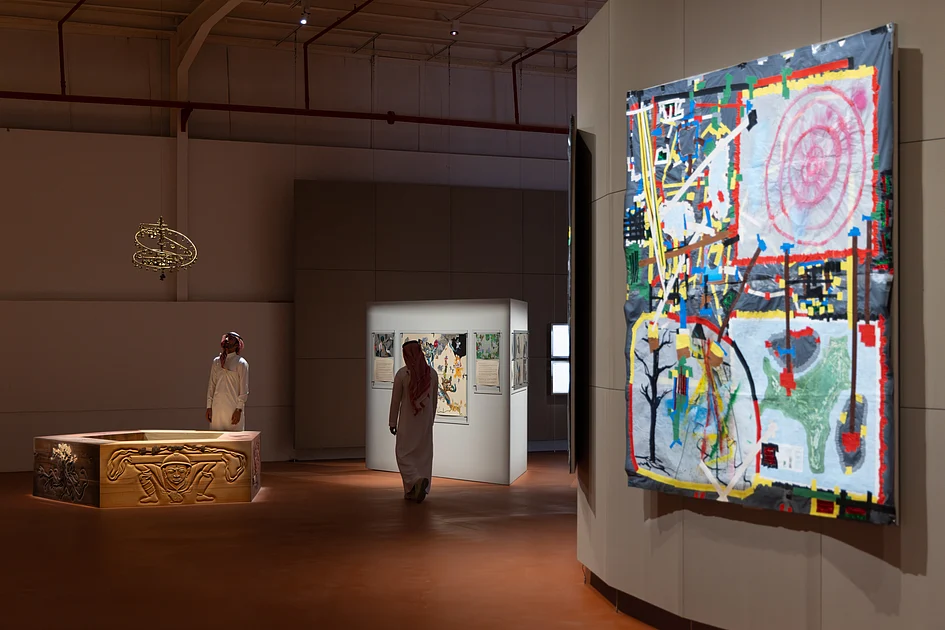
RIYADH — The third Diriyah Contemporary Art Biennale, now open at JAX District’s repurposed warehouses until May 2, presents a profound exploration of movement, migration, and temporal transitions through diverse artistic mediums. Titled ‘In Interludes and Transitions’ (Arabic: ‘Fil hil wal terhal’), the exhibition features 68 international artists, including over 25 newly commissioned works, curated by Nora Razian and Sabih Ahmed.
Bangladeshi artist Sarker Protick’s photographic series ‘Awngar’ investigates British colonial railway infrastructure in historic Bengal, connecting coal mining regions across Bangladesh and India. His luminous photographs examine how transportation networks shaped South Asian identity while subtly commenting on colonialism’s environmental legacy.
Kosovar artist Petrit Halilaj presents ‘Very volcanic over this green feather,’ an installation born from childhood memories of the Kosovo War that transforms trauma into imaginative resistance. ‘Fantasy and invention are not escapes, they are necessities,’ Halilaj explained, describing his work as advocating ‘tenderness and vulnerability as political positions.’
French sculptor Théo Mercier’s ‘House of Eternity’ creates archaeological fiction from 400 tonnes of locally sourced sand, resembling ancient desert monoliths. This paradoxical installation—both permanent and ephemeral—will be returned to its original dunes post-exhibition, highlighting sand as both allegory and exploited resource.
The biennale’s opening ceremony featured Mohammed Alhamdan’s procession performance ‘Folding the Tents,’ with roaring Chasse cars heralding Saudi Arabia’s growing contemporary art scene. Notable video works include Raqs Media Collective’s ‘Something Rare to Lose’ and Saudi artist Ahaad Alamoudi’s dreamlike imagery exploring elusive pursuit.
UAE connections appear through Abu Dhabi-born Afra Al Dhaheri’s plexiglass dining table and Abdullah Al Saadi’s ‘The Slipper’s Journey’ with found stones. Curators Razian (Jameel Arts Centre) and Ahmed (Ishara Art Foundation) bring extensive Gulf region experience, shaping the biennale into a platform for empathetic dialogue.
Against global political tensions, this multi-month event invites rhythmic contemplation of shared human journeys—from Arabian nomadic traditions to modern migrations—affirming art’s capacity to document transformation while fostering continuity.