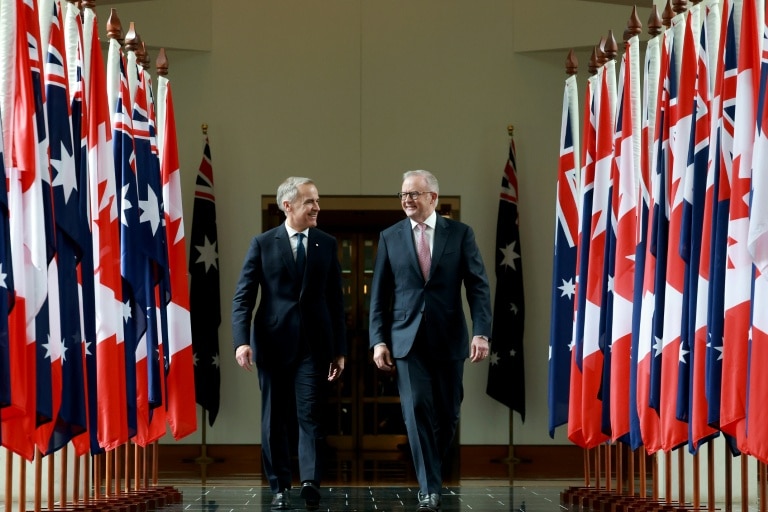
During an official visit to Canberra, Canadian Prime Minister Mark Carney addressed escalating tensions in the Middle East, acknowledging that Canadian military involvement, while not currently planned, could not be entirely ruled out under specific circumstances. The comments came alongside Australian Prime Minister Anthony Albanese, with their bilateral discussions largely dominated by the fallout from a recent massive US-Israeli strike that killed Iranian Supreme Leader Ayatollah Ali Khamenei.
Prime Minister Carney characterized questions about direct engagement as ‘hypothetical’ but firmly stated, ‘We will stand by our allies,’ and emphasized that Canada ‘will always defend Canadians.’ This stance exists alongside his previous criticism that the strikes on Iran were ‘inconsistent with international law.’ He expressed regret over the situation, describing it as a manifestation of a failing international order, even as he reaffirmed support for non-proliferation efforts to prevent a nuclear-armed Iran.
The core of Carney’s visit, however, focused on a strategic pivot away from traditional alliances. His tour of the Asia-Pacific is explicitly designed to reduce Canadian reliance on the United States, hedging against what he termed a ‘fading US-led global order.’ In a major address to Australia’s parliament, Carney issued a rallying cry for ‘middle powers’ like Canada and Australia to collaboratively shape emerging global rules rather than submit to the compulsion of great powers or ‘hyperscalers.’
To this end, he announced deepened cooperation with Australia, branding the two nations as ‘strategic collaborators.’ This partnership will involve pooling their vast rare earth mineral resources and enhancing collaboration in defense and artificial intelligence. Carney argued that such middle-power alliances, built on shared values and a reputation for matching words with actions, hold unique ‘convening power’ in a increasingly hegemonic world. This posture stands in sharp contrast to his frequently adversarial relationship with US President Donald Trump, who has previously threatened annexation and imposed severe tariffs on Canada.