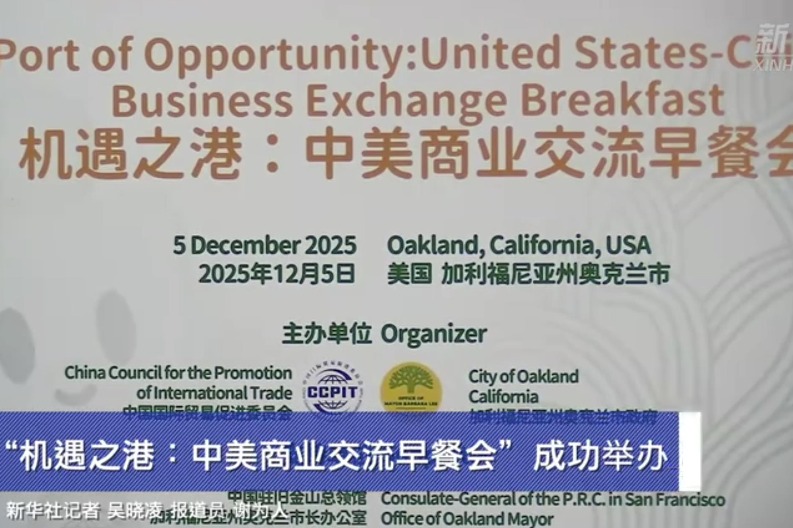
Business leaders from China and California convened in Berkeley on Friday to explore strengthened trade relationships, focusing particularly on emerging economic sectors despite ongoing international diplomatic strains. The gathering, titled “Port of Opportunity: US-China Business Exchange Breakfast,” brought together a 25-company Chinese delegation representing finance, manufacturing, agriculture, logistics, aviation, healthcare, new energy and cultural industries with approximately 100 local business representatives and elected officials.
Ren Hongbin, chairman of the China Council for the Promotion of International Trade, who led the Chinese delegation, pointed to recent diplomatic developments as grounds for optimism. He referenced the successful meeting between President Xi Jinping and President Trump in Busan, which he said “steered the cause of China-US relations at a critical juncture, providing reassurance to the business communities of both nations.” Ren emphasized that business communities should translate the important consensus reached by the two leaders into concrete actions and outcomes.
Oakland Mayor Barbara Lee highlighted the significant economic implications for California, revealing that approximately three-quarters of all trade through the port last year was with Asia, with China accounting for 29 percent of the Port of Oakland’s total trade volume, maintaining its position as the port’s largest import partner. “Regardless of challenges and what’s happening in Washington DC, we have to stay very focused on who we are and what drives Oakland and what drives our economy and what drives the friendship between our two countries,” Lee stated.
The mayor emphasized Oakland’s longstanding connections with China, including a decades-old sister city relationship with Dalian, and positioned the East Bay as a strategic partner for Chinese investment, particularly in agriculture, advanced manufacturing, logistics, technology and life sciences. She specifically highlighted opportunities in building the green economy as both China and the United States invest in clean energy, zero emission vehicles and port decarbonization.
John Grubb, interim president and CEO of the Bay Area Council, noted that his member companies strongly believe in expanding global trade ties, with many being significant trading partners with China. He revealed that approximately a quarter of all trade between the United States and China actually occurs between California and China. Grubb characterized the relationship as experiencing “many tides”—some incredible and some challenging—but emphasized the importance of maintaining “the vessel and the bridges.”
Ren identified strategic emerging industries as pivotal areas for collaboration, predicting that sectors including new energy, new materials, aerospace, biopharmacy and the low-altitude economy “will generate trillion-yuan level or even larger markets.” He cited the San Francisco Bay Area’s role as a global innovation hub, noting that companies like Apple, Intel and Nvidia have “actively expanded their business in China, contributing to China’s reform and opening up while reaping substantial rewards.”
Chinese Consul General in San Francisco Zhang Jianmin emphasized that economic interdependence remains a “global reality,” noting that approximately two-thirds of all exports worldwide contain imported components and global supply chains account for about 70 percent of global trade. Zhang highlighted the China International Supply Chain Expo as a platform where Bay Area companies, including Apple and Nvidia, have been “active participants and direct beneficiaries,” enabling businesses to showcase products, match supply with demand and achieve greater synergy across global supply chains.
Against the backdrop of slowing global economic growth, Zhang stressed that innovation and cooperation are more crucial than ever, noting that China’s substantial market and comprehensive industrial system complement the Bay Area’s innovation ecosystem, creating “tremendous potential for mutually beneficial cooperation.”