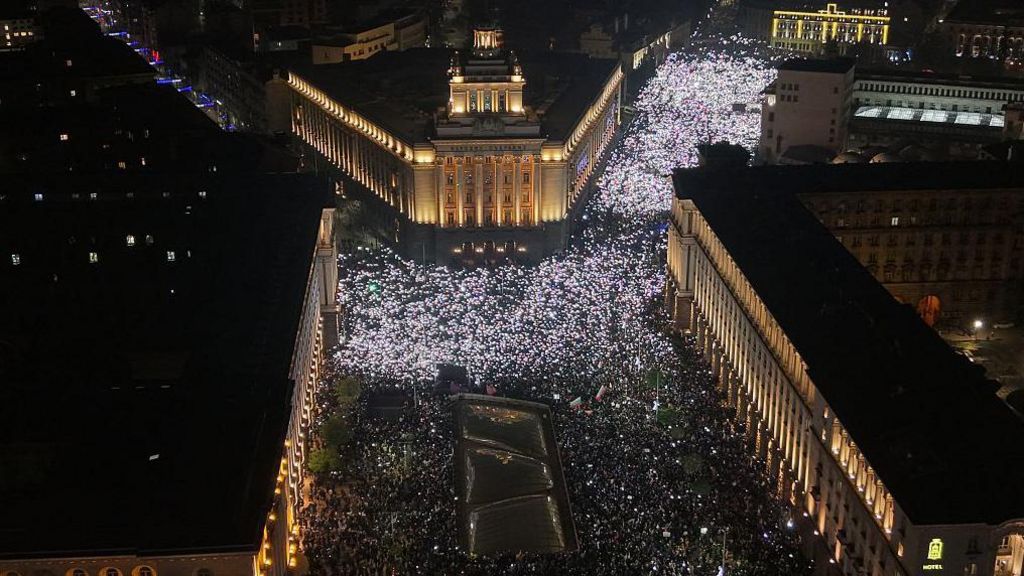
Bulgaria’s political landscape underwent a seismic shift as Prime Minister Rosen Zhelyazkov announced the resignation of his minority government following massive nationwide demonstrations against alleged corruption. The dramatic decision came just hours before a scheduled parliamentary no-confidence vote and mere weeks before Bulgaria’s planned adoption of the euro currency on January 1st.
Central Sofia witnessed an extraordinary display of public discontent as between 50,000 to 100,000 protesters flooded the Triangle of Power and Independence Square on Wednesday evening. The parliament building itself became a canvas for dissent with projections reading ‘Resignation’ and ‘Mafia Out’ illuminating its facade. These demonstrations, organized under the banner ‘Resignation! Peevski and Borissov Out of Power,’ targeted two controversial political figures: oligarch Delyan Peevski, who faces international sanctions for alleged corruption, and former Prime Minister Boyko Borissov.
The government’s collapse marks the culmination of months of political tension. Despite surviving five previous no-confidence votes since taking power in January, Zhelyazkov’s administration could not withstand the growing public outrage. Last week, the government had already withdrawn a controversial budget proposal in response to initial protests, but this concession failed to quell the movement.
In a televised address, Zhelyazkov acknowledged the public’s demands: ‘We hear the voice of citizens protesting against the government. Both young and old have raised their voices for our resignation. This civic energy must be supported and encouraged.’ The government website confirmed ministers would maintain their positions temporarily until a new cabinet forms.
The political turmoil occurs against the backdrop of Bulgaria’s persistently low ranking on Transparency International’s corruption index, where it trails behind most European nations. Despite the governmental crisis, financial analysts suggest Bulgaria’s transition to the eurozone remains on track, with the central bank confirming the changeover schedule remains unaffected.
President Rumen Radev, who had previously endorsed the protesters’ demands, now faces the challenge of facilitating a smooth political transition during this critical period for the Balkan nation.