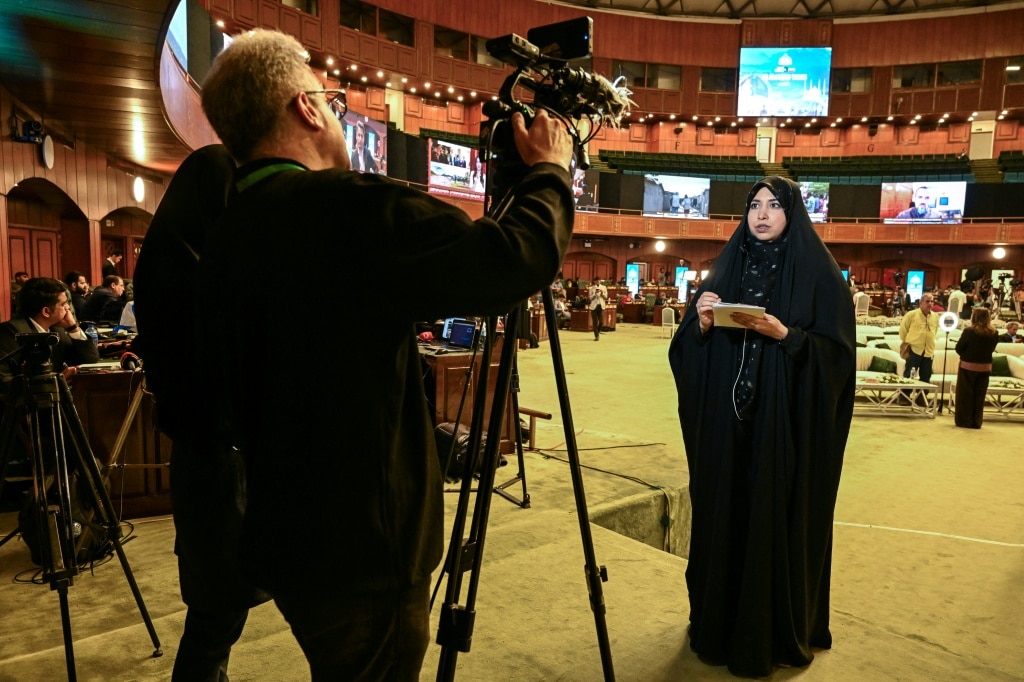
When Pakistan announced it would host landmark negotiations between the United States and Iran aimed at ending the long-running Middle East conflict, journalists from every corner of the globe descended on Islamabad’s Jinnah Convention Centre, eager to cover what could be a historic turning point for regional security. Pakistani authorities had converted the sprawling flagship venue into a purpose-built media hub, rolling out branding for the so-called “Islamabad Talks” that plastered a logo combining the flags of all three nations across billboards and public spaces across the capital.
What greeted reporters on the ground on Saturday was a study in contrasts. Inside the convention centre, accommodations for the press were anything but sparse: a lavish wedding-style buffet spread of local favorites including fragrant biryani, grilled kebabs, and sweet gulab jamun was laid out, a specialty coffee stall served artisanal lattes blended from Brazilian and Ethiopian beans stamped with the event’s tagline “Brewed for Peace”, and a small stage hosted live performances by local folk musicians including sitar player Amir Hussain Khan, who combines performing with teaching music. Even the internet, a scarce reliable commodity across much of Pakistan, was top-tier: independent testing by AFP recorded speeds exceeding 150 megabits per second, six times the country’s national average of 25 Mbps recorded by Speedtest.net in February 2026.
But the access that matters most to journalists — entry to the actual negotiations, and opportunities to speak directly with the negotiating delegations — was entirely off the table. The closed-door talks were being held just 500 meters from the media centre, and no official press briefings, the standard for international events of this scale, were scheduled. Security was tight across the capital: overcast Saturday saw nearly all civilian traffic cleared from Islamabad’s wide avenues, with only heavily armed uniformed personnel patrolling the streets. Even accredited journalists were held up for an hour at a checkpoint outside the venue while VIP convoys passed, and reporters were segregated by their home countries’ affiliation: US media were given prime seating with a clear view of the main media stage, while Iranian journalists were seated on the opposite side of the hall.
With no substantive access to the talks, frustration quickly mounted among the hundreds of reporters who had traveled thousands of miles to cover the event. “I’m bored out of my mind,” one anonymous journalist told AFP, with many others echoing the sentiment. The first official updates did not trickle out until more than three hours after US Vice President JD Vance, who leads the American delegation alongside Special Envoy Steve Witkoff and Jared Kushner, touched down in the capital. The only updates made available to the press were short, pre-written press statements distributed via WhatsApp, rather than on-the-record briefings that would allow journalists to ask questions. State television only broadcast footage of Vance’s arrival and his reception by senior Pakistani officials, including army chief Field Marshal Asim Munir, and later released readouts of his meetings with Foreign Minister Ishaq Dar and Prime Minister Shehbaz Dar, both of which emphasized Pakistan’s hope that the talks would deliver lasting regional peace.
“They say they have facilitated the media. No doubt they have given 5G internet speeds,” veteran journalist Nadir Guramani noted. “But media teams deputed inside Jinnah Convention Centre do not know what’s happening outside.” Even small concessions were off limits: security guards refused to allow reporters to bring their coffee into the main media hall, telling an AFP correspondent cryptically “Foreign media is here, and they are watching.” By sunset, the only tangible outcomes of the event for the assembled press were a full meal, fast internet, and a collection of generic press statements. Any substantive progress toward ending the Middle East war remained entirely out of reach — for the reporters waiting in the convention centre, at least.