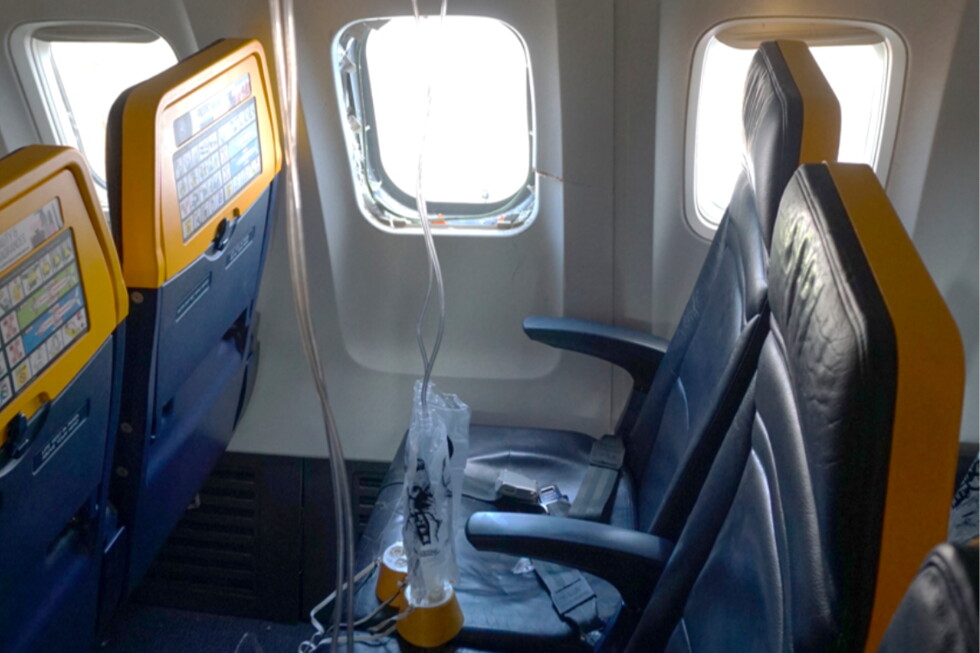
A mid-flight emergency that unfolded over Greece last July has been detailed in a new preliminary report from U.S. National Transportation Safety Board (NTSB) investigators, outlining how broken engine components shattered a passenger window minutes after takeoff, leaving a 61-year-old man partially pulled outside the aircraft before quick-acting fellow travelers pulled him back to safety.
The incident occurred on July 10 aboard a Malta Air-operated Boeing 737-800, a subsidiary of European budget airline giant Ryanair, which had just departed Thessaloniki, a major port city in northern Greece. According to the NTSB’s account, a fan blade inside the jet’s right engine fractured and broke loose, sending high-speed debris tearing through the fuselage and destroying the adjacent window in row 11, where the injured passenger was seated.
Investigators discovered bird remains within the damaged engine, leading to preliminary speculation that the aircraft may have collided with a flock of birds during its climb after takeoff. Still, the agency has not yet reached a final conclusion on what exactly caused the fan blade to fail.
After the structural failure, the cabin immediately lost pressure, triggering the drop-down of emergency oxygen masks and filling the cabin with visible smoke or fog, crew members told investigators. It was only moments later that crew noticed passengers standing and calling for help, after the 61-year-old window-seat passenger was pulled partially into the broken window opening by rapid decompression. Fellow travelers worked quickly to haul him back into the cabin, a move that likely prevented a fatal outcome.
The injured man was relocated to an empty seat in row 12, where a passenger who worked as a physician provided immediate first aid for his injuries – which included neck and shoulder damage and friction burns from the decompression event. Other passengers worked with crew to retrieve a heavy metal box, which they positioned to block the broken opening and reduce air flow into the cabin until the jet could make an emergency landing.
Footage captured by passengers on board and later shared by local outlet Radio Thessaloniki documents the chaotic scene: passengers wearing dropped oxygen masks after pressure loss, a clear view of the blown-out window, and first responders working the aisle after the plane landed safely back at Thessaloniki Airport.
Maintenance records reviewed by investigators show the failed right engine’s fan blades had undergone required ultrasonic inspections as recently as May 2026, with no damage detected in that check or a prior inspection in November 2025. Over the 12 months leading up to the incident, however, flight crews reported four separate suspected bird strikes involving the same engine, with bird remains confirmed after two of those events.
This incident marked an unusual handover of investigative authority: under international aviation regulations, Greece’s Hellenic Air and Rail Safety Investigation Authority permitted the NTSB to lead the probe, with Greek experts participating in the process. The NTSB issued a public reprimand to Ryanair CEO Michael O’Leary earlier this month after O’Leary told investors the investigation was already focused on foreign object damage, ruling out issues with the aircraft’s age or maintenance. The agency clarified that no causes have been ruled out at this preliminary stage, and O’Leary was not authorized to publicly disclose investigative details.
Jeff Guzzetti, a veteran former NTSB and FAA investigator who reviewed the preliminary findings on behalf of the Associated Press, noted that maintenance checks were completed on schedule per regulatory requirements. He added that investigators will almost certainly focus on how the inspections were conducted, and whether the four prior suspected bird strikes left hidden pre-existing damage that weakened the fan blade before the final failure.
“ We already understand the sequence of events that day, and even have some ideas about root causes, but there are still critical unanswered questions the NTSB will work to resolve,” Guzzetti explained.
The AP reached out to Ryanair, Boeing, and CFM International – the manufacturer of the 737-800’s engine – for comment on the NTSB’s preliminary findings, but had not received responses as of the report’s publication.
This engine failure is not an isolated incident for CFM-produced powerplants: at least two prior fatal or near-fatal incidents have involved broken engine parts penetrating the cabin. In 2018, a passenger on a Southwest Airlines flight was killed after being partially pulled out of a broken window caused by a fractured fan blade, and a similar blade failure occurred on another Southwest jet over Florida in 2016.
Flight tracking data from Flightradar24 shows the 189-seat narrow-body jet was originally delivered new to Ryanair in 2008. Six minutes after departing Thessaloniki, the aircraft had climbed past 15,000 feet before pilots initiated an immediate descent to 6,000 feet to burn excess fuel over 30 minutes, before landing safely back at Thessaloniki roughly one hour after takeoff. All passengers disembarked normally after landing, with only the injured passenger requesting and receiving on-the-ground medical care.