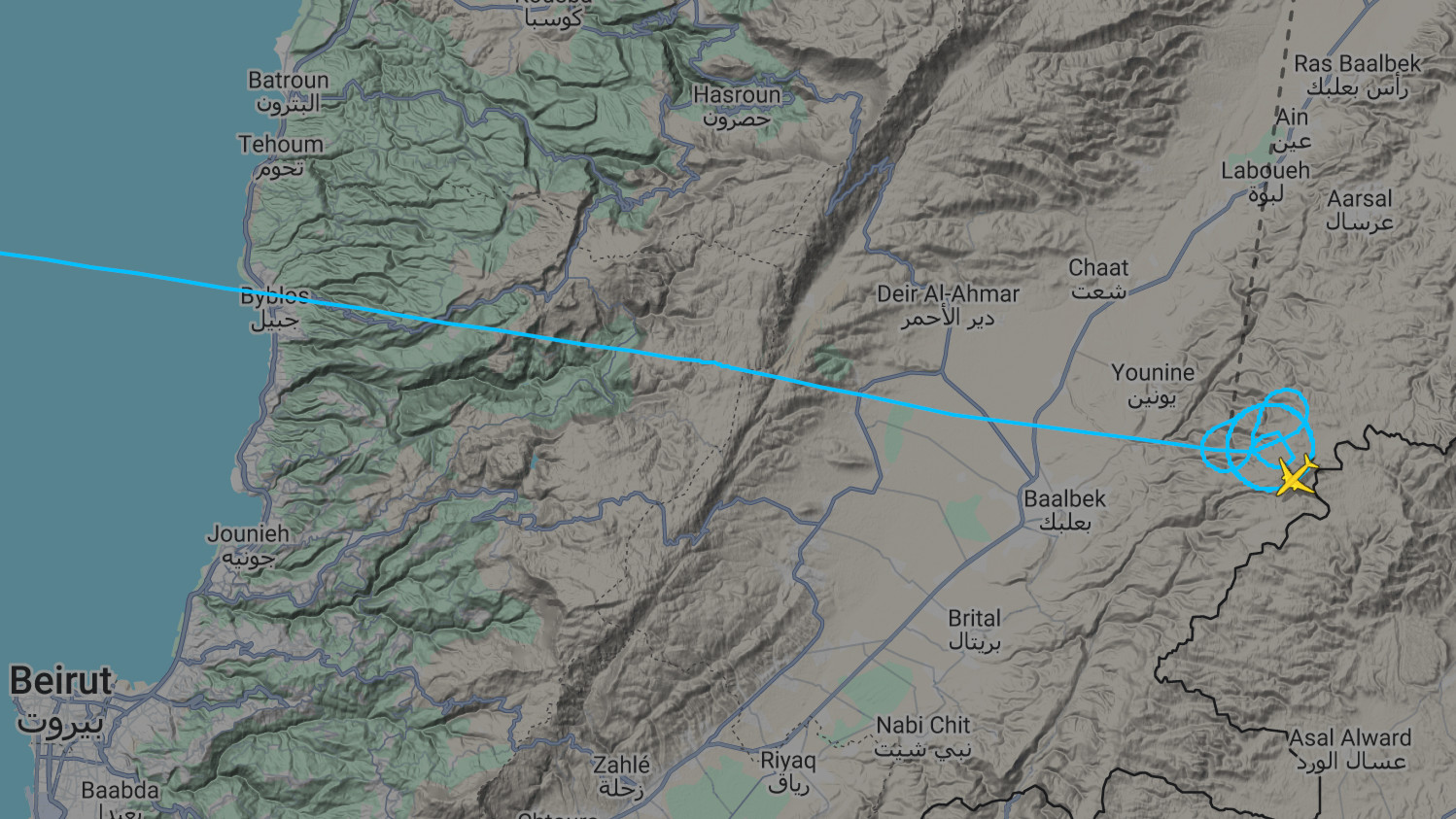
On a Wednesday that would see Israel launch one of its deadliest single waves of attacks on Lebanese territory in months, a British military drone carried out a mysterious flight over Lebanon, including low-altitude circling near the eastern city of Baalbek, flight tracking data analyzed by Middle East Eye (MEE) confirms.
The unmanned Royal Air Force (RAF) MQ-9B Protector drone took off from RAF Akrotiri, the UK’s strategically located permanent military base on the Mediterranean island of Cyprus, in the early hours of Wednesday, and entered Lebanese airspace at approximately 6:20 a.m. local time, according to the analysis. From 6:30 a.m. to 6:50 a.m., the aircraft maintained a circular flight path over a region near the towns of Baalbek and Younine, located in eastern Lebanon’s Beqaa Valley just kilometers from the Syrian border.
Flight tracking logs show the drone crossed into Syrian airspace around 8 a.m., flying north past the central Syrian city of Homs before traversing the northwestern province of Idlib. No public flight data records the drone’s movements for the following roughly 12 hours, but the aircraft reappeared near Baalbek at approximately 8:15 p.m. — several hours after Israel’s large-scale early-afternoon strikes that left more than 300 people dead across Lebanon. It then traveled west across Baalbek, passed north of the capital Beirut, exited Lebanese airspace around 8:30 p.m., and returned to its base in Cyprus.
The Protector drone is a workhorse of RAF operations, regularly deployed for missions ranging from long-range surveillance and search and rescue to armed combat operations alongside NATO and U.S. forces, official RAF documentation confirms. What makes this flight notable is its timing: it operated over Lebanon both before and after Wednesday’s devastating Israeli strike wave, which came just one day after a two-week ceasefire between Iran and the United States was brokered. The purpose of the flight has not been disclosed by UK defense officials.
MEE has submitted two key questions to the UK Ministry of Defence (MoD): whether the flight was coordinated and cleared in advance with the Lebanese Armed Forces (LAF), and whether any intelligence or surveillance data collected during the mission was shared with Israeli or U.S. authorities. As of publication, no response has been received.
Local casualty data confirms the scale of the Israeli strikes that coincided with the British drone’s presence: Lebanon’s civil defense rescue organization reports 18 people killed and 28 wounded in strikes targeting Baalbek alone. Wednesday’s attacks were unannounced and intensive, hitting central Beirut and its suburbs simultaneously alongside multiple locations in southern Lebanon and the eastern Beqaa Valley.
The UK has a long-standing military relationship with Lebanon, focused primarily on border security assistance: since 2009, British military trainers have trained tens of thousands of LAF personnel, most assigned to the force’s Land Border Regiments, and the UK has funded the construction and upgrade of dozens of border observation posts along Lebanon’s northern and eastern frontiers.
RAF Akrotiri, the launch point for Wednesday’s drone flight, has already been a source of significant controversy during the ongoing regional conflict. Throughout Israel’s military campaign in the Gaza Strip, the base has hosted hundreds of RAF surveillance flights over the besieged enclave. The MoD has repeatedly claimed these flights were conducted exclusively to support Israeli hostage rescue operations, but the program has been wrapped in layers of official secrecy. Over the past two years, evidence has emerged that British officials share surveillance intelligence with Israel, and that RAF aircraft captured footage of Gaza on days when Israeli strikes killed British citizens in the territory.
A source familiar with British intelligence capabilities in the Middle East told MEE last year that the Gaza surveillance flights gave Britain an unobstructed, high-altitude “bird’s-eye view of the genocide” unfolding in the enclave. The source added that the UK, a core member of the Five Eyes intelligence-sharing alliance alongside the U.S., Australia, Canada, and New Zealand, is the “number one gatherer of intelligence” across the Middle East, with better situational awareness of on-the-ground events than any other external actor.
The UK also maintains a deep, formal defense partnership with Israel: in 2020, the two countries signed a classified military cooperation agreement designed to formalize and expand bilateral defense ties. The full text of the agreement has never been released to the public. Former Conservative UK defense minister James Heappey stated in 2021 that the accord would “streamline and provide a mechanism for planning our joint activity”. In 2024, Labour defense minister Luke Pollard confirmed the government would not declassify the agreement due to its high security classification, and the MoD confirmed last October that the agreement remains in full force, according to reporting from Declassified UK.
During the open conflict between the U.S.-Israeli alliance and Iran that began in late February, the UK repeatedly stated it would not participate directly in offensive operations, but it did allow American bombers to use British military bases to launch strikes targeting Iranian missile sites.
In comments released Thursday, British Foreign Secretary Yvette Cooper said the UK government believes Lebanon must be included in the terms of the Iran-U.S. ceasefire agreed Tuesday night. That ceasefire has been marked by conflicting claims over its scope: Pakistan, which mediated the bilateral truce, stated the two-week pause in fighting would extend to all fronts, including Lebanon. Israel has rejected that claim, and its large-scale strikes on Lebanon continued unchanged through Wednesday.
Following international outcry over Wednesday’s high-casualty strikes and threats of expanded retaliation from Iran, Israeli officials announced they would reduce the scope of their offensive operations in Lebanon and agreed to hold direct talks with the Lebanese government in Washington next week.
Lebanese government data puts the total death toll from Israeli air strikes across Lebanon at roughly 1,900 people since the outbreak of the war in late February, with more than one million Lebanese displaced from their homes. The conflict spread to Lebanon in early March, after Hezbollah launched a large rocket barrage across the Israeli border. The group said the attack was both in retaliation for the killing of Iran’s supreme leader Ali Khamenei, a key spiritual and political patron for the movement, and a pre-emptive strike to stop a planned large-scale Israeli invasion of Lebanon, a assessment that has been corroborated by independent reporting in Israeli media.