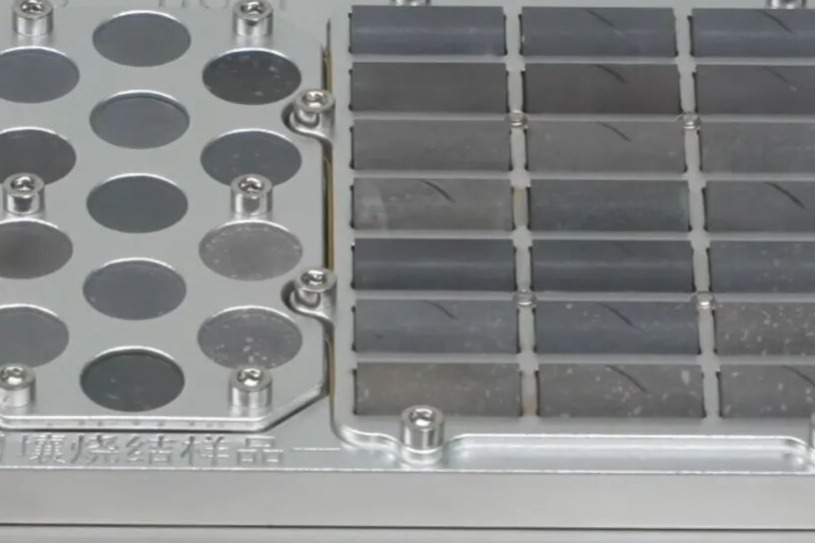
China has achieved a significant breakthrough in its lunar exploration ambitions by successfully testing experimental ‘lunar bricks’ in the harsh conditions of space for nearly a year. These bricks, designed to mimic the composition of lunar soil, were recently returned to Earth aboard the Shenzhou XXI spacecraft, marking a pivotal step toward the construction of a permanent lunar base by 2035. The 34 sample bricks, weighing approximately 100 grams in total, were exposed to extreme space conditions, including vacuum, cosmic radiation, and temperature fluctuations ranging from -190°C to 180°C. Despite these challenges, the bricks remained largely intact, demonstrating their durability and potential for lunar construction. Scientists at Huazhong University of Science and Technology, who developed the bricks, noted that they are over three times stronger than standard bricks and showed no signs of cracks or pits caused by space debris. However, a slight color change was observed, prompting further investigation. The project, led by Ding Lieyun of the Chinese Academy of Engineering, aims to address the high costs of transporting building materials from Earth by utilizing lunar resources. The bricks were created using volcanic ash from China’s Changbai Mountains, which closely resembles lunar soil, through a process called hot-press sintering. The experiment is part of a broader plan to establish the International Lunar Research Station, with China aiming to land astronauts on the moon by 2030 and expand the station by 2045, potentially serving as a launchpad for missions to Mars.