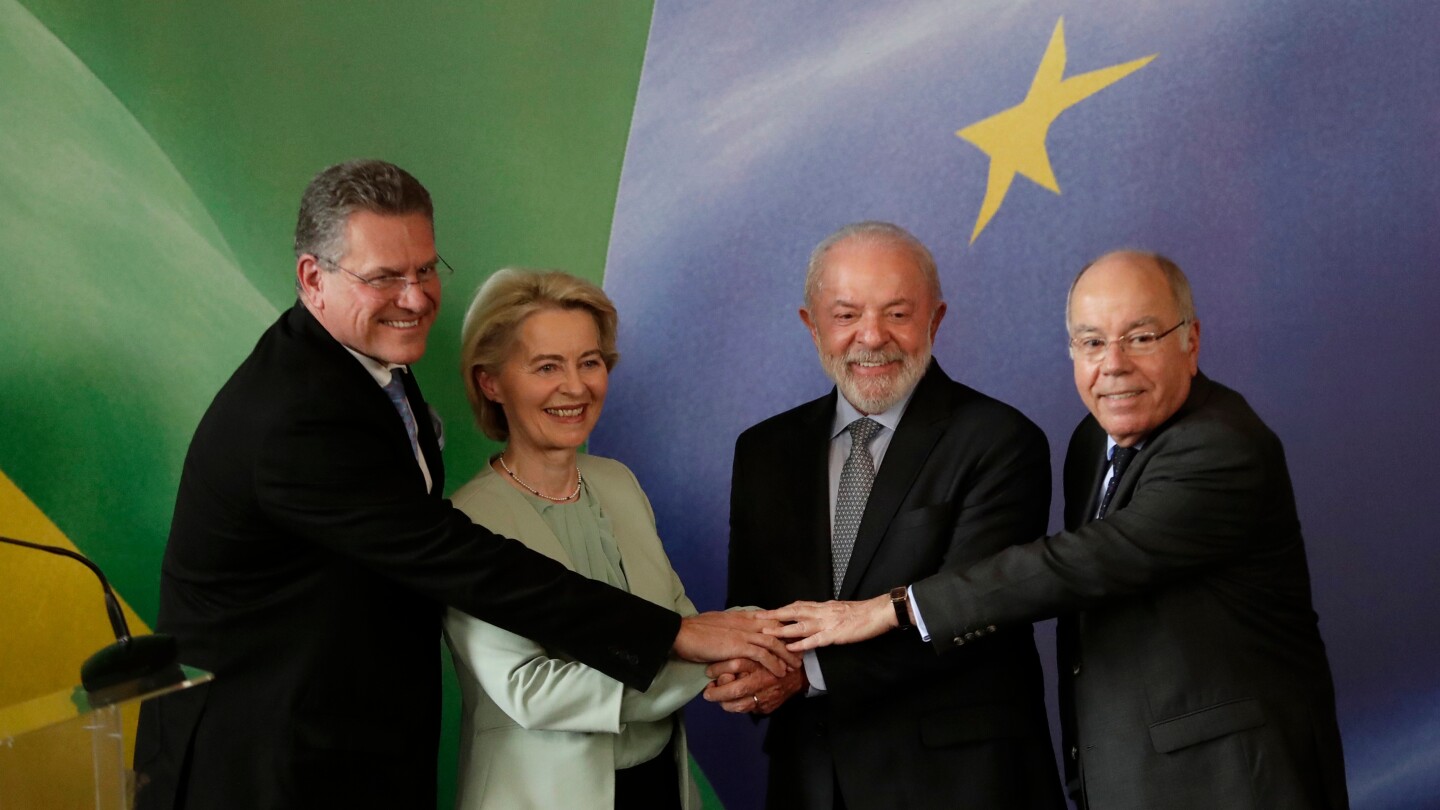
After a quarter-century of complex negotiations, the European Union and the Mercosur bloc have reached a landmark free trade agreement, creating one of the world’s largest trading zones encompassing approximately 720 million people with a combined GDP exceeding $22 trillion. The historic pact was formally signed in Asunción, Paraguay, on Saturday, marking a significant geopolitical shift in global trade dynamics.
The agreement between the EU and Mercosur (comprising Brazil, Argentina, Paraguay, and Uruguay) represents Mercosur’s first major international trade deal. Bolivia, the newest Mercosur member, was not involved in initial negotiations but retains the option to join the agreement in subsequent years.
Despite Brazilian President Luiz Inácio Lula da Silva’s vigorous advocacy for the pact since returning to office in 2023, he notably abstained from attending the signing ceremony. Instead, Brazil was represented by Foreign Minister Mauro Vieira. This absence has been interpreted by political analysts as a strategic signal of Brazil’s dissatisfaction with the delayed signing, which was originally anticipated during Brazil’s rotating Mercosur presidency in December.
European Commission President Ursula von der Leyen praised Lula’s “political leadership and personal commitment” during the final negotiation phase, acknowledging his crucial role in advancing the agreement. The European Council similarly recognized Brazil’s recent Mercosur presidency as instrumental in finalizing the decades-long negotiation process.
The comprehensive trade accord grants South American nations preferential access to European markets for agricultural products, with Brazil’s government investment agency Apex projecting approximately $7 billion in additional exports of commodities including instant coffee, poultry, and orange juice. However, President Lula emphasized that Mercosur nations seek to transcend their traditional role as commodity exporters, stating their intention to “produce and sell industrial goods with higher added value.”
Experts view the agreement as a strategic counterbalance to both United States and Chinese influence in the resource-rich South American region. The pact emerges amid former President Donald Trump’s protectionist trade policies and China’s expanding economic influence through trade and loans throughout Latin America.
International relations scholars note that while the agreement demonstrates economic advantages for the EU, it carries significant political benefits for both blocs. For Europe, it represents a commitment to multilateral partnership diversification, while for Mercosur, it validates the bloc’s continued relevance in global trade architecture despite previous criticisms regarding its effectiveness and longevity.