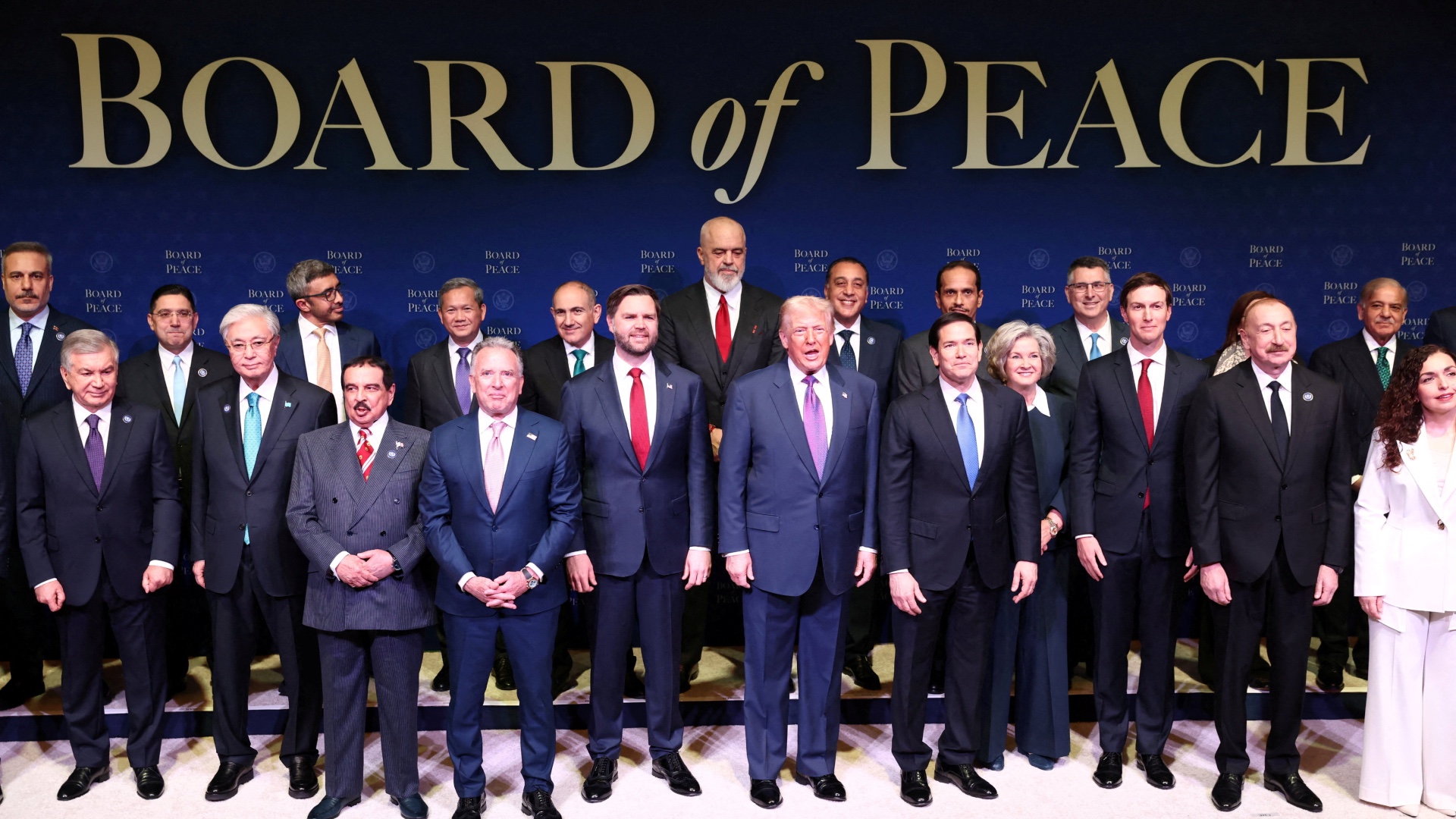
WASHINGTON, DC – In a significant development for Middle Eastern diplomacy, nine member nations of former President Donald Trump’s newly established “Board of Peace” have collectively pledged $7 billion toward humanitarian relief and reconstruction efforts in Gaza. President Trump announced the commitments during the board’s inaugural meeting held at the Donald J Trump Institute for Peace on Thursday.
The contributing nations include Kazakhstan, Azerbaijan, the United Arab Emirates, Morocco, Bahrain, Qatar, Saudi Arabia, Uzbekistan, and Kuwait. While a detailed breakdown of individual contributions was not immediately disclosed, Trump indicated that “many more are contributing to the numbers.” The United States is separately investing an additional $10 billion, though this allocation is understood to support the board’s overall operations rather than being exclusively designated for Gaza.
Beyond member contributions, the international community is mobilizing substantial support. The United Nations Office for the Coordination of Humanitarian Affairs will raise $2 billion, while FIFA, the global football governing body, has committed $75 million for sports-related projects in the enclave. FIFA President Gianni Infantino, a recipient of the first-ever FIFA Peace Prize from Trump last year, attended the meeting and sits on the board. Furthermore, Japan has committed to hosting an aid fundraiser with participation expected from regional nations including South Korea, the Philippines, and Singapore, with potential involvement from China and Russia.
World Bank President Ajay Banga, serving on the board’s executive committee, outlined the institution’s role as a “limited trustee.” The Bank will manage and disperse the pledged funds for reconstruction and development projects in Gaza, leveraging its AAA rating to attract private investment and de-risk the funding process.
However, the initiative faces significant challenges. The security situation remains precarious. U.S. Major General Jasper Jeffers, appointed to oversee the accompanying International Stabilization Force (ISF), revealed that Indonesia, Morocco, Kazakhstan, Kosovo, and Albania will contribute troops to the force, which will be trained by Egypt and Jordan. The ISF’s mandate includes protecting civilians, training local forces, and assisting in the disarmament of factions—a point that has caused hesitation among some potential contributors. Indonesia will assume deputy command of the ISF, and deployment will begin in the Rafah sector, though no precise timeline was provided. The Trump administration confirmed no U.S. troops would be deployed on the ground.
On the ground governance falls to the National Committee for the Administration of Gaza (NCAG), led by Palestinian technocrat Ali Shaath. He described operating in “extremely difficult conditions” with large areas “destroyed” and humanitarian needs “acute.” Bulgarian diplomat Nickolay Mladenov, appointed to oversee Gaza’s demilitarization, announced the creation of the Office of the High Representative for Gaza to guide the NCAG. A key priority is establishing security through a new 5,000-strong professional civilian police force, for which recruitment is already underway with 2,000 applicants so far. These officers will be trained in Egypt as part of a broader 20-point plan to consolidate all weapons under a single civilian authority.
Despite the focus on Gaza, the board’s official charter notably makes no mention of either “Gaza” or “Palestinian,” reflecting the Trump administration’s break from the long-standing U.S. policy goal of a two-state solution. The board has also faced international skepticism. Spain and most European nations have refused to join, with some EU representatives attending only as “observers.” The Vatican declined its invitation, and Canada’s was rescinded. At a recent security conference, EU foreign affairs chief Kaja Kallas criticized the board for its omissions. Trump, however, positioned the board as a supplement to the UN, stating it would be “looking over the United Nations and making sure it runs properly,” while pledging to work closely with the international body.