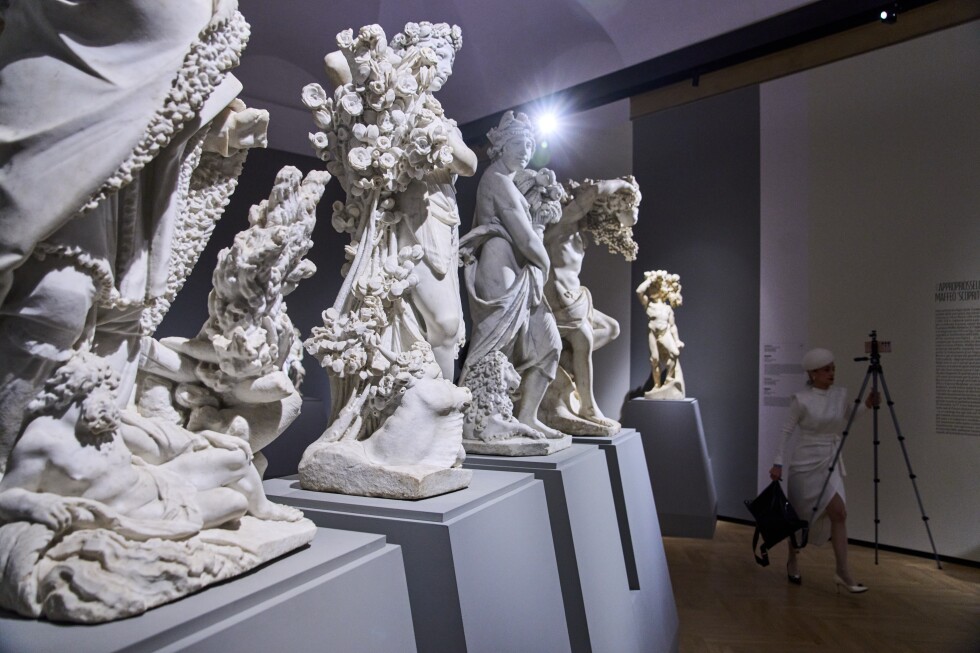
ROME — A groundbreaking exhibition at Palazzo Barberini is illuminating one of art history’s most consequential partnerships: the dynamic relationship between Baroque master Gian Lorenzo Bernini and his powerful patron Pope Urban VIII that fundamentally reshaped Rome’s artistic landscape.
“Bernini and the Barberini,” opening this Thursday, meticulously examines the two-decade collaboration between the artistic prodigy and the pontiff who reigned from 1623-1644. The exhibition positions Urban VIII as the visionary who recognized Bernini’s extraordinary talent early in his career, ultimately empowering him to transform Rome into the undisputed center of Christian artistic achievement.
The timing of this exhibition coincides with Vatican initiatives commemorating the 400th anniversary of Urban’s consecration of St. Peter’s Basilica in 1626. While the basilica’s construction spanned a century, Urban commissioned Bernini to create its most iconic interior elements, including the magnificent bronze baldacchino canopy over St. Peter’s tomb, recently restored for the Vatican’s 2025 Holy Year.
Even before ascending to the papacy, Cardinal Maffeo Barberini identified exceptional talent in the young Bernini that surpassed even that of his father Pietro, under whom he trained. According to co-curator Andrea Bacchi, Urban immediately recognized that Bernini “could become the Michelangelo of his century” upon assuming the papacy, commissioning numerous works that would define Baroque art.
Co-curator Maurizia Cicconi notes that their collaboration served dual purposes: advancing artistic excellence while reinforcing the Catholic Church’s primacy during a period of significant challenge to its authority. Italian Culture Minister Alessandro Giuli characterized the relationship as Urban VIII “governing through culture” by leveraging the skills of exceptional artists, with Bernini emerging as his favored “lost son” entrusted with monumental projects.
The exhibition deliberately focuses exclusively on the Urban-Bernini years, excluding the artist’s later masterpieces such as Piazza Navona’s Fountain of the Four Rivers and St. Peter’s Square colonnade, commissioned by subsequent popes. Instead, it traces the origins of Bernini’s papal commissions through rare sculptures, sketches, busts, and paintings gathered from international museums and private collections, including a Vatican-loaned model of Bernini’s bronze casing for St. Peter’s throne.
The presentation also addresses Urban’s complicated legacy, including his refusal to pardon Galileo Galilei and the controversial removal of bronze from the Pantheon for cannon production—actions that prompted contemporary criticism that “what the barbarians did not do, the Barberini did.” Despite these controversies, the exhibition credits Urban with identifying and nurturing Bernini’s genius, which would forever alter Rome’s architectural and artistic identity.
The show runs through June 14 at Palazzo Barberini, following the venue’s successful 2025 Caravaggio exhibition.